


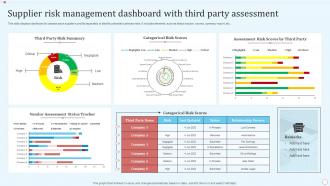
Supplier Risk Management Dashboard With Third Party Assessment





Try Before you Buy Download Free Sample Product
 Impress Your
 Audience
 100%
100% Editable
 Save Hours
 of Time


This slide displays dashboard to assess each suppliers profile separately to identify potential business risks. It includes elements such as status tracker, scores, summary report, etc.
People who downloaded this PowerPoint presentation also viewed the following :
Supplier Risk Management Dashboard With Third Party Assessment with all 7 slides:
Use our Supplier Risk Management Dashboard With Third Party Assessment to effectively help you save your valuable time. They are readymade to fit into any presentation structure.





FAQs for Supplier Risk Management Dashboard With
Okay so you need four main things: first, figure out which suppliers actually matter to your business and rank them. Then set up regular check-ins on their financial health - this is where most companies screw up honestly, they do it once during setup then never again. Third thing is having backup suppliers ready to go. And make sure your contracts are crystal clear about who's responsible when things go sideways. I'd probably start by mapping out your most critical suppliers first since that's way less overwhelming. Don't wait until something breaks to start monitoring them - check in regularly on the important ones.
First thing - grab their financial statements and dig into cash flow, debt ratios, profit margins from the past few years. Credit reports from Dun & Bradstreet are clutch for this stuff. If they're publicly traded, even better since you get way more transparency (those quarterly reports tell you everything). Red flags to watch for: late vendor payments, leadership shake-ups, revenue drops. I always ask for trade references from their other customers - people will be surprisingly honest about payment issues. Oh, and set up quarterly check-ins for your critical suppliers so you're not blindsided when something goes sideways.
Supplier scorecards are probably your best starting point - track delivery times, quality stuff, financial health. Riskmethods and Prevalent are decent third-party platforms that pull real-time data and alert you when things go sideways. Contract management systems help with compliance too, though honestly they can be a pain to set up. The trick is finding something that plays nice with whatever ERP system you're already stuck with. Don't try to boil the ocean here - figure out where you're most vulnerable first, then grab tools that actually fix those specific problems. All-in-one solutions sound great but usually suck at everything.
Dude, geopolitical stuff can seriously mess with your suppliers. Trade wars, sanctions, political chaos - all that can shut down operations or block shipments overnight. I got burned during that whole China trade mess a few years ago, so trust me on this one. Map out where your suppliers actually are and check the political situation in those areas. You'll want suppliers spread across different countries, not all clustered in one spot. That's basically asking for trouble. Keep tabs on political news that might hit your supply chain. Have backup plans ready because disruptions happen fast. Start with your most critical suppliers - figure out if they're all concentrated in risky areas.
Start with the obvious stuff - credit scores, cash flow, delivery times, defect rates. Geographic concentration is huge though, can't stress this enough. I've watched way too many companies crash because they put everything with suppliers in one region. Track your diversification ratios and compliance scores too. Here's what really matters: set baseline thresholds for everything so you'll catch problems before they bite you. Automated alerts are your friend - they'll ping you when suppliers hit your risk limits. Business continuity scores round it out nicely.
Honestly, get on a call with them instead of just firing off emails - trust me on this one. Half the time those reports just sit in someone's inbox anyway. Walk them through what you found and why it matters for the business. The key is making it feel collaborative, not like you're just throwing problems at them. Say something like "here's the issue we spotted, let's figure out how to tackle this together." Give them realistic deadlines too. Oh, and definitely follow up with written action items afterward so nobody can claim they forgot what was discussed.
So basically, technology does all that tedious monitoring you'd normally have to do yourself. It watches your suppliers' finances, scans news for red flags, tracks compliance stuff - all automatically. AI can catch weird patterns too, like how bad weather screws up supply chains in ways you'd never think of. You'll get alerts when something hits your risk thresholds instead of staring at dashboards all day. Honestly, I'd start with automated financial monitoring first - that's where you see the biggest wins. Way better than finding out a supplier's going under when your shipment doesn't show up.
Build ESG factors right into your risk scoring - carbon footprint, waste practices, labor standards, regulatory compliance stuff. Third-party ESG databases work great, or just send detailed questionnaires. Weight these sustainability metrics properly in your overall score. Honestly, this isn't optional anymore - it's baseline expectations now. Set minimum bars too, like requiring science-based emission targets or fair labor certs before they even get to round one. I know it feels like added complexity, but you'll catch risks that financial metrics miss completely.
Oh man, supplier audits - yeah, you'll want to hit the big stuff first. Financial health, operations, compliance, and cybersecurity are your main targets. Prioritize by risk though - critical suppliers need way more attention than the small ones. We totally got burned once by assuming a "low-risk" vendor was fine. Mix up announced visits with surprise ones, and honestly? Always double-check their certifications yourself. Can't trust everything at face value these days. Document like crazy, but here's the real key - when you find problems, create actual action plans with real deadlines. Finding issues is pointless if nothing gets fixed afterward.
Don't rely on just one supplier, even if they're giving you amazing deals right now. Map out where everything comes from so you can spot trouble before it hits. Build relationships with backup vendors early - way before you actually need them. Get some monitoring system that'll ping you when stuff goes wrong (trust me on this one). Yeah, keeping extra inventory costs money, but it beats having your whole operation shut down. Oh, and start small - pick your three most critical suppliers and figure out backup plans for those first. The rest can wait.
Third-party suppliers basically multiply your risk because you inherit all their problems. Financial trouble, quality issues, cyber attacks - it all flows straight to you. The tricky part is you can't see what's happening on their end most of the time. Plus disruptions ripple through supplier tiers you didn't even know existed (honestly, the whole thing can be a nightmare). You need to map out your critical suppliers first, then build backup options wherever you can. It's that weakest link thing but way more complicated.
Honestly, cultural stuff can totally throw off your supplier assessments. Like, what seems like flaky communication might just be how they do business there - maybe they prioritize relationships over hitting every deadline exactly. Some cultures are way more indirect too, which can come across as sketchy when it's really not. Different views on contracts and hierarchy create these weird blind spots you don't expect. I learned this the hard way with a vendor in Thailand once. Anyway, you've gotta adjust your criteria and actually understand their business culture first, otherwise you're just measuring misunderstandings instead of real risks.
Honestly, supplier legal stuff is way trickier than most people think. First thing - check if they're actually compliant with whatever regulations hit your industry (GDPR, SOX, etc.). Their financial health matters too because a bankrupt supplier will screw you over mid-contract. Look at their litigation history while you're at it. Contract-wise, dig into the IP protections and data handling terms. Termination clauses are huge - you don't want to be stuck. International suppliers add geographic risks on top of everything else. My advice? Build a legal risk checklist and make them provide compliance certs upfront. Saves headaches later.
Honestly, I'd break it down by department first - procurement needs totally different stuff than legal or ops. Use real supplier disasters from your industry for the workshops. Trust me, people remember actual case studies way better than boring theoretical crap. Get teams working together on these exercises too since supplier problems always end up touching multiple departments anyway. Cover the obvious bases - risk frameworks, spotting red flags, who to call when things go sideways. Oh and don't make it a one-and-done thing. Keep it practical and repeat it regularly or people forget everything.
Talk to them more often - like actually schedule monthly check-ins with your top 3 risky suppliers. Share dashboards and do joint risk assessments together. Here's the thing though: you gotta treat them like actual partners, not just vendors you order from. Offer longer contracts or bigger volume commitments if they'll beef up their risk reporting. Maybe throw some training their way or help fund equipment upgrades that cut down on issues. I learned this the hard way - suppliers respond way better when there's something in it for them. Make your relationship worth prioritizing over their other clients.
-
I faced no difficulty while searching for the slide I wanted. Honestly, the website’s interface is easy to use and can be navigated easily!
-
Like always a great experience with you guys. Always there on the drop of hat to help.