


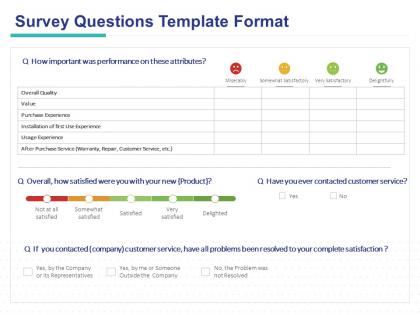
Survey questions template format ppt powerpoint presentation samples




Try Before you Buy Download Free Sample Product
 Impress Your
 Audience
 100%
100% Editable
 Save Hours
 of Time


Our Survey Questions Template Format Ppt Powerpoint Presentation Samples are explicit and effective. They combine clarity and concise expression.
People who downloaded this PowerPoint presentation also viewed the following :
Survey questions template format ppt powerpoint presentation samples with all 2 slides:
Give your audience a fulfilling experience. They will find our Survey Questions Template Format Ppt Powerpoint Presentation Samples elevating.
FAQs for Survey questions template format ppt
**INPUT**: What is the primary objective of your survey? **OUTPUT**: A survey's primary objective should align with specific business goals, whether gathering customer feedback, measuring employee satisfaction, conducting market research, evaluating product features, or assessing brand perception. Clear objectives enable targeted question design and meaningful data collection, with many organizations finding that well-defined survey purposes deliver actionable insights, improved decision-making, and enhanced strategic planning across departments. [Word count: 58 words]
Business professionals, HR managers, marketing teams, researchers, and organizational leaders seeking to gather structured feedback from employees, customers, or stakeholders represent the primary target audience. These templates particularly benefit companies conducting employee engagement surveys, customer satisfaction assessments, market research initiatives, and organizational development projects, with many finding that pre-designed frameworks significantly streamline their data collection processes while ensuring comprehensive coverage.
Key demographic information to capture includes age, gender, income level, education, geographic location, employment status, and industry sector. These data points enable organizations to segment responses effectively, identify target audience patterns, and tailor products or services accordingly, with many businesses finding that strategic demographic analysis delivers deeper customer insights and competitive market positioning.
**INPUT**: Which specific topics or themes will you cover in your survey? **OUTPUT**: Survey topics typically include customer satisfaction, product feedback, market research, employee engagement, brand perception, demographic analysis, and user experience evaluation. These themes enable organizations to streamline decision-making processes, enhance customer relationships, and deliver competitive advantages, with many businesses finding that strategic survey design ultimately drives measurable improvements in service delivery and operational efficiency. [Word count: 56 words]
Both open-ended and closed-ended questions serve distinct strategic purposes, with closed-ended questions delivering quantifiable data for statistical analysis, while open-ended questions capture nuanced insights and unexpected feedback. The optimal approach combines both formats strategically, with many organizations finding that closed-ended questions streamline data collection and analysis, while open-ended responses enhance understanding of customer motivations and experiences.
Ensuring reliability and validity involves pre-testing questions with sample audiences, using established question formats, avoiding leading or biased language, and conducting pilot surveys to identify issues. Through statistical analysis, question refinement, and expert review, organizations can minimize response bias, improve data accuracy, and ultimately deliver more actionable insights, with many research teams finding that systematic validation significantly enhances survey credibility.
Effective survey questions templates typically incorporate Likert scales for measuring attitudes and satisfaction, multiple choice for demographic data, rating scales for performance evaluation, yes/no questions for binary decisions, and open-ended responses for detailed feedback. The strategic combination of these response types enables comprehensive data collection while maintaining respondent engagement, with many organizations finding that mixed-scale approaches deliver higher completion rates and more actionable insights for decision-making.
Survey length depends on complexity and respondent motivation, but research suggests 5-10 questions for general surveys and up to 20 for specialized research maintain optimal engagement. Strategic question design, including varied formats, logical flow, and progress indicators, helps minimize abandonment rates while maximizing response quality, with many organizations finding shorter surveys deliver higher completion rates.
Survey incentives include monetary rewards like gift cards or cash, non-monetary benefits such as exclusive content or early access to results, charitable donations, prize draws, and recognition programs. These approaches enhance response rates by providing tangible value, with many organizations finding that strategic incentive combinations, especially in competitive markets, ultimately deliver higher participation rates and more comprehensive data quality.
Survey distribution combines multiple channels including email campaigns, social media platforms, website integration, mobile apps, and direct outreach through phone or in-person methods. Strategic distribution leverages targeted approaches like employee intranets for internal surveys, customer databases for feedback collection, and social networks for broader reach, ultimately maximizing response rates and ensuring representative data collection across diverse audience segments.
Survey data analysis methods include descriptive statistics, cross-tabulation, regression analysis, sentiment analysis, and statistical significance testing. These approaches enable organizations to identify patterns, correlations, and actionable insights by segmenting responses, measuring relationships between variables, and quantifying feedback trends, ultimately delivering comprehensive understanding of customer preferences, employee satisfaction, and market opportunities for strategic decision-making.
Survey anonymity and confidentiality are ensured through secure data collection platforms, unique identifier codes instead of personal information, encrypted storage systems, and restricted access protocols. These measures streamline participant trust while enhancing response rates, with many organizations finding that transparent privacy policies and automatic data anonymization ultimately deliver more honest feedback and improved survey outcomes.
Survey bias includes leading questions that suggest preferred answers, loaded language with emotional triggers, double-barreled questions addressing multiple topics, and acquiescence bias encouraging agreement. These biases significantly impact data quality by skewing responses, reducing reliability, and compromising decision-making accuracy, with many organizations finding that neutral, single-focus questions deliver more actionable insights.
Survey questions should be tested through pilot testing with a small representative group, cognitive interviews to assess question comprehension, expert review for bias and clarity, and pre-testing survey flow and timing. These validation methods help identify confusing wording, technical issues, and response patterns, while ensuring questions accurately capture intended data, ultimately delivering more reliable results and higher completion rates for the final distribution.
Based on survey results, follow-up actions typically include analyzing data patterns, developing targeted improvement strategies, communicating findings to stakeholders, implementing specific changes, and creating action timelines. Organizations often prioritize high-impact areas identified through responses, with many finding that systematic follow-through on survey insights delivers enhanced engagement, operational improvements, and stronger stakeholder relationships.
No Reviews