

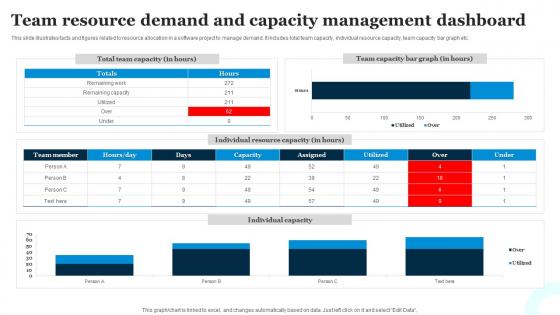
Team Resource Demand And Capacity Management Dashboard




Try Before you Buy Download Free Sample Product
 Impress Your
 Audience
 100%
100% Editable
 Save Hours
 of Time


This slide illustrates facts and figures related to resource allocation in a software project to manage demand. It includes total team capacity, individual resource capacity, team capacity bar graph etc.
People who downloaded this PowerPoint presentation also viewed the following :
Team Resource Demand And Capacity Management Dashboard with all 7 slides:
Use our Team Resource Demand And Capacity Management Dashboard to effectively help you save your valuable time. They are readymade to fit into any presentation structure.






FAQs for Team Resource Demand And
Okay so first thing - figure out what resources you actually have vs what you need. People, money, equipment, whatever. Then match those up with your real priorities, not just whoever's yelling loudest (we've all been there). The brutal truth? You'll have to say no to decent ideas when there's just no bandwidth. I'd start with a quick audit of where everything's going now. Are resources in the right places? Regular check-ins help too - catch problems before they blow up. Stay flexible though, things always change.
Honestly, get some decent resource management software - it'll show you exactly what's happening with your team and equipment in real time. The dashboards are pretty solid, you'll start seeing patterns that were totally invisible before. I'd pick just one thing to digitize first though, maybe time tracking or how you book equipment? Then build from there. Cloud tools are worth it because everyone can update their availability instantly instead of dealing with those nightmare spreadsheets we all pretend work. You can actually catch bottlenecks before they wreck your schedule, and the automated scheduling part saves so much headache.
Think of data analytics as your secret weapon for not wasting stuff. It takes all your messy operational numbers and shows you exactly where you're bleeding resources - or where you desperately need more. Peak demand periods become obvious, bottlenecks get caught early, and you can actually predict what you'll need instead of scrambling constantly. Honestly though, the whole thing can feel overwhelming at first. My advice? Pick one thing - inventory works great - and just track a few simple metrics consistently. Once you get comfortable with that, branch out to other areas.
So basically you want to compare what you're spending on resource management against what you're getting back. The formula's pretty straightforward - benefits minus costs, divided by costs, times 100 for your percentage. Track stuff like less waste, projects finishing faster, or higher output per person. Putting actual dollar amounts on the fuzzy benefits is honestly a pain though - like how do you price better team morale? Pick 2-3 metrics that actually matter to your company and stick with them for at least 6 months. That's when you'll start seeing real trends instead of just random noise.
Honestly, it all comes down to not having enough stuff when you need it. Budget's tight, people are stretched thin, and materials show up late - classic nightmare combo. Forecasting is brutal too because you're basically guessing what people will want months ahead. Half the time departments aren't even talking to each other, so Bob in marketing doesn't know Sarah in production already claimed those resources. My advice? Get some decent tracking going and do weekly check-ins with your team. Seriously helps you catch problems before they blow up in your face.
Honestly, bad resource management is probably the fastest way to miss deadlines and end up with crappy work. You'll get bottlenecks where half your team is drowning while others are just waiting around for stuff they need. I've watched so many projects crash because people figured the resources would magically sort themselves out - spoiler: they won't. Map out what you actually need for each phase first. Then add buffer time because trust me, something weird always pops up. Without proper planning, you're basically setting yourself up for scope creep and chaos.
Start with the basics: reduce, reuse, recycle - but actually make it systematic. I'd honestly go circular economy route first since it gives you the biggest bang for your buck. Switch to renewable resources where you can, and definitely set up some kind of tracking system so you're not flying blind on consumption. Getting everyone on board early matters way more than people think. Don't try to fix everything at once though - that's where most people mess up. Pick one thing, test it out, see what actually works. Then expand from there. Oh and efficiency tweaks can save you tons of money if you're not already doing that.
Honestly, cross-functional teams are game-changers for resource sharing. You know how departments usually hoard their tools and expertise? Mixed teams fix that automatically. People start sharing knowledge and skills they'd normally keep to themselves. The visibility thing is huge too - suddenly you can see who actually has bandwidth and what resources exist across the company. No more awkward "wait, you guys have that license too?" discoveries. I'd start with one small pilot project and see how it goes. Oh, and definitely set up regular planning sessions where teams can hash out what they need versus what they've got extra of.
Look, people are literally everything when it comes to managing resources. Sure, you might have tons of money and fancy equipment sitting around, but without the right team? You're screwed. Your people make the big calls, run the day-to-day stuff, and pivot when everything inevitably goes wrong. Plus they actually get better over time - unlike that expensive machine that's worth half what you paid after a year. I always tell people to hire smart first, worry about the rest later. Good people will figure out how to make the most of whatever else you've got.
Good resource management lets you move fast when stuff hits the fan. You'll know exactly who's available and can shuffle people around without waiting for approvals or playing phone tag. Think of it like having your tools organized - no digging through junk drawers when you need something. Market shifts? Customer freakouts? You can actually do something about it while your competitors are still trying to figure out their staffing. Honestly, most companies are terrible at this part. Start by mapping where your people are now and find where the bottlenecks happen when you try moving them around.
Honestly, planning upfront saves you so much headache later. Map out what you actually need and when - but add buffer time because projects always go sideways somehow. I've learned not to stockpile stuff "just in case" since other teams probably need those resources too. Track what you're using vs what you planned so you can catch patterns early. Weekly check-ins with your team are clutch for spotting problems before they get expensive. Oh and release anything you're not actively using - hoarding resources is such a waste!
Honestly, think of it like managing your personal budget but for business stuff. I'd go with that 70-20-10 split - most money keeps the lights on, then 20% for the promising new things, and 10% for wild card bets. The hardest part? Not touching that future money when things get tight (been there). Set up those quarterly check-ins to see what's actually working. Sometimes the experimental stuff surprises you way more than the "safe" investments. Just don't let short-term panic make you abandon the whole strategy - that's where most people mess up.
So for tracking resources, Microsoft Project or Asana work great for project stuff, and Jira's perfect if you're dealing with dev work. Cloud-wise? AWS Cost Explorer and Azure Resource Manager are your friends. ITIL framework is solid for IT resources, lean principles help with physical assets. Honestly though, the biggest thing is just getting everyone to use ONE system instead of having spreadsheets everywhere - I swear half my old team had their own random Excel files going. Pick something simple that people will actually stick with. Even a basic tool beats an amazing one that sits there collecting dust.
So basically, good resource management lets you see exactly where you're wasting stuff - materials, energy, even people's time. Once you spot the waste, you can fix it. Saves money while helping the environment, which is pretty cool. My old company did this and freed up tons of budget for community projects. Start with your biggest resource drains first since that's where you'll make the most difference. Set up tracking systems across departments, then actually use that data to make better choices. Honestly sounds boring but the CSR impact is real.
Honestly, globalization turns resource management into this whole different beast. You're not just dealing with local competition anymore - now you're fighting for talent and materials worldwide. Currency swings will mess with your budgets, and don't even get me started on coordinating across time zones (seriously, someone's always asleep when you need them). Supply chains can get wrecked by stuff happening halfway across the globe. The flip side? You can find amazing specialists anywhere and sometimes way cheaper options. I'd say build in flexibility from day one. Have backup plans in different regions so you're not scrambling when things go sideways.
-
Great templates that you can use in your next keynote or conference. They are perfect for quick and visually-engaging delivery.
-
Illustrative design with editable content. Exceptional value for money. Highly pleased with the product.