


Tiered Structure Sales Commission Plan




Try Before you Buy Download Free Sample Product
 Impress Your
 Audience
 100%
100% Editable
 Save Hours
 of Time


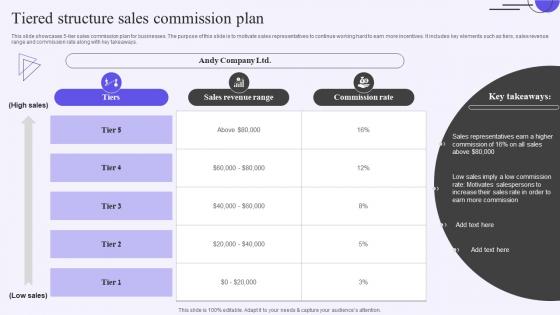
This slide showcases 5 tier sales commission plan for businesses. The purpose of this slide is to motivate sales representatives to continue working hard to earn more incentives. It includes key elements such as tiers, sales revenue range and commission rate along with key takeaways.
People who downloaded this PowerPoint presentation also viewed the following :
Tiered Structure Sales Commission Plan with all 9 slides:
Use our Tiered Structure Sales Commission Plan to effectively help you save your valuable time. They are readymade to fit into any presentation structure.








FAQs for Tiered Structure
Honestly, tiered commissions are great because your sales team will actually push harder to hit those higher brackets - more money per sale once they climb up, you know? Your top performers won't get pissed off watching mediocre reps earn the same rates (which always kills morale). Plus reps don't just coast after hitting basic quotas anymore. They keep grinding because there's always that next tier to reach. Makes forecasting way easier too since you can predict how people will behave. Oh, and definitely look at your current sales data first to figure out where those thresholds should actually sit.
Dude, tiered commissions are genius - way better than one flat rate. Basically you bump up the commission percentage as people hit higher levels. Like 80% of quota gets them 5%, but 120% might pay 12%. The psychology totally works because reps keep grinding after they hit their basic numbers, knowing the big money is in those upper tiers. Kind of reminds me of those mobile games where you can't stop leveling up, honestly. Start that first tier pretty low though - maybe 80% of quota so people get that early win and stay motivated. The real cash should kick in at tier 2 and 3.
Start with realistic sales targets that'll actually push your team without being crazy unrealistic. Commission percentages need good jumps between tiers - big enough to motivate but not so big people give up. Monthly vs quarterly timing totally changes how people behave, so think about that. Budget obviously matters too. I'd probably start simple with just 2-3 tiers and test it for a quarter. Then tweak based on what actually works. Oh, and decide early if you want accelerators for top performers or if there's gonna be a cap somewhere.
Yeah, tiered commissions definitely work. Reps get way more motivated when they're close to hitting that next bracket - you'll literally see them scrambling at month-end to squeeze out extra deals. Makes each sale worth more as they climb up, so they don't just coast after hitting basic numbers. Honestly, some people do try to game it by holding back sales early in the month, which is annoying but predictable. The math usually works out though - most companies see like 15-25% better sales volume versus flat rates. Just gotta set those tier thresholds smart.
Honestly, the worst thing you can do is make those tier jumps way too steep - like when people need to hit 150% quota just to get into the next level. Nobody's gonna push for something impossible. Also watch out for those weird "dead zones" where hitting higher numbers actually makes you earn less money (yeah, it's a thing and it's stupid). I'd keep the whole structure pretty simple. Clear milestones that actually make sense. Oh, and definitely test it first! Run some scenarios with real numbers from your current team before rolling it out. You don't want any nasty surprises.
Match your tier thresholds to how long your sales actually take. Got 6-month cycles? Don't do monthly tiers - that's just setting people up to fail. Go quarterly or yearly instead with higher breakpoints. Shorter cycles can handle lower thresholds but reset more often. Your reps need to feel like they can actually reach those higher tiers, otherwise what's the point? I'd run your historical numbers first to see what your best people would've hit. Way too many companies screw this up by not thinking about timing. Model it out before you roll anything new.
Track your sales volume growth first - that's the big one. Then look at how many reps are hitting each tier and whether your top performers are staying hungry (you don't want them getting lazy once they hit their number). Rep retention rates matter too, obviously. I'd also watch your cost of sales percentage and how fast people are reaching quota compared to before you had tiers. Pull monthly reports and compare everything to your old baseline - that's honestly the only way to know if this whole tiered thing is actually moving the needle or just creating more spreadsheets.
Yeah, tiered commissions can get messy real quick. Your top performers start earning way more per sale, which honestly feels unfair when everyone's working their ass off. Junior reps get discouraged watching senior colleagues pull ahead faster. Knowledge sharing? Forget about it - nobody wants to help competition climb into their tier. But I've seen teams flip this around by pairing senior reps with newer ones in mentorship setups. Makes the whole thing less cutthroat, you know? The trick is celebrating team wins too, not just individual achievements. Otherwise you're just breeding resentment.
Honestly, just be super upfront about everything from the start. Show them exactly how the tiers work, what the commission rates are, all that stuff. I've watched teams completely fall apart because nobody understood what they'd actually make - it's brutal. Your reps need to know where they stand so they can game plan their way to the next level. Give them updates on their progress regularly too. Oh, and make a simple one-page cheat sheet breaking down the whole structure. Monthly dashboards work great for tracking. When people get the system, they'll actually push harder to hit those targets.
Give them at least 30-60 days heads up - this stuff makes people panic about their paychecks. Send a detailed email showing old vs new structure with real examples at different performance levels. People will assume they're getting screwed over (they always do), so tackle that upfront. Your managers need to know everything first so they don't contradict you later. Then do one-on-ones or team meetings for questions. I learned this the hard way once - way better to over-explain than have your top performers start job hunting because they think you're cutting their money.
Honestly, keep it simple - 3 to 5 tiers max or your team will lose track. Don't make crazy jumps between levels either, like 25-50% increases work way better than doubling everything. I learned this the hard way when we set our first tier impossibly high and literally nobody hit it lol. Look at your past performance data to set realistic benchmarks. Be upfront about how everything works from day one. Oh and definitely review quarterly - teams change, market shifts, you know how it is. What motivated people last year might totally flop now.
Honestly, the software just does all the math for you automatically. No more manually tracking every single sale or trying to figure out which tier everyone's in - it pulls everything straight from your CRM and spits out the calculations. During crazy busy quarters, I swear it's the only thing keeping me sane instead of drowning in endless spreadsheets. Your reps can actually log in and see where they stand in real-time too, which cuts down on all those "hey, what's my commission looking like?" emails. Just make sure whatever platform you pick plays nice with your current CRM setup.
So there's tons of ways to mix up your tiered commissions depending on what each role actually does. SDRs usually get lower tiers but hit them faster since they're all about volume. Enterprise reps? Totally different - higher thresholds but way bigger payouts when those huge deals finally close (which takes forever, obviously). Account managers might have separate tiers for upsells vs renewals. You can even adjust when people hit their first tier - maybe junior reps start at 50% of quota while senior folks don't see anything until 75%. Just match it to what actually motivates each role instead of using the same boring structure for everyone.
Honestly, most companies mess this up by only making tiers reachable for their superstars. Your thresholds need to work for regular performers too - like 60-70% of people should be able to hit the next level if they actually try. Don't do massive jumps between tiers either, that just kills motivation. Territory matters too since selling in Manhattan vs some small town in Kansas is totally different, so factor that in. Keep everything transparent - nobody likes mystery formulas that change randomly. Test it with real sales data first though, and do regular check-ins to tweak things.
First thing - check your wage laws because that's where people mess up most. Document the hell out of everything so nobody's confused about tier thresholds or when they get paid. States have weird rules about commission timing that'll bite you if you're not paying attention. Don't base tiers on anything that could look discriminatory either - like factors that hurt protected groups. Your agreement needs to spell out exactly how calculations work and payment schedules. Honestly, just have legal review it before you launch. Way easier than fixing problems later.
-
Unique and attractive product design.
-
I'm happy to discover your PowerPoint presentations and templates. They met my expectations precisely. Very innovative!