


Transactions trial balance powerpoint template 9




Try Before you Buy Download Free Sample Product
 Impress Your
 Audience
 100%
100% Editable
 Save Hours
 of Time


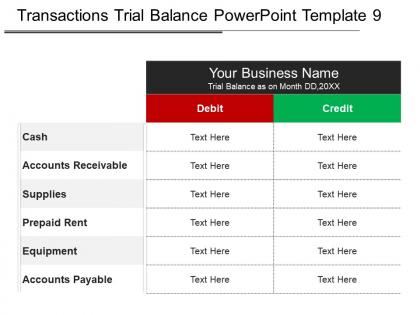
Put on the transactions trial balance PowerPoint template 9 slideshow and facilitates your team to make a list of all the general ledger accounts (both revenue and capital) which are contained in the ledger of your business or organization. The general ledger accounts PowerPoint shape is very helpful for the accountants, chartered accountants that avails presenter to provide the complete platform to obtain the lists which will contain the name(s) of each nominal ledger account and the value of that nominal ledger balance for the future references as each nominal ledger account will hold either a debit balance or a credit balance for further use. Furthermore, the trading profit, loss statement, balance sheet and other financial reports of your organization can also be produced in the business account transactions PowerPoint presentation for creating the ledger accounts which have been listed on the same balance. Pick this slide which helps the user and team members to prove that the value of all the debit value balances is equal to the total of all the credit value balances. Give them enough cause to agree with our Transactions Trial Balance Powerpoint Template 9. They will become more accepting.
People who downloaded this PowerPoint presentation also viewed the following :
Transactions trial balance powerpoint template 9 with all 5 slides:
Ensure you display authenticated information with our Transactions Trial Balance Powerpoint Template 9. It helps identify factual elements.




FAQs for Transactions trial balance
A transactions trial balance records every individual transaction chronologically, showing detailed movement of accounts, while a regular trial balance displays only ending balances after all transactions are summarized. This detailed approach enables organizations to track transaction histories, identify specific entries causing discrepancies, and maintain comprehensive audit trails, ultimately delivering enhanced financial transparency and streamlined reconciliation processes.
A transactions trial balance serves as a critical checkpoint in the accounting cycle, verifying that total debits equal total credits after all journal entries are posted to the general ledger. This verification process enables accountants to identify posting errors, ensure mathematical accuracy, and prepare reliable financial statements, with many organizations finding that regular trial balance reconciliation streamlines month-end closing procedures and enhances overall financial reporting accuracy.
Businesses ensure trial balance accuracy through systematic account reconciliation, regular financial reviews, automated accounting systems, and comprehensive internal controls. Through cloud-based platforms and standardized procedures, organizations streamline data verification, minimize manual errors, and maintain real-time financial transparency, with many companies finding that automated reconciliation tools significantly reduce discrepancies while enhancing operational efficiency.
Key components in a transactions trial balance include account names, debit balances, credit balances, transaction references, and period totals. These elements work together by providing comprehensive financial verification, enabling accurate ledger reconciliation, and streamlining audit processes, with many accounting departments finding that systematic trial balance reviews ultimately deliver enhanced accuracy and faster month-end closing procedures.
**INPUT**: How frequently should a transactions trial balance be prepared for optimal financial management? **OUTPUT**: A transactions trial balance should be prepared monthly for most organizations, though high-volume businesses like retail chains, financial services, and manufacturing companies often benefit from weekly or even daily preparation. This frequent reconciliation enables faster error detection, streamlines month-end closing processes, and enhances cash flow visibility, with many finance teams finding that regular preparation ultimately delivers improved accuracy and operational efficiency.
Common errors include mathematical mistakes in addition or subtraction, posting transactions to incorrect accounts, omitting entries entirely, recording debits as credits or vice versa, and transposing numbers during data entry. These errors can significantly impact financial accuracy and decision-making, with many accounting departments finding that systematic review processes, automated reconciliation tools, and dual verification methods help minimize discrepancies while ensuring reliable financial reporting.
A transactions trial balance aids fraud detection by revealing unusual account movements, identifying unauthorized entries, highlighting timing discrepancies, and exposing balances that don't reconcile with supporting documentation. Through systematic transaction analysis, organizations can spot irregular patterns, duplicate entries, and suspicious adjustments, while automated reconciliation processes enable faster identification of discrepancies, ultimately strengthening internal controls and financial oversight.
**INPUT**: Can a transactions trial balance be utilized for forecasting and budgeting? If so, how? **OUTPUT**: A transactions trial balance can be strategically utilized for forecasting and budgeting by providing detailed historical transaction patterns, seasonal trends, and account-level insights that inform future projections. Financial teams leverage this granular data to identify spending patterns, revenue cycles, and cost behaviors, ultimately enabling more accurate budget allocations and forecasts, with many organizations finding enhanced financial planning precision.
Software tools enhance transactions trial balance preparation by automating data entry, reducing manual errors, and providing real-time updates from integrated accounting systems. These platforms streamline reconciliation processes, generate instant reports, and offer analytical features like variance detection, with many financial departments finding that automated trial balance software delivers faster month-end closes and improved accuracy.
Journal entries serve as the foundation for the transactions trial balance, with each recorded debit and credit from journal entries flowing directly into the trial balance's account summaries. This systematic relationship enables organizations to verify accounting accuracy, detect posting errors, and ensure debits equal credits across all transactions, with many financial departments finding that this connection streamlines month-end reconciliation processes and enhances reporting reliability.
Changes in accounting standards affect transactions trial balance preparation by requiring updated chart of accounts, revised classification methods, and modified recognition criteria for various transactions. These standards updates often necessitate account reclassifications, timing adjustments for revenue and expense recognition, and enhanced disclosure requirements, with many organizations finding that systematic implementation ensures compliance while maintaining accurate financial reporting across all business units.
Small businesses face challenges including insufficient accounting knowledge, manual data entry errors, irregular transaction recording, and limited financial software access when maintaining trial balances. These difficulties often result in misallocated expenses, unreconciled accounts, and delayed financial reporting, with many small enterprises finding that investing in automated bookkeeping systems and basic accounting training ultimately delivers improved accuracy and operational efficiency.
Adjustments in a transactions trial balance directly impact financial reporting by correcting errors, recognizing accrued revenues and expenses, and ensuring compliance with accounting principles. These modifications enhance accuracy in financial statements, enable proper matching of revenues with expenses, and deliver more reliable data for stakeholder decision-making, ultimately strengthening organizational transparency and regulatory compliance.
Best practices for reconciling trial balance discrepancies include systematically reviewing journal entries, verifying account classifications, cross-referencing supporting documentation, analyzing timing differences, and performing detailed account reconciliations. These methodical approaches streamline the reconciliation process by identifying data entry errors, classification mistakes, and posting irregularities, with many accounting teams finding that consistent documentation and regular monthly reconciliations ultimately deliver faster closes and enhanced financial accuracy.
A transactions trial balance serves as a critical verification tool in internal audits by providing detailed transaction-level data that auditors use to trace individual entries, identify discrepancies, and verify account balances against source documents. Through this comprehensive record, internal audit teams can streamline their testing procedures, enhance detection of irregularities or fraud, and ultimately deliver more thorough risk assessments while significantly reducing audit completion time.
-
Unique and attractive product design.
-
Top Quality presentations that are easily editable.
-
Great quality slides in rapid time.
-
Appreciate the research and its presentable format.