


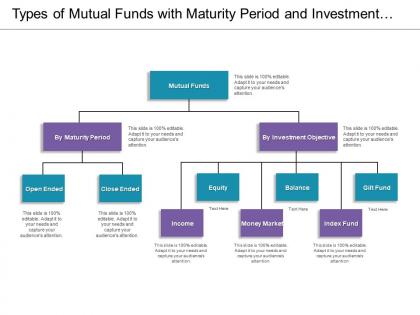
Types of mutual funds with maturity period and investment objectives




Try Before you Buy Download Free Sample Product
 Impress Your
 Audience
 100%
100% Editable
 Save Hours
 of Time


Build facilities for a brighter future with our Types Of Mutual Funds With Maturity Period And Investment Objectives.Indulge in infrastructure creation.
People who downloaded this PowerPoint presentation also viewed the following :
Types of mutual funds with maturity period and investment objectives with all 5 slides:
Your recent experiment has proved successful. Our Types Of Mutual Funds With Maturity Period And Investment Objectives willhelp demonstrate the process.




FAQs for Types of mutual funds with maturity period
Mutual funds are professionally managed investment vehicles that pool money from multiple investors to purchase diversified portfolios of stocks, bonds, and other securities. These funds work by spreading risk across various assets while providing individual investors access to professional management, broad market exposure, and economies of scale, with many retail investors finding that mutual funds deliver simplified investing, reduced costs, and strategic diversification in an increasingly complex financial landscape.
Mutual funds include equity funds, bond funds, money market funds, balanced funds, and index funds, each varying by asset composition, risk levels, and investment objectives. Equity funds target growth through stocks while bond funds prioritize income stability, with balanced funds combining both approaches, ultimately enabling investors to match their risk tolerance and financial goals across different market conditions.
Investors determine risk tolerance by evaluating their investment timeline, financial goals, age, income stability, and comfort with market volatility through questionnaires and financial assessments. Many financial advisors recommend younger investors consider growth-oriented funds while those nearing retirement often prefer conservative income funds, with portfolio diversification ultimately delivering balanced risk management and long-term wealth building opportunities.
Key factors include expense ratios, historical returns versus benchmarks, fund manager tenure and track record, portfolio turnover rates, and risk-adjusted metrics like Sharpe ratio. These performance indicators enable investors to assess consistency, cost efficiency, and management quality across different market conditions, with many financial advisors finding that long-term performance relative to peer funds ultimately delivers better investment outcomes.
Fund managers serve as the strategic decision-makers who research investments, construct portfolios, monitor market conditions, and execute buy-sell decisions to achieve fund objectives. Their expertise directly impacts returns through asset allocation, risk management, and timing decisions, with many successful funds finding that experienced managers who adapt to market changes while maintaining disciplined investment strategies ultimately deliver superior long-term performance and competitive advantage.
Investors should typically rebalance their mutual fund portfolios annually or semi-annually, though quarterly reviews help monitor allocation drift from target percentages. Through systematic rebalancing, financial advisors and individual investors maintain desired risk levels, capitalize on market opportunities, and ensure portfolio alignment with long-term goals, ultimately delivering consistent returns and strategic asset allocation.
Mutual funds typically charge management fees, expense ratios, load fees, redemption fees, and 12b-1 marketing fees, which collectively range from 0.5% to 2.5% annually. These fees directly reduce investment returns by compounding over time, with many financial advisors finding that even seemingly small fee differences can significantly impact long-term wealth accumulation and retirement planning outcomes.
Investors utilize mutual funds for retirement planning by leveraging diversified portfolios, systematic investment plans, tax-advantaged accounts, and professional fund management to build long-term wealth. Through target-date funds and balanced portfolios, retirement savers can automatically adjust risk exposure over time, minimize individual stock selection risks, and benefit from compound growth, ultimately delivering consistent wealth accumulation for financial security.
The expense ratio represents the annual fees charged by mutual funds as a percentage of assets under management, directly impacting investment returns by reducing the fund's net performance. A lower expense ratio means more of your investment growth stays in your pocket, with many investors finding that even small differences, like 0.5% versus 1.5%, can significantly affect long-term wealth accumulation over decades of investing.
Market conditions significantly influence mutual fund performance through interest rate changes, economic cycles, sector rotations, and overall market sentiment that directly impact underlying securities. During bull markets, equity funds typically deliver strong returns while bond funds may underperform, whereas economic downturns often favor defensive sectors and fixed-income investments, with many portfolio managers finding that diversified strategies help navigate these fluctuations more effectively.
Investors can maximize mutual fund returns through systematic investment plans (SIPs), diversified portfolio allocation, regular performance reviews, cost-conscious fund selection, and strategic asset rebalancing. These approaches enable consistent wealth building while minimizing risks, with many financial advisors finding that combining growth and value funds across sectors ultimately delivers superior long-term performance.
Dollar-cost averaging in mutual funds involves investing fixed amounts at regular intervals, regardless of market conditions, which helps smooth out price volatility and reduce timing risks. This strategy enables investors to purchase more shares when prices are low and fewer when high, ultimately lowering average cost per share over time while building disciplined, long-term wealth accumulation habits.
Mutual fund tax implications include capital gains taxes on distributions, dividend taxes on income distributions, and potential tax-deferred growth in retirement accounts. These tax considerations vary by fund type and holding period, with many investors finding that tax-efficient funds and strategic timing of purchases help minimize tax burdens while maximizing long-term returns.
Mutual funds offer professional management and diversification but typically charge higher fees than ETFs, while providing more stability than individual stocks through risk distribution. Unlike ETFs which trade throughout market hours, mutual funds price once daily, and compared to individual stocks, they deliver built-in diversification with lower volatility, making them increasingly popular for long-term wealth building strategies.
Mutual funds offer diversification, professional management, liquidity, and lower investment minimums, making them accessible to various investors. While they provide risk reduction through portfolio spreading and expert oversight, investors should consider management fees, potential tax implications, and reduced control over individual securities, with many finding that the professional management and diversification benefits ultimately outweigh these considerations.
-
Colors used are bright and distinctive.
-
Unique research projects to present in meeting.