

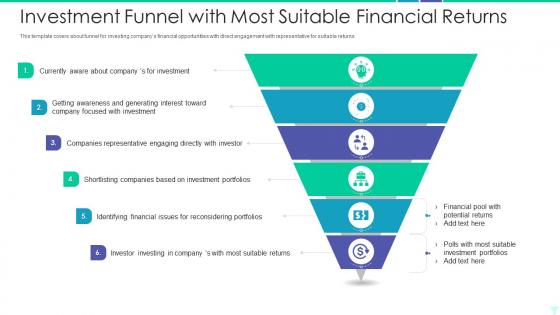
Investment funnel with most suitable financial returns




Try Before you Buy Download Free Sample Product
 Impress Your
 Audience
 100%
100% Editable
 Save Hours
 of Time


Our Investment Funnel With Most Suitable Financial Returns are topically designed to provide an attractive backdrop to any subject. Use them to look like a presentation pro.
People who downloaded this PowerPoint presentation also viewed the following :
Investment funnel with most suitable financial returns with all 6 slides:
Use our Investment Funnel With Most Suitable Financial Returns to effectively help you save your valuable time. They are readymade to fit into any presentation structure.





FAQs for Investment funnel with most
Investment funnels include deal sourcing, initial screening, due diligence, investment committee review, and portfolio management stages, differing from traditional sales funnels through longer cycles, relationship-driven processes, and regulatory compliance requirements. These stages enable venture capital firms and private equity organizations to systematically evaluate opportunities, minimize risk exposure, and maximize returns, with many finding that structured funnel approaches deliver enhanced decision-making efficiency and stronger portfolio outcomes.
Investors can effectively assess deal quality through comprehensive due diligence frameworks, financial modeling, market analysis, management evaluation, and risk assessment protocols at each funnel stage. Investment firms increasingly utilize data analytics, peer benchmarking, and sector-specific metrics, with many finding that systematic evaluation processes across screening, evaluation, and final selection stages ultimately deliver higher portfolio returns and reduced investment risks.
Data analytics plays a crucial role in optimizing investment funnels by tracking lead conversion rates, identifying bottleneck stages, analyzing investor behavior patterns, and predicting funding success probabilities. Through advanced analytics platforms, venture capital firms and investment managers streamline due diligence processes, enhance risk assessment capabilities, and improve portfolio allocation decisions, ultimately delivering faster investment cycles and higher returns.
Startups successfully navigate the investment funnel by developing compelling pitch decks, demonstrating clear market validation, building strong financial projections, and establishing meaningful investor relationships at each stage. Through strategic preparation and targeted outreach, companies streamline their fundraising process, reduce rejection rates, and secure better terms, with many startups finding that early investor engagement and transparent communication ultimately accelerate funding timelines.
Common pitfalls include inadequate market research, unrealistic financial projections, weak business models, insufficient traction metrics, and poor presentation skills. These challenges often derail promising ventures by undermining investor confidence, with many entrepreneurs finding that thorough preparation, transparent communication, and strategic mentor guidance significantly enhance their success rates through each funding stage.
Investors should evaluate ROI by tracking stage-specific metrics including lead acquisition costs, conversion rates, time-to-close ratios, and portfolio performance indicators at each funnel level. Through systematic measurement frameworks, investment firms can optimize resource allocation, identify high-performing channels, and streamline decision-making processes, with many finding that structured ROI analysis ultimately delivers enhanced portfolio returns and competitive market positioning.
Investment funnel success metrics include conversion rates, time-to-decision, deal quality scores, portfolio performance ratios, and investor satisfaction indices at each stage. These measurements enable investment firms to streamline deal flow, enhance due diligence efficiency, and optimize resource allocation, with many organizations finding that systematic tracking ultimately delivers higher returns and competitive advantage.
Investor behavior evolves from broad market research and passive information gathering in early stages to focused due diligence, active engagement with fund managers, and detailed risk assessment in later phases. Through this progression, investors become increasingly selective and relationship-focused, with many institutional investors finding that deeper partnerships ultimately deliver better portfolio outcomes and strategic alignment.
**INPUT**: What strategies can be employed to shorten the investment funnel timeline without sacrificing due diligence? **OUTPUT**: Effective strategies include streamlined documentation processes, parallel review workflows, digital due diligence platforms, pre-qualified investor pools, and standardized evaluation frameworks. These approaches enhance efficiency by automating routine assessments, enabling simultaneous reviews across teams, and maintaining rigorous standards, with many investment firms finding that strategic digitization ultimately delivers faster decision-making while preserving thorough analysis.
Different asset classes fundamentally reshape investment funnel structures through varying risk profiles, liquidity requirements, due diligence processes, and investor qualification criteria. While stocks follow streamlined retail-accessible funnels with broad market participation, real estate and venture capital create multi-tiered frameworks requiring extensive documentation, accredited investor verification, and prolonged evaluation periods, ultimately delivering specialized investment opportunities with higher barriers but potentially greater strategic returns.
Market volatility significantly impacts the investment funnel by extending due diligence periods, increasing risk assessment requirements, and prompting more conservative valuation approaches throughout each stage. During volatile periods, investors become more selective with deal flow, require additional financial modeling and scenario planning, while portfolio companies face longer fundraising cycles, ultimately leading to more strategic decision-making and enhanced focus on fundamentally strong investments.
Technology enhances the investment funnel through automated deal sourcing, AI-powered due diligence platforms, digital pitch presentations, and streamlined communication tools. These solutions enable faster screening processes, data-driven decision making, and seamless investor-startup interactions, with venture capital firms and accelerators finding significantly reduced evaluation timelines and enhanced portfolio management capabilities.
Networking accelerates prospect movement through investment funnels by building trust, providing social proof, and creating multiple touchpoints for relationship development. Through industry events, referral partnerships, and strategic introductions, investment firms cultivate deeper connections with potential clients, ultimately delivering higher conversion rates and stronger investor relationships in an increasingly relationship-driven financial landscape.
Entrepreneurs should develop stage-specific materials including executive summaries for awareness, detailed pitch decks for interest, comprehensive business plans with financials for consideration, and due diligence packages for decision phases. These tailored approaches enable investors to progressively evaluate opportunities through clear value propositions, market validation, and scalable business models, ultimately delivering faster funding cycles and stronger investor confidence across sectors.
Ethical considerations include transparency in fund allocation, responsible due diligence practices, fair treatment of all stakeholders, environmental and social impact assessment, and avoiding conflicts of interest. These principles enhance investor credibility by building sustainable relationships, ensuring regulatory compliance, and delivering long-term value, with many institutional investors finding that ethical frameworks ultimately strengthen portfolio performance and stakeholder trust.
-
Excellent Designs.
-
Content of slide is easy to understand and edit.