


Types of investment detailed investment options planned ppt presentation slides




Try Before you Buy Download Free Sample Product
 Impress Your
 Audience
 100%
100% Editable
 Save Hours
 of Time


Bid the jinx goodbye with our Types Of Investment Detailed Investment Options Planned Ppt Presentation Slides. Enable folks to end their good fortune.
People who downloaded this PowerPoint presentation also viewed the following :
Content of this Powerpoint Presentation
Description:
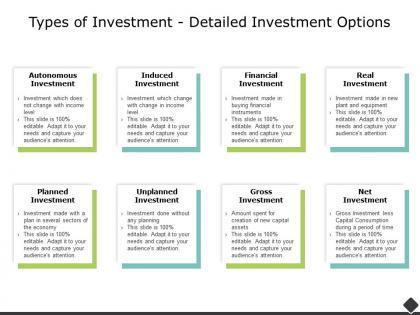
The image displays a PowerPoint slide titled "Types of Investment - Detailed Investment Options." The slide provides valuable information about various categories of investments, covering seven distinct types:
1. Autonomous Investment:
Investment that remains constant and doesn't change with income levels.
2. Induced Investment:
Investment that varies with changes in income levels.
3. Financial Investment:
Investment in financial instruments.
4. Real Investment:
Investment in physical assets, such as new plant and equipment.
5. Planned Investment:
Investments are made according to a predetermined plan in different sectors of the economy.
6. Unplanned Investment:
The investment made without prior planning.
7. Gross Investment:
The total amount spent on creating new capital assets.
8. Net Investment:
Equals Gross Investment minus capital consumption during a specific period.
The definitions provided for each type of investment offer a clear understanding of their respective characteristics and roles in economic and financial contexts.
Use Cases:
This informative slide can be valuable in diverse industries where knowledge of investment options and economic concepts is essential. Here are seven specific industries where this information can be valuable:
1. Finance:
Use: To educate clients on various investment strategies.
Presenter: Financial Advisor.
Audience: Individual Investors.
2. Education:
Use: Teaching economic concepts and principles.
Presenter: Economics Professor.
Audience: Students.
3. Corporate Training:
Use: Employee financial literacy training.
Presenter: Training Specialist.
Audience: Company Employees.
4. Banking:
Use: Providing client advisory services on investment products.
Presenter: Bank Manager.
Audience: Bank Clients.
5. Government:
Use: Explaining public investment strategies and policies.
Presenter: Policy Analyst.
Audience: Public Sector Stakeholders.
6. Real Estate:
Use: Discussing investment trends in the real estate and property sector.
Presenter: Real Estate Analyst.
Audience: Investors and Property Developers.
7. Entrepreneurship:
Use: Advising startups and entrepreneurs on funding and investment strategies.
Presenter: Venture Capitalist.
Audience: Entrepreneurs and Startup Owners.
Types of investment detailed investment options planned ppt presentation slides with all 5 slides:
Enable folks to end their good fortune with our Types Of Investment Detailed Investment Options Planned Ppt Presentation Slides. Help them bid the jinx goodbye.

FAQs for Types of investment detailed investment options planned
So basically stocks mean you actually own part of a company - you get a slice of their wins and losses. Bonds are more like you're loaning money to someone (could be a company or the government) and they pay you back with interest. Here's the thing though - stocks can swing wildly but that's where the real money potential is. Bonds? Way more chill, steady payments, but you won't get rich quick. I always think stocks are like that ambitious friend while bonds are your dependable coworker who never calls in sick. Starting out, you'll probably want some of both honestly.
So ETFs usually charge way less - like 0.03-0.75% compared to 0.5-2%+ for actively managed mutual funds. Most ETFs just track indexes while mutual funds can be active or passive. Here's the thing though - those tiny fee differences compound like crazy over 20-30 years. You used to pay trading fees since ETFs trade like stocks, but honestly most brokers dropped those now. Oh and if you're cool with just getting market returns instead of trying to beat them, ETFs are probably your cheapest option. More money stays invested instead of going to fees.
First thing - check your cash situation because real estate locks up serious money, unlike stocks where you can bail anytime. Location is everything for both appreciation and finding tenants. Those ongoing costs will eat you alive if you're not careful - maintenance, taxes, vacancy periods when nobody's renting. Being a landlord takes way more time than people realize too, despite what all those "passive income" gurus claim online. Honestly, I'd run the actual numbers on a few properties first. See if the math even makes sense before you get excited about becoming the next real estate mogul.
Dude, rates mess with everything. Low rates? You're basically forced into stocks because bonds are trash - like who cares about 2% when groceries cost double now. High rates flip it though. Suddenly CDs don't suck and bonds actually pay you something decent. Plus stocks usually get hammered since companies can't borrow cheap money anymore. I've been tweaking my mix based on what the Fed's doing. Watch their meetings and shift between stocks/bonds accordingly. Honestly the whole thing's exhausting but you gotta adapt.
So inflation basically eats away at what your money can buy, right? Cash and bonds get crushed because they're stuck with fixed returns while everything gets more expensive. Stocks usually fare better since companies can jack up their prices and earnings grow with inflation - though it's definitely a bumpy ride sometimes. Real estate and commodities are where you want to be during these periods since they're actual physical stuff that goes up in value. Honestly, I'd spread your money across different types of investments and maybe look into TIPS (those inflation-protected bonds). It's not foolproof but it helps.
Honestly, index funds are probably your best bet. The fees are crazy low - like 0.1% instead of 1%+ for actively managed ones. That difference compounds hard over decades. Here's the thing though - most fund managers can't even beat the market consistently anyway, which is kind of embarrassing for them lol. With index funds you just get whatever the whole market does. Yeah, you'll never have those amazing years where you crush it, but you also won't get burned by some overconfident portfolio manager. It's boring but it works. I'd start with something broad like total market.
Hey! Spread your money across different stuff - stocks, bonds, maybe some REITs. Don't dump everything into one thing (I learned that the hard way lol). Within stocks, mix up the sectors too. Tech's cool but don't go all-in on it. Geographic diversification matters since markets move differently everywhere. Honestly, if you're starting out, just grab some broad index funds. They do the heavy lifting for you - instant diversification without researching individual companies. Way easier than trying to pick winners yourself.
Your risk tolerance is basically what decides if an investment will stress you out or not. High tolerance? Go for stocks and growth stuff - way better returns but bumpy rides. More conservative? Bonds, CDs, dividend stocks are your friends. Boring but they won't give you heart attacks. Here's the thing though - most people lie to themselves about this. I know so many "aggressive" investors who completely freaked when everything tanked in 2020. Don't build a portfolio for who you think you should be. Build it for who you actually are when shit hits the fan.
Look, crypto can make you crazy money - some people hit 1000%+ gains but that's super rare obviously. I like that you can trade whenever, not just market hours, and it's totally separate from stocks. But dude, the swings are absolutely nuts. You could wake up down 50% on a random Tuesday. Exchanges get hacked, regulations are all over the place, and half the projects feel sketchy honestly. My take? Don't put in more than you're cool with losing entirely. Maybe start with like 5-10% just to see how you handle it.
Honestly, sustainable investing can actually improve your returns long-term. Yeah, there might be some short-term trade-offs initially. But here's the thing - companies with solid ESG practices are usually just better run overall. They face fewer regulatory headaches later and they're positioned for future trends like clean energy. You'll miss some "sin stocks" that do well temporarily, but whatever. Most data shows sustainable portfolios match or beat regular ones after 5+ years anyway. I'd start with ESG-focused ETFs if you're just getting into it - way easier than picking individual stocks.
Okay so first thing - grab that 401k match if your company offers it. Seriously, don't leave free money on the table. After that, max out your 401k and IRA since they cut your taxable income immediately. Tax-loss harvesting is clutch too - you sell your losers to offset any gains you made. Sounds weird but trust me on this one. Oh and put your growth stocks in regular accounts since they're way more tax-friendly. Save the tax-advantaged space for bonds and REITs instead. Those generate more taxable income anyway so they benefit more from the shelter.
Honestly, demographics are huge for investing but most people ignore them. Boomers are driving healthcare and senior living demand through the roof. Meanwhile millennials are obsessed with apps, green investing, all that stuff. Population booms in places like India and Southeast Asia? That's where infrastructure plays make sense. I always check census data to see where things are heading - way more useful than looking backward. Oh and Gen Z's spending habits are wild compared to previous generations, so keep an eye on that too. Match your picks to demographic momentum, not yesterday's trends.
So basically, markets go through these predictable phases - growth, peak, crash, recovery. Once you get this, you're way less likely to freak out and sell everything when things tank. Or buy a bunch of random stocks when everyone's making money (which I've definitely done before lol). You can actually plan around these cycles too. Maybe play it safer when everything seems too good to be true. Go harder when others are scared. The main thing? Learn from past market patterns so you don't let your emotions make terrible decisions for you.
Honestly, robo-advisors are pretty genius for this stuff. They'll automatically rebalance your portfolio and handle all the tax optimization without you having to think about it. No emotional decisions either - like when everyone's freaking out during a market crash, the algorithm just keeps doing its thing. Fees are way better too, usually around 0.25-0.50% vs what traditional advisors charge. I've heard good things about Betterment and Wealthfront if you want something totally hands-off. Perfect if you're starting out or just don't want to babysit your investments constantly.
Ugh yeah, geopolitical stuff totally messes with investments. Markets hate uncertainty - like when there's wars or trade fights happening, everyone runs to safe stuff like gold and bonds. Emerging market stocks? They get destroyed. I always spread my money across different regions and asset types so I'm not screwed if one area blows up. My cousin learned this the hard way during that whole Russia thing. Keep up with news but don't freak out and sell everything when something crazy happens. That's usually when you lose money.
No Reviews