


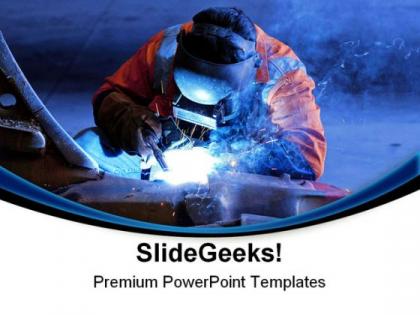
Welding industrial powerpoint templates and powerpoint backgrounds 0711




Try Before you Buy Download Free Sample Product
 Impress Your
 Audience
 100%
100% Editable
 Save Hours
 of Time


Avoid a sleepy audience with our fun and engaging Welding Industrial PowerPoint Templates And PowerPoint Backgrounds 0711. It is hard to ignore the beautiful graphics and animations.
People who downloaded this PowerPoint presentation also viewed the following :
Welding industrial powerpoint templates and powerpoint backgrounds 0711 with all 3 slides:
Do not compromise with your high standards. Our Welding Industrial PowerPoint Templates And PowerPoint Backgrounds 0711 will meet your exacting checks.



FAQs for Welding industrial powerpoint templates and
The fundamental welding processes include arc welding, gas welding, resistance welding, laser welding, and friction welding, each utilizing different heat sources and application methods. These processes differ significantly in their energy delivery mechanisms, material compatibility, and operational requirements, with manufacturing industries, automotive sectors, and construction companies selecting specific methods based on material thickness, joint accessibility, and production volume needs.
Filler material selection significantly influences weld strength, corrosion resistance, and overall joint integrity by determining chemical composition, mechanical properties, and compatibility with base metals. The right filler material ensures proper fusion, minimizes defects like cracking or porosity, and delivers optimal performance in specific applications, with many welding professionals finding that matching filler properties to project requirements ultimately enhances structural reliability and longevity.
Welding safety precautions include proper ventilation, protective equipment like helmets and gloves, fire-resistant clothing, adequate lighting, and secure workspace preparation. These measures streamline operations by preventing accidents, reducing downtime, and ensuring regulatory compliance, with manufacturing facilities and construction companies finding that comprehensive safety protocols ultimately enhance productivity while minimizing liability risks.
Welding is most commonly used in construction, automotive manufacturing, aerospace, shipbuilding, and oil and gas industries, with applications ranging from structural steel frameworks to precision aircraft components. These sectors leverage welding for pipeline installations, vehicle assembly lines, bridge construction, and specialized applications like underwater repairs, while industries increasingly adopt automated welding technologies to enhance precision, reduce costs, and maintain competitive advantage in complex manufacturing environments.
Heat input significantly affects weld penetration, fusion quality, microstructure formation, and cooling rates, directly influencing the weld's strength, ductility, and resistance to cracking. In manufacturing industries like automotive and aerospace, controlling heat input enables welders to optimize joint integrity, minimize distortion, and achieve consistent mechanical properties, ultimately delivering stronger assemblies and reduced rework costs.
Welding's environmental impacts include air pollution from fumes and gases, energy consumption, waste generation from consumables, noise pollution, and potential soil contamination. These effects can be mitigated through advanced filtration systems, energy-efficient equipment, proper waste recycling, and eco-friendly consumables, with many manufacturing facilities finding that sustainable welding practices reduce operational costs while enhancing workplace safety and regulatory compliance.
Technological advancements enhance welding through automated robotic systems, real-time monitoring sensors, laser welding capabilities, augmented reality guidance, and AI-powered quality control. These innovations streamline operations by reducing human error, accelerating production speeds, and ensuring consistent weld quality, with manufacturing and construction industries finding that automated systems deliver significantly improved efficiency and cost reduction.
Key factors include material type and thickness, joint design requirements, production volume, quality specifications, and environmental conditions. These considerations guide welders by determining heat input needs, penetration depth, and finish quality, with manufacturing industries finding that matching method to application ultimately delivers stronger joints, reduced costs, and enhanced production efficiency.
Joint designs significantly influence welded connection strength through load distribution, penetration depth, and stress concentration factors. Different configurations like butt, fillet, and groove joints offer varying structural capabilities, with aerospace and construction industries finding that proper joint selection, combined with appropriate welding techniques and material considerations, ultimately delivers enhanced structural integrity and long-term performance reliability.
Welding dissimilar metals presents challenges including different melting points, thermal expansion rates, galvanic corrosion susceptibility, and intermetallic compound formation that can weaken joints. Advanced techniques like friction stir welding, explosion welding, and specialized filler materials address these issues by minimizing heat-affected zones and controlling chemical interactions, with aerospace and automotive industries increasingly adopting these methods for enhanced component performance.
Weld defects can be detected through visual inspection, radiographic testing, ultrasonic testing, magnetic particle inspection, and dye penetrant testing. These inspection methods streamline quality control by identifying cracks, porosity, and incomplete fusion early, while preventive measures like proper joint preparation, controlled heat input, and skilled operator training ultimately deliver stronger welds and reduced rework costs.
Training and certification ensure welding quality and safety by establishing standardized competency levels, teaching proper techniques, and validating skills through rigorous testing protocols. These programs enable welders to master safety procedures, material specifications, and industry standards, with sectors like aerospace, construction, and manufacturing finding that certified professionals deliver superior workmanship while minimizing costly rework and safety incidents.
Automation has revolutionized welding through robotic systems, AI-powered quality control, automated welding processes, and real-time monitoring technologies. These advancements enable manufacturers to achieve consistent weld quality, reduce human error, and increase production speeds, with automotive and shipbuilding industries finding that automated welding delivers significant cost savings while enhancing precision.
Emerging welding materials include carbon fiber reinforced plastics, aluminum-lithium alloys, high-strength steels, titanium composites, and nickel-based superalloys. These advanced materials enable manufacturers to reduce weight while enhancing strength and corrosion resistance, with aerospace, automotive, and energy sectors finding that strategic material selection delivers improved fuel efficiency, enhanced performance, and significant competitive advantages.
Proper maintenance of welding equipment significantly enhances productivity by reducing downtime, ensuring consistent weld quality, and extending equipment lifespan, while simultaneously improving safety through reliable operation and reduced malfunction risks. Manufacturing facilities, construction companies, and shipbuilding operations find that preventive maintenance programs ultimately deliver faster project completion, lower operational costs, and safer working environments.
-
Appreciate the research and its presentable format.
-
Appreciate the research and its presentable format.