


Workshop agenda day one day two time session and theme




Try Before you Buy Download Free Sample Product
 Impress Your
 Audience
 100%
100% Editable
 Save Hours
 of Time


Expose them to the craft with our Workshop Agenda Day One Day Two Time Session And Theme. Give them a glimpse of your expertise.
People who downloaded this PowerPoint presentation also viewed the following :
Content of this Powerpoint Presentation
Description:
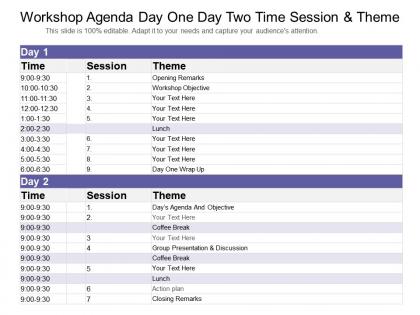
The image shows a PowerPoint slide titled "Workshop Agenda Day One Day Two Time Session & Theme." It serves as a schedule template for a two-day workshop, listing the times, session numbers, and themes for each segment of the event. The slide is divided into two sections, one for each day, and is designed to be fully editable so that specific details can be added to tailor it to the particular workshop's agenda.
For Day 1, the agenda includes:
Opening Remarks
Workshop Objective
Multiple sessions with time slots from 9:00 AM to 6:30 PM, including a lunch break.
Day One Wrap-Up at the end of the day.
For Day 2, the template lists:
Day's Agenda And Objective
Several sessions with placeholder times are all set at 9:00-9:30, which need to be adjusted according to the actual schedule.
Specific notations for a Group Presentation & Discussion, Coffee Breaks, Lunch, an Action Plan, and Closing Remarks.
Use Cases:
This type of slide can be used in a variety of industries for planning and communicating workshop schedules:
1. Education:
Use: Structuring teacher development workshops.
Presenter: Education Coordinator
Audience: Teachers, faculty members
2. Corporate Training:
Use: Outlining employee training sessions.
Presenter: HR Development Manager
Audience: Company employees
3. Healthcare:
Use: Scheduling medical seminars or continuing education.
Presenter: Medical Education Director
Audience: Doctors, nurses, healthcare professionals
4. Technology:
Use: Detailing tech conferences or product training.
Presenter: Tech Company Trainer
Audience: Software developers, engineers
5. Financial Services:
Use: Planning financial planning workshops.
Presenter: Financial Advisor
Audience: Clients, financial professionals
6. Marketing:
Use: Organizing marketing strategy retreats.
Presenter: Marketing Consultant
Audience: Marketing teams
7. Hospitality:
Use: Crafting customer service excellence training.
Presenter: Service Excellence Trainer
Audience: Hotel staff, service employees
Workshop agenda day one day two time session and theme with all 5 slides:
Our Workshop Agenda Day One Day Two Time Session And Theme have a fresh approach. They make you feel bright and bouncy.
FAQs for Workshop agenda day one day two time
Okay so first thing - figure out 2-3 super clear goals that answer "what will people actually learn?" Put those right at the top before you even get into the schedule part. Honestly, I hate when agendas are just random time slots with vague topics. Your goals need to be specific enough that you could check later if you hit them or not. Then connect each agenda item back to those main objectives so people aren't wondering why they're sitting through certain sessions. Oh and definitely circle back to them at the end - gives people that satisfying sense of completion, you know?
Oh man, I swear by the 70-30 thing - like 70% hands-on stuff, max 30% talking at people. Anything longer than 15 minutes and you'll lose them completely. I made that mistake with a brutal 45-minute presentation once... never again! Start with some kind of icebreaker, then bounce between short content bits and actual activities. Put your heaviest material right after breaks when everyone's still awake. Oh and always wrap up with action items or reflection time. People need to walk away feeling like they didn't just waste two hours, you know?
Keep sessions to 45-60 minutes tops, with decent breaks in between. People's attention just dies after an hour - I've seen it happen so many times. The trickier the topic, the shorter you should go. Maybe 45 minutes for complex stuff, closer to an hour for easier discussions. Put your hardest content right at the beginning when everyone's still sharp. Oh, and those 10-15 minute breaks aren't optional - people actually need them to reset. Try 50-minute chunks next time and you'll probably notice way better engagement than those brutal marathon sessions.
Break every 60-90 minutes, trust me on this. Give people 15 minutes for coffee and stretching, then do a longer lunch (30-45 min). After 90 minutes everyone's basically zombies anyway. Time your breaks right after heavy content or before switching topics - helps people reset mentally. Oh, and throw in quick 5-minute stand-up breaks during marathon sessions. People need to move around and decompress. Put all breaks directly on your printed agenda. Otherwise you'll skip them when you're running behind, and that's when things fall apart.
Make a list of both tech stuff and physical materials that fit your workshop goals. Include specific software or apps people need, plus worksheets and handouts. Trust me - always double-check the basics like markers and flipchart paper. I've watched perfectly good workshops crash because nobody brought pens (seriously). Time estimates for each tool help too. Send participants a prep checklist about a week before so they're not scrambling. Oh, and throw in some follow-up resources - links or whatever - so people can keep learning afterward if they want.
Mix it up with different delivery styles - some people need visuals like slides, others learn better by doing activities or talking through stuff. I always do at least one interactive thing because honestly, people zone out otherwise. Send materials ahead of time for the prep-lovers, and don't forget to build in quiet reflection moments since not everyone processes at the same speed. You can't hit every learning style in each segment, but variety throughout the day works well. Oh, and definitely survey people beforehand about what they prefer - saves you from guessing.
Honestly, just shoot them a quick Google Form asking what topics they care about most and if anything's missing from your agenda. During pre-calls, I'll throw in a 5-minute poll too - people are way more honest when they can actually talk. Oh, and try sharing the agenda as a collaborative doc where they can drop comments. Not everyone's comfortable giving feedback the same way, so give them options. The biggest thing though? Actually use their suggestions or they'll ghost you on future surveys. Trust me on that one.
Always pad your schedule with 10-15 minutes between sessions - trust me, something will go sideways. Tech issues, people rambling, whatever. Keep a "parking lot" list for random topics that come up (and they will). Get someone to be the time cop so you don't have to. Honestly, prep some backup activities you can ditch if things run long. Don't pretend you're still on schedule when you're not - just tell people what's happening. Your main goals matter most. If you hit those, being a few minutes off isn't the end of the world.
Look, your intro and conclusion are like bookends for the whole thing. Start strong by setting expectations and getting people pumped about what's coming. Otherwise you'll get those blank stares all day - trust me on this one. Your conclusion needs to wrap everything up nicely and give people actual next steps. You don't want them leaving like "well that was... something" and then forgetting it all by Tuesday. These two parts are honestly what save your workshop from being a hot mess, even when the middle gets a little chaotic.
Okay so first thing - make a list of everything you want to cover, then literally cut the bottom third. Trust me on this one, you'll thank me later. Build in like 10-15 minutes between sessions because people WILL go over time. Maybe send some reading materials beforehand? That way you're not wasting workshop time on basic stuff and can actually get into the good discussions. Oh, and don't try to cram everything into one exhausting day - break it up into shorter sessions. Keep a "parking lot" list for random ideas that pop up so you don't lose track but also don't get completely off topic.
Oh totally - follow-up is where workshops either sink or swim. Most people leave pumped up then completely forget by next week (classic). Set up a 30-day check-in meeting and maybe create some shared space where everyone can grab materials later or ask random questions. Small action items work great too - nothing crazy overwhelming though. Actually, buddy systems are clutch for this stuff. People need that gentle peer pressure to actually do something with what they learned. Pick like 2-3 solid follow-up moves instead of going overboard with some elaborate system. Keep it simple but structured, you know?
Oh definitely try Miro or Mural for real-time collaboration - people love those. Slido's great for live polls too, keeps everyone awake lol. I'd set up a shared Google Doc or Notion page so people can follow along on their phones if they want. Don't forget screen readers and live captions though, accessibility matters way more than people think. Actually, here's what I learned the hard way - pick maybe two tools max. I went overboard once with like five different platforms and everyone was confused as hell. Less is more with this stuff.
Build participation right into your agenda from day one. Break things up with small groups, anonymous polls, rotating speakers - basically anything except those painful open discussions where the same three people monopolize everything. Send materials beforehand so introverts can actually prep. Some folks think out loud, others need time to process their thoughts first. I always make sure to directly ask quieter people what they think instead of waiting for them to jump in. Oh, and before moving to the next topic, pause and check if anyone's got different perspectives they haven't shared yet.
First thing I'd do is list out your company's big priorities and what's happening in your industry - that's your foundation. Work backwards from there to build sessions that actually connect to those goals. Honestly, I write down the connection for each agenda item because it forces you to be specific about "how does this help us get where we're going?" Get your key people involved early to make sure you're not missing anything obvious. The best part is when everyone in the room can actually see how what they're learning ties to the company's direction - that's when it clicks.
Oh man, don't pack your agenda too tight - I learned this the hard way! You'll rush through everything and people just zone out. Give folks breaks every hour or so because honestly, nobody can focus after sitting that long. Buffer time is clutch since conversations always go over. Those random tangents? Sometimes that's where the good stuff happens. Don't be the person who talks for 3 hours straight either - yawn. My rule now is cutting like 20% of what I originally wanted to cover. Less is more.
-
Designs have enough space to add content.
-
Awesome use of colors and designs in product templates.