


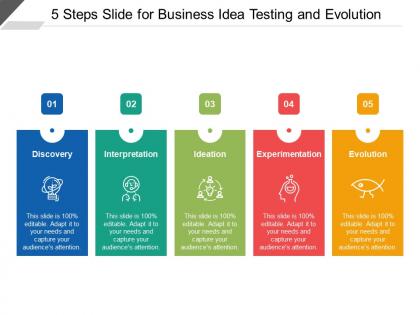
5 steps slide for business idea testing and evolution




Try Before you Buy Download Free Sample Product
 Impress Your
 Audience
 100%
100% Editable
 Save Hours
 of Time


Communicate your ambitions with our 5 Steps Slide For Business Idea Testing And Evolution. Your determination to achieve will come across clearly.
People who downloaded this PowerPoint presentation also viewed the following :
5 steps slide for business idea testing and evolution with all 5 slides:
Your determination comes across clearly with our 5 Steps Slide For Business Idea Testing And Evolution. They help communicate your ambitions.




FAQs for 5 steps slide for business idea
Key metrics for business idea validation include market size and growth potential, customer acquisition cost, lifetime value, conversion rates, and competitive positioning analysis. These metrics enable entrepreneurs to assess commercial viability through demand testing, pricing sensitivity evaluation, and scalability projections, with many startups finding that early validation data significantly reduces investment risks while accelerating market entry strategies.
Customer interviews help validate business concepts by revealing actual customer pain points, testing product-market fit assumptions, and uncovering pricing sensitivities through direct dialogue. Through structured conversations, entrepreneurs can identify gaps between perceived and real customer needs, refine value propositions, and validate market demand before significant investment, ultimately reducing risk and enhancing product development focus.
Market research serves as the foundation for startup validation by providing data on target demographics, competitor landscapes, pricing strategies, and market demand patterns. Through surveys, focus groups, and industry analysis, entrepreneurs can identify potential customer pain points, assess market size, and refine their value propositions, ultimately reducing investment risks while enhancing product-market fit and competitive positioning.
An MVP facilitates idea validation by testing core assumptions with real users, gathering authentic feedback, and measuring actual market demand before full development. This approach enables entrepreneurs to identify necessary pivots, refine features based on user behavior, and validate product-market fit, while minimizing resource investment and accelerating time-to-market for viable solutions.
Market research methods include surveys, focus groups, competitor analysis, prototype testing, and pre-order campaigns to gauge customer interest and purchasing intent. Through digital tools like landing page analytics and social media engagement, businesses can measure demand across demographics while minimizing investment risk, with many startups finding that combining multiple validation approaches delivers more accurate market insights.
Competitor analysis is crucial during validation as it reveals market gaps, pricing strategies, customer pain points, and differentiation opportunities that directly impact your business model's viability. Through comprehensive competitive research, entrepreneurs can identify underserved segments, refine their value propositions, and develop strategic positioning that delivers sustainable competitive advantages, with many successful startups finding that thorough competitor insights significantly reduce market entry risks.
Common pitfalls include confirmation bias, limited market research, ignoring competitor analysis, over-relying on friends' opinions, and skipping financial feasibility assessments. These validation errors often lead to misguided product development, poor market positioning, and resource misallocation, with many entrepreneurs finding that systematic validation frameworks help minimize risks while enhancing strategic decision-making and competitive positioning.
Online surveys validate business ideas by collecting structured feedback on market demand, pricing sensitivity, feature preferences, and customer pain points from targeted demographics. Through carefully crafted questions and strategic distribution across social media, email lists, and industry forums, entrepreneurs can gather quantitative data on purchase intent, competitive positioning, and product-market fit, ultimately delivering actionable insights that minimize risk and optimize business concepts before launch.
Customer personas are significant in validation because they transform abstract market assumptions into specific, actionable customer profiles that guide targeted research, feature prioritization, and messaging strategies. By developing detailed personas, businesses can conduct more precise validation interviews, test relevant pain points, and ensure their solutions address real customer needs rather than hypothetical ones, ultimately reducing market risk and improving product-market fit accuracy.
Social media feedback validates business concepts by providing real-time market insights, identifying target audience preferences, testing messaging effectiveness, and gauging demand levels before full launch. Through platforms like LinkedIn, Instagram, and Facebook, entrepreneurs can analyze engagement patterns, collect direct customer feedback, and refine their value propositions, ultimately reducing market risk while building early customer relationships.
Financial projections during validation should include revenue forecasts, break-even analysis, cash flow projections, customer acquisition costs, and operating expense estimates. These projections enable startups to assess market viability, secure funding, and make strategic decisions, with many investors finding that realistic financial modeling demonstrates business acumen and market understanding.
Pivot strategies significantly enhance business model validation by enabling entrepreneurs to test multiple market approaches, gather diverse customer feedback, and identify optimal product-market fit through iterative adjustments. These strategic shifts allow companies to validate assumptions across different segments, pricing models, and value propositions, with many startups finding that successful pivots ultimately deliver stronger market positioning and sustainable competitive advantage.
Recommended validation tracking tools include Google Analytics, Mixpanel, Typeform, Hotjar, and Airtable for comprehensive data collection and analysis. These platforms streamline progress monitoring by tracking user engagement, survey responses, and behavioral patterns, with many startups finding that integrated dashboards ultimately deliver clearer insights and faster decision-making throughout their validation process.
Comprehensive validation requires customer interviews, surveys, focus groups, and competitor analysis for qualitative insights, while quantitative data includes market size, pricing sensitivity, conversion rates, and financial projections. Through combined approaches, entrepreneurs can assess demand patterns, user behavior, and revenue potential, with many startups finding that this dual-method validation reduces market entry risks and accelerates product-market fit.
Validation findings can significantly reshape your business model by revealing customer pain points, pricing sensitivities, market demand patterns, and operational requirements that differ from initial assumptions. Through customer interviews, prototype testing, and market analysis, entrepreneurs often discover new revenue streams, adjust target segments, or pivot core offerings, ultimately delivering more aligned products and stronger competitive positioning in increasingly dynamic markets.
No Reviews