

Angel Investment Powerpoint Presentation Slides





Try Before you Buy Download Free Sample Product
 Impress Your
 Audience
 100%
100% Editable
 Save Hours
 of Time


If you are ready to raise seed funding, think about your start-up pitch PPT presentation and your financial model. SlideTeam presents you content-ready angel investment PowerPoint presentation slides. This informal investment PowerPoint slide carries templates on the elevator pitch, problem statement, the solution offered, value proposition, product roadmap, milestones achieved, business model, company’s growth strategy, Go To-market strategy, marketing strategy, competitive landscape, SWOT analysis, financial projection, break-even analysis and exit strategy of investors. A venture funding PPT presentation provides you all the details with context to seed capital, crowdfunding, seed money, business angel, start-up money, private investment, business plan, informal investment etc. Using our seed investment presentation slides, you can demonstrate your company’s strategies to the third party investors. Download our perfectly designed angel investment PowerPoint presentation templates and grab your potential investors. Initiate the dialogue with our investment ppt Slides. Give folks cause to bring about accord.
People who downloaded this PowerPoint presentation also viewed the following :
Content of this Powerpoint Presentation
Slide 1: This slide introduces Angel Investment. State Your Company Name and get started.
Slide 2: This is an Agenda slide. State your agendas here.
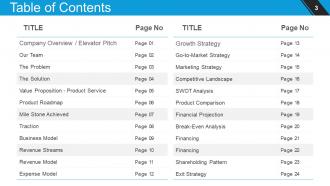
Slide 3: This slide presents Table of Contents showcasing- Company Overview / Elevator Pitch, Our Team, The Problem, The Solution Service, Value Proposition - Product Service, Product Roadmap, Mile Stone Achieved, Traction, Business Model, Revenue Streams, Revenue Model, Expense Model, Growth Strategy, Go-to-Market Strategy, Marketing Strategy, Competitive Landscape, SWOT Analysis, Product Comparison, Financial Projection, Break-Even Analysis, Financing, Use of Funds, Shareholding Pattern, Exit Strategy.
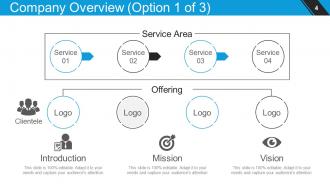
Slide 4: This is a slide on Company Overview displaying- Introduction, Mission, Our Mission & Vision, Clientele, Service Area, Logo, Offering.
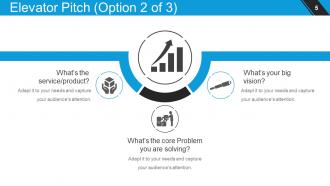
Slide 5: This is an Elevator Pitch slide showcasing- What’s the service/product? What’s the core problem you are solving? What’s your big vision?
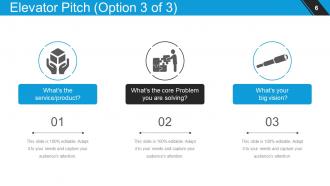
Slide 6: This slide shows the Elevator Pitch showing- What’s the core problem you are solving? What’s the service/product? What’s your big vision?
Slide 7: This slide presents Our team with names, designation and image boxes.
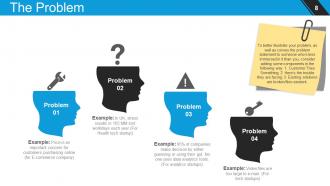
Slide 8: This slide shows The Problem to be presented and strategized about.
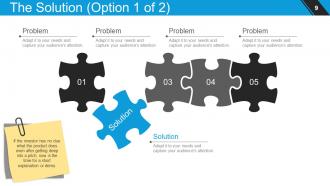
Slide 9: This slide shows The Solution to be presented and implemented. If the investor has no clue what the product does even after getting deep into a pitch; now is the time for a short explanation or demo.
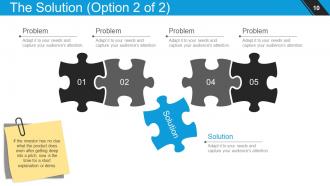
Slide 10: This slide also shows The Solution to be presented and implemented.
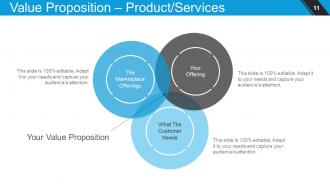
Slide 11: This slide shows the Value Proposition – Product/Services with- Your Offering, What The Customer Needs, The Marketplace Offerings, Your Value Proposition.
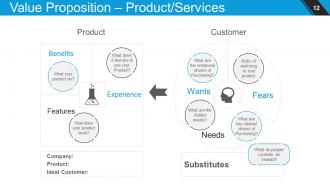
Slide 12: This slide shows Value Proposition – Product/Services displaying- Benefits, Features, Experience, Company, Product, Wants, Fears, Needs, Substitutes, Customer.
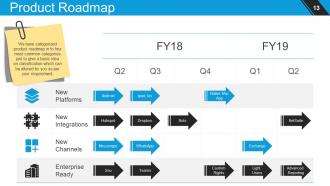
Slide 13: This slide showcases a Product Roadmap. We have categorized product roadmap in to four most common categories just to give a basic idea on classification which can be altered by you as per your requirement.
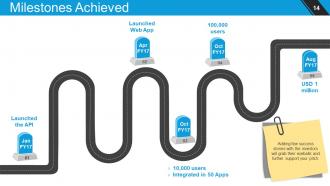
Slide 14: This slide shows Milestones Achieved (if any) to highlight fundraising aspects. Adding few success stories with the investors will grab their eyeballs and further support your pitch.
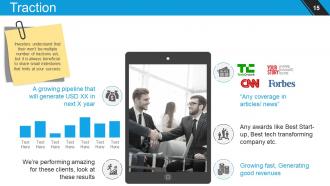
Slide 15: This slide shows Traction to present product market fit.
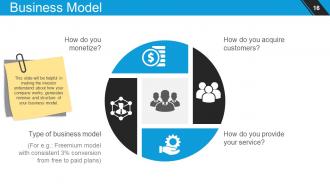
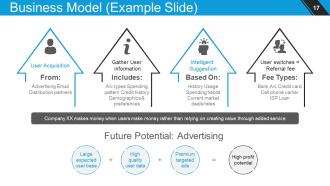
Slide 16: This slide presents a Business Model displaying- How do you provide your service? How do you acquire customers? How do you monetize? Type of business model as the main factors for understanding your business plan.
Slide 17: This slide showcases Business Model (Example Slide) displaying- From: Advertising, Email, Distribution partners, User Acquisition. Fee Types: Bank A/c, Credit card, Cell phone carrier ISP Loan, User switches = Referral fee. Includes: A/c types, Spending pattern, Credit history, Demographics & preferences, Gather User information. Based On: History, Usage, Spending habits, Current market deals/rates, Intelligent Suggestion. Future Potential: Advertising Large expected user base, High quality user data, Premium targeted ads, High profit potential.
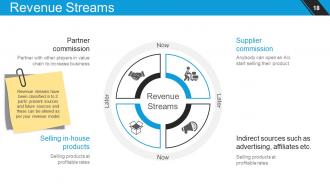
Slide 18: This slide presents Revenue Streams with the following subheadings- Partner commission, Supplier commission, Indirect sources such as advertising, affiliates etc. Selling in-house products, Revenue Streams. Revenue streams have been classified in to 2 parts: present sources and future sources and these can be altered as per your revenue model.
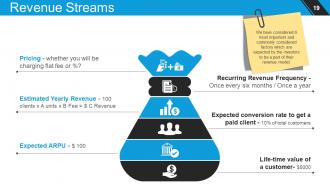
Slide 19: This slide shows Revenue Streams showing- Estimated Yearly Revenue, Pricing, Expected ARPU, Life-time value of a customer, Recurring Revenue Frequency, Expected conversion rate to get a paid client. We have considered 6 most important and commonly considered factors which are expected by the investors to be a part of their revenue model.
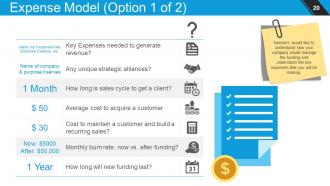
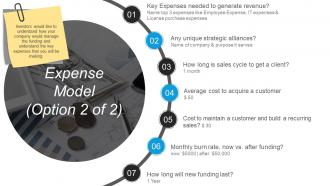
Slide 20: This slide presents an Expense Model. Investors would like to understand how your company would manage the funding and understand the key expenses that you will be making.
Slide 21: This slide also presents an Expense Model displaying- Key Expenses needed to generate revenue? Any unique strategic alliances? How long is sales cycle to get a client? Cost to maintain a customer and build a recurring sales? Monthly burn rate, now vs. after funding? How long will new funding last? Investors would like to understand how your company would manage the funding and understand the key expenses that you will be making.
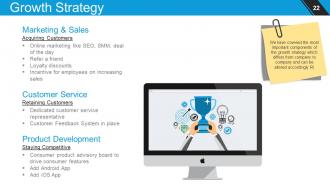
Slide 22: This slide presents Growth Strategy showing- Marketing & Sales, Customer Service, Product Development. We have covered the most important components of the growth strategy which differs from company to company and can be altered accordingly RI.
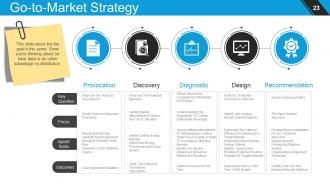
Slide 23: This slide presents Go-to-Market Strategy in tabular form.
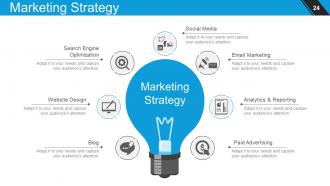
Slide 24: This slide showcases Marketing Strategy with the following subheadings- Email Marketing, Analytics & Reporting, Paid Advertising, Blog, Website Design, Search Engine Optimization.
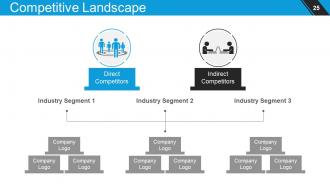
Slide 25: This slide shows Competitive Landscape showcasing- Industry Segment, Indirect Competitors, Direct Competitors.
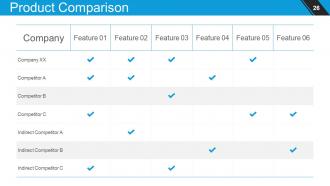
Slide 26: This slide shows Product Comparison in tabular form.
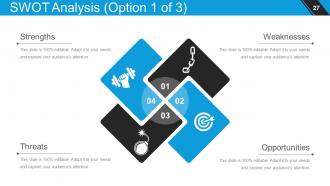
Slide 27: This is a SWOT Analysis slide in tabular form.
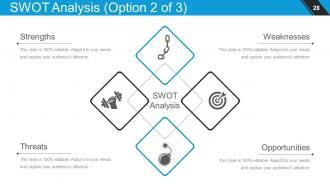
Slide 28: This is also a SWOT Analysis slide.
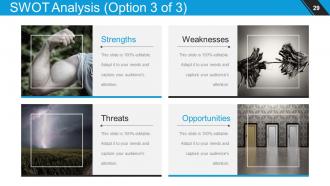
Slide 29: This slide too displays a SWOT Analysis.
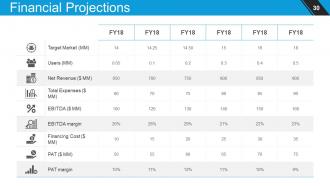
Slide 30: This slide showcases Financial Projections in tabular form.
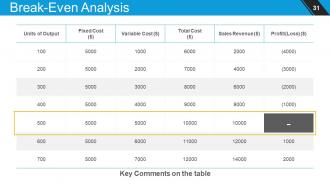
Slide 31: This slide shows a Break-Even Analysis in tabular form.
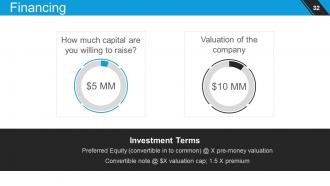
Slide 32: This slide shows Financing aspects to display how much are you willing to raise and what is valuation of the company.
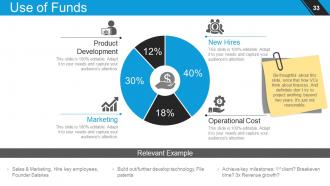
Slide 33: This slide shows Use of Funds with the following subheadings- New Hires Product Development Marketing Operational Cost Be thoughtful about this slide, since that how VCs think about finances. And definitely don’ t try to project anything beyond two years. It's just not reasonable.
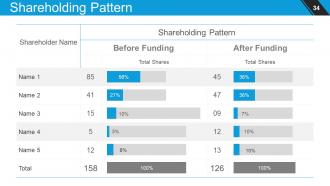
Slide 34: This slide presents Shareholding Pattern in tabular form.
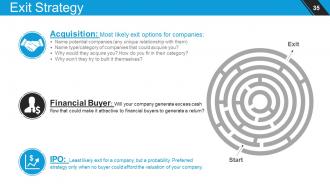
Slide 35: This slide shows Exit Strategy with- Acquisition, Financial Buyer, IPO as factors to present.
Slide 36: This is a Client Testimonials slide with name, designation and image boxes to fill information for.
Slide 37: This is a Contact Details slide with Address# street number, city, state, Contact Numbers, Email Address.
Slide 38: This is a Coffee Break slide to halt. You can change the image as per requirement/need.
Slide 39: This is an Icons Slide Seed Funding. Use them as per requirement.
Slide 40: This slide is titled Additional Slides to move forward. You may change the slide content as per need.
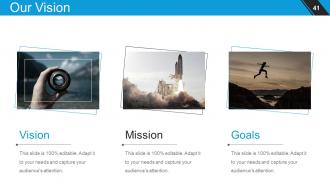
Slide 41: This is Our Vision slide with Mission and Goasl and text boxes to go with. State them here.
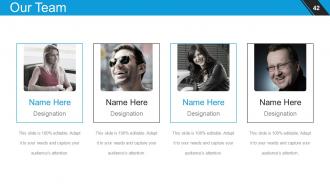
Slide 42: This is Our team slide with names and designation to fill information for.
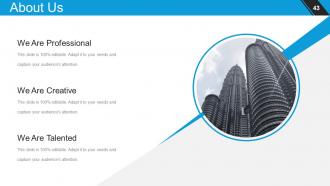
Slide 43: This is an About us slide. State team/company specifications here.
Slide 44: This is Our Goal slide. State goals, targets etc. here.
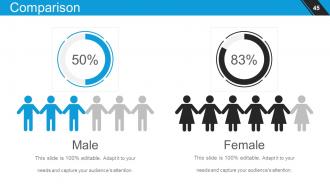
Slide 45: This is a Comparison slide to show comparison, information, specifications etc.
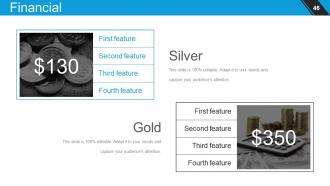
Slide 46: This is a Financial Score slide. State financial aspects etc. here.
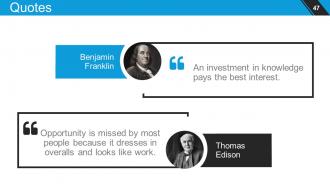
Slide 47: This is a Quotes slide. Convey message, beliefs etc. here.
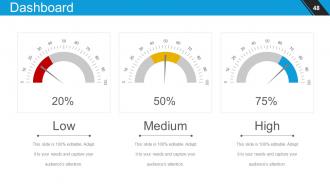
Slide 48: This is a Dashboard slide for showing information, specifications etc.
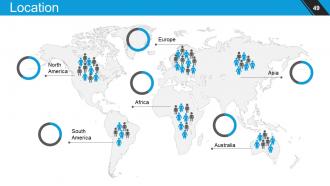
Slide 49: This is a Locations slide of world map top show global marketing, growth, presence etc.
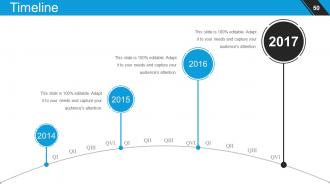
Slide 50: This is a Timeline slide to show milestones, evolution, growth highlights etc.
Slide 51: This is an Important Notes slide to mark reminders, events etc.
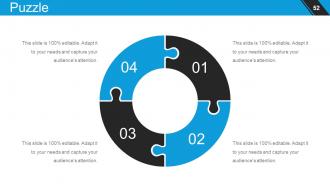
Slide 52: This is a Puzzle image slide. State information, specifications etc. here.
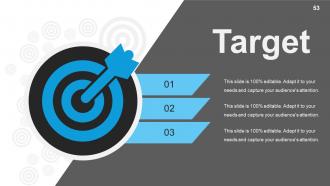
Slide 53: This is a Target slide. State your targets here.
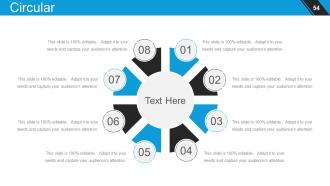
Slide 54: This is a Circular image slide with icons. State information, specifications etc. here.
Slide 55: This is a Newspaper slide to show important information etc.
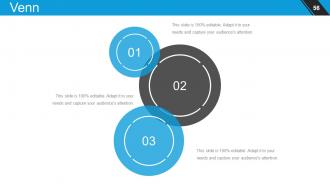
Slide 56: This is a Venn diagram image slide. State information, specifications etc. here.
Slide 57: This is a Mind Map image slide to show information, specifications etc.
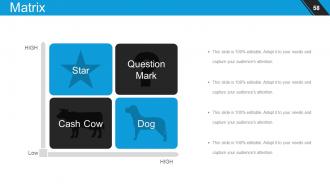
Slide 58: This slide presents a BCG Matrix for representing an information.
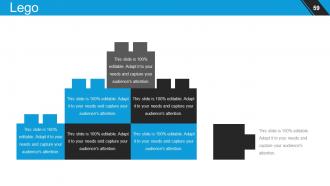
Slide 59: This is a LEGO slide with text boxes to show information, specifications etc.
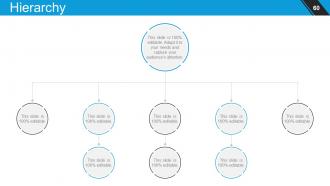
Slide 60: This is a Hierarchy Chart slide with text boxes to show information, organization/team specifications etc.
Slide 61: This slide shows Silhouettes with text boxes. State people related information, specifications etc. here.
Slide 62: This is a Magnifier Glass image slide to show information, specifications etc.
Slide 63: This is a Bulb or Idea slide to state a new idea or highlight innovative specifications/information etc.
Slide 64: This is a Funnel slide. Showcase the funnel aspect of your team, company, product etc.
Slide 65: This slide is titled Our Charts to move forward. You can change the slide content as per need.
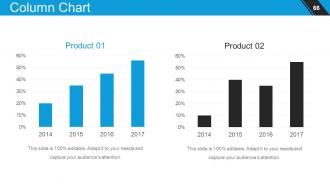
Slide 66: This is a Column chart slide to show product/entity comparison, specifications etc.
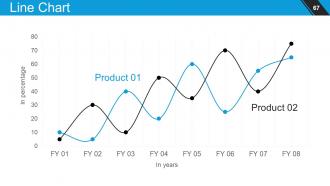
Slide 67: This is a Line chart slide to show product/entity comparison, specifications etc.
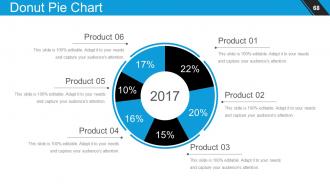
Slide 68: This is a Donut Pie chart slide to show product/entity comparison, specifications etc.
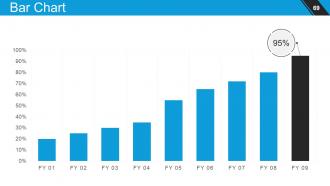
Slide 69: This is a Bar Chart slide to show product/entity comparison, specifications etc.
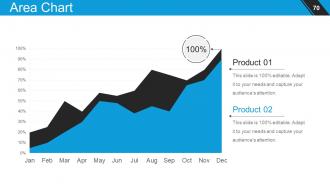
Slide 70: This is an Area Chart slide to show product/entity comparison, specifications etc.
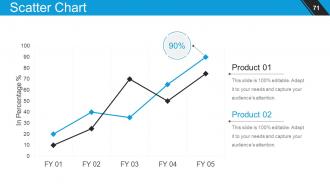
Slide 71: This is a Scatter Chart slide to show product/entity comparison, specifications etc.
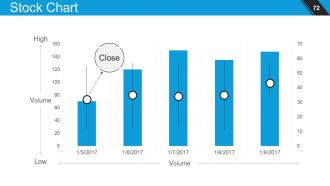
Slide 72: This is a Stock Chart slide to show product/entity comparison, specifications etc.
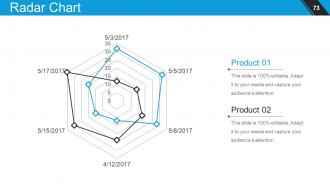
Slide 73: This is a Radar Chart slide to show product/entity comparison, specifications etc.
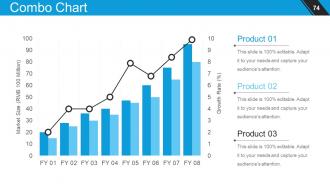
Slide 74: This is a Combo Chart slide to show product/entity comparison, specifications etc.
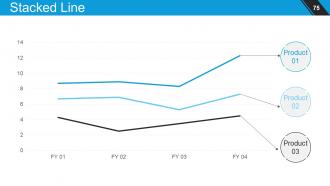
Slide 75: This is a Stacked Line chart slide to show product/entity comparison, specifications etc.
Slide 76: This is a Contact Us slide with Email Address, Address# street number, city, state, Contact Numbers.
Slide 77: This is a Thank You slide for acknowledgement.
Angel Investment Powerpoint Presentation Slides with all 77 slides:
Our Angel Investment Powerpoint Presentation Slides encourage forthright expression. Thoughts will flow with complete clarity.









FAQs for Angel Investment
Angels are just rich people investing their own cash - usually $25K-$500K when you're super early stage. VCs manage other people's money and write way bigger checks ($1M+) but they're pickier about traction. Most angels used to be entrepreneurs so they actually get the struggle, though some can be annoying micromanagers. VCs are more buttoned-up and formal about everything. Oh, and angels move faster since they don't need committee approval. I'd definitely hit up angels first - they're your best shot when you're still figuring things out.
Alright, so first things first - get super clear on what problem you're solving and have solid numbers that show people actually want this thing. Angels care way more about traction than your fancy deck. Know your market size and competitors inside out, obviously. Practice with friends first because you'll definitely bomb the first few times (we all do). Your business model should take like 10 seconds to explain, not a dissertation. Have a specific dollar amount you need and exactly where it's going - none of that vague "marketing and operations" BS. Oh, and prep for the scaling question because they'll ask it every single time.
So angels care about five big things when they're looking at startups. Your team is honestly the biggest one - they're betting on whether you can actually pull this off and adapt when things go sideways. Market size matters too, obviously. They want to see your product has some real competitive edge and that you've got early traction with customers or users. Oh, and your financial projections need to make sense, not be totally pie-in-the-sky stuff. The team thing though? That's where most decisions get made. Show them you've already validated people actually want what you're building and have the numbers to prove it.
Honestly, due diligence is just fancy talk for "don't get screwed over." Check their financials first - are those revenue numbers actually real? Then dig into legal stuff and whether the team is who they say they are. I usually spend like 10-20 hours on this, but some deals move crazy fast so you work with what you've got. Focus on the big red flags instead of getting lost in details. Oh and make a checklist - sounds boring but you'd be surprised what obvious stuff people miss when they're excited about a deal.
Honestly, start with people you already know - friends, old coworkers, mentors. Someone in your circle probably knows an angel or is one themselves. AngelList is solid for finding investors, plus hit up local startup meetups where these people actually show up. Cold emails are pretty much pointless though. Warm intros are where it's at. When you finally do reach out, don't just pitch - show them your numbers and exactly what you'll spend their money on. Oh and angels usually stick to industries they understand, so research that first. Bottom line: ask your network for introductions, not cash directly.
Yeah so most angels use convertible notes or SAFEs now - way less paperwork than equity deals. Individual angels usually put in $25K-$250K, and total rounds hit like $500K-$2M typically. Key stuff to know: valuation cap (think $3M-$10M for early stage), discount rate around 15-25%, plus interest if it's a note. Some angels still want actual equity upfront but that's getting rarer. Honestly? Just learn the convertible note basics before you pitch anyone. Makes you look like you actually get how this works instead of being totally clueless about fundraising mechanics.
Yeah so basically it's just math - higher valuation means angels get less equity for their cash. Like if you're at $1M pre-money, $100K gets them 10%. At $5M? Only 2%. Angels hate that obviously, but here's the thing - overvaluing screws you too because then you can't hit those numbers for your next round. I've seen founders get stuck this way. You want something fair enough that investors don't laugh at you, but not so crazy high that you paint yourself into a corner. Sweet spot is key.
Honestly, AI and fintech are crushing it with angels right now. Biotech too if you've got something solid. Climate tech's getting crazy attention - probably because everyone's finally realizing we're kinda screwed if we don't fix this planet situation. SaaS is still doing well, but only if you're actually solving real problems, not just building another "Uber for X" thing. Oh, and D2C brands that know how to work social media are getting funded left and right. The key is making sure you're fixing an actual pain point people have, not just riding whatever trend seems hot this month.
Angel investing is wild - you could make 50x your money if you pick the next Uber, but most startups just... die. I'm talking total loss of whatever you put in. Your cash gets locked up for years too, which honestly sucks if you need liquidity. The math only works if you spread bets across multiple companies, hoping one or two massive wins offset all the duds. Only throw in money you're cool with never seeing again. My buddy made bank on some fintech startup, but he also lost everything on like 6 other deals first.
Dude, networking is everything for angel money. Most deals come through warm intros, not random cold emails. Having someone vouch for you makes angels way more likely to actually meet with you and invest. Other founders will tell you who's writing checks and what they want - honestly saved me so much time when I was raising. Nobody wants to hand over cash to a total stranger, right? Join some local entrepreneur groups and hit up startup events. Oh, and definitely ask people you know for intros to angels in your industry. That's where the magic happens.
Honestly, syndicates are huge right now - angels are pooling money instead of going it alone. AI's helping people find deals and do research, which is pretty cool. There's this massive push for diversity too, both with who's investing and who gets funded. Micro-funds are everywhere now, making everything way more accessible than it used to be. Geographic stuff doesn't matter anymore since everyone invests remotely. Oh, and most angels are getting super niche instead of trying to cover everything - makes sense I guess. If you're considering it, definitely join a group first. Learn from people who've done this before going solo.
Honestly, social media is huge for this. Start posting your wins on LinkedIn and Twitter - like when you hit milestones or your team crushes something. Angels eat that momentum stuff up. Behind-the-scenes content works too because it proves you're actual humans, not just another boring deck. Don't wait until you need cash to start building relationships though (rookie mistake). Comment on investors' posts, join those startup communities where they lurk. Oh and be consistent - can't just ghost for months then pop up asking for money. The authentic stuff always wins over the sales-y posts anyway.
Okay so first thing - only deal with accredited investors or the SEC will come for you. Investment structure is key too, like convertible notes versus straight equity. Get your documentation tight on dilution protection, board seats, liquidation preferences. Pro rata rights are absolutely critical, seriously don't mess that up. Oh and sort your cap table early because once you have multiple angels involved it becomes a total nightmare. I know a securities lawyer feels crazy expensive but trust me, going cheap there will bite you later. The paperwork side gets wild fast.
Dude, treat them like actual partners, not ATMs. Monthly updates are clutch - share the messy stuff too, not just wins. Honestly, they've probably screwed up way worse than you have, so they get it. Hit them up for advice on big decisions and intros when it makes sense. Oh and transparency about problems is huge. The ones who invest again? They're usually the investors who felt like they were part of the ride from the beginning, not just spectators throwing money at you.
Dude, definitely diversify your angel group. You'll get way better connections and advice when investors come from different industries and backgrounds. Makes fundraising less sketchy too - you're not stuck if one person changes their mind or runs out of cash. The problem-solving gets so much better honestly, since everyone brings different experiences to the table. I'd be super intentional about finding angels across various sectors and demographics. Don't just take the first "yes" you get - that's tempting but you'll regret it later when you need specific expertise.
-
Graphics are very appealing to eyes.
-
Top Quality presentations that are easily editable.