

Bar graph with percentage chart and icons powerpoint slides




Try Before you Buy Download Free Sample Product
 Impress Your
 Audience
 100%
100% Editable
 Save Hours
 of Time


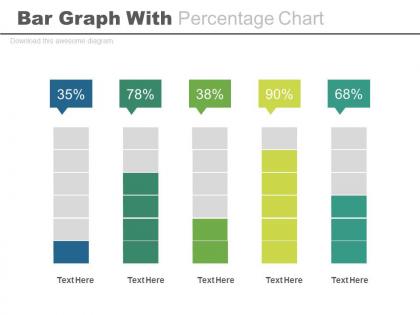
Searching for the exquisite percentage PowerPoint template design for your presentation? If yes then check our bar graph with percentage chart and icons PowerPoint slides. Demonstrating any essential business information with percentage empowers you to highlight the key focuses to your gathering of people. The presentation template highlights some rate values that are spoken to in the circle outline. Regardless of whether you need to demonstrate your business numbers or execution report graph, the PPT format slide will surely help you to exhibit the information in the ideal way. The PowerPoint graph is totally editable and you can adjust it in your own specific manner. The measurements can be changed and in addition the hues. Other than this, there is a choice to refresh the substance according to your exchange. Any business information can be effortlessly given this eye-getting introduction slide. You can simply download and make it a piece of your introduction. Additionally, check our bar graph chart PowerPoint template that are planned professionally only for your business necessity. Experience great cheer with our Bar Graph With Percentage Chart And Icons Powerpoint Slides. They will certainly make you happy.
People who downloaded this PowerPoint presentation also viewed the following :
Content of this Powerpoint Presentation
Description:
The image depicts a bar graph with percentage chart designed for PowerPoint presentations. It's a visual representation of data, featuring five vertical bars, each corresponding to a different category or item. Above each bar, there's a speech bubble with a percentage, indicating the value or proportion each bar represents. These percentages are 35%, 78%, 38%, 90%, and 68%, from left to right. Each bar is divided into segments, with the colored segment corresponding to the percentage indicated. The colors—blue, green, lighter green, yellow, and teal—distinguish the bars from one another. Below each bar is a placeholder saying "Text Here," inviting the presenter to specify what each bar represents. This kind of slide is versatile and can be adapted for various industries and purposes. It aims to simplify complex information into digestible visual chunks for an audience.
Use Cases:
Here are seven industries where such slides can be used:
1. Marketing:
Use: Displaying campaign conversion rates
Presenter: Marketing Analyst
Audience: Marketing team, stakeholders
2. Education:
Use: Illustrating student performance statistics
Presenter: Academic Researcher
Audience: Educators, administrators
3. Finance:
Use: Comparing quarterly revenue percentages
Presenter: Financial Analyst
Audience: Investors, company executives
4. Healthcare:
Use: Showing patient satisfaction scores by department
Presenter: Hospital Administrator
Audience: Healthcare staff, board members
5. Real Estate:
Use: Visualizing occupancy rates of properties
Presenter: Real Estate Manager
Audience: Investors, property management teams
6. Technology:
Use: Demonstrating software adoption rates
Presenter: Product Manager
Audience: Development team, sales force
7. Human Resources:
Use: Benchmarking employee engagement levels
Presenter: HR Specialist
Audience: HR department, senior management
Bar graph with percentage chart and icons powerpoint slides with all 4 slides:
Your ideas deserve their due. Our Bar Graph With Percentage Chart And Icons Powerpoint Slides exhibit them like gems.
FAQs for Bar graph with percentage chart and
Okay so bar graphs with percentages are clutch because people don't have to do math in their heads. Visual comparison between categories? Check. Exact numbers right there? Also check. Even my data-phobic coworkers actually pay attention instead of zoning out completely. Percentages work great when you're showing parts of a whole or comparing how different teams performed. Icons can be useful too if they make sense. I swear, sometimes the simplest charts are the most effective. Use them when you actually want people to get it and remember the numbers later.
Honestly, icons are a game-changer for bar graphs. People instantly know what they're looking at instead of squinting at labels. A house icon? boom - housing data, no confusion. You can stick them next to categories, build them right into the bars, or put them by your percentages. Just pick ones that actually make sense - like, don't use a random star for sales data, you know? I started doing this with my charts and it's crazy how much faster people understand what I'm showing them. Try throwing 2-3 simple ones on your next graph.
Make your percentages add up to 100% if you're showing a whole thing - sounds obvious but you'd be surprised how often people mess this up. Put the labels where they're actually readable, inside bars or right next to them. Icons work great but honestly, less is more here. I once used this super cute airplane icon that nobody understood lol. Stick with symbols everyone recognizes and line them up properly with your bars. Oh, and definitely show it to someone else first. They'll spot confusing stuff way faster than you will.
Pick high contrast colors like dark blue on white - way easier to read. Yellow on white? Your audience will literally squint at you. Don't make color the only way to show differences since colorblind people won't catch it. I learned this the hard way once. Keep it simple with max 5-6 colors or it'll look like a rainbow exploded. Use the same colors for identical data across all your charts. Here's a quick test: view everything in grayscale. Can you still tell things apart? You're good to go.
Just use simple stuff everyone gets right away - people icons for demographics, dollar signs for money data, basic circles and arrows. Don't get fancy with weird symbols that nobody recognizes. I made that mistake once and people just stared at my chart looking confused lol. Keep them the same size and style throughout so it looks clean. Test it on someone first - if they have to think about what an icon means, you've lost them. Honestly, boring icons are your friend here. Save the creativity for something else.
First thing - double check your percentages add up to 100%. I know it sounds dumb but I've seen so many people screw this up lol. Pick either whole numbers or one decimal place and stick with it throughout. Your icons should be super simple and actually make sense for what you're showing. Position the percentage labels so they're not competing with everything else for space. Always cite where you got the data from - people appreciate that. Oh and write a quick sentence explaining what the percentages mean. Honestly though? Show it to someone first. If they get confused, you'll know right away what needs fixing.
Honestly just start with Excel or Google Sheets - they'll do the percentage math for you automatically. Canva's actually pretty great if you want it to look nice, tons of chart templates and icons to choose from. I've been using Canva for like everything lately, probably more than I should lol. PowerPoint works fine too if you're making slides anyway. The fancy stuff like Tableau and Power BI are overkill unless you're building actual dashboards for work. Just use whatever you already have on your computer first, then worry about upgrading if you need more features later.
Okay so first thing - hit them with your highest and lowest bars right off the bat. People need that big picture immediately. Then break down what each percentage actually means, like "30% picked option A but only 10% went with option B." Those little icons? Honestly just eye candy, but they do help people remember stuff better. Point at the actual bars while you're talking - sounds obvious but people forget. Also pause between your key numbers or everyone's brain just shuts off. Oh and here's the thing everyone messes up: don't just rattle off percentages like you're reading a grocery list. Tell them why it matters to them specifically.
Keep your icons simple - too much detail just fights with your actual data. Also make sure they actually make sense for what you're showing (I've seen some truly bizarre clipart choices that left everyone scratching their heads). Size and style should match across the whole chart. Here's the thing though - don't try making the icons bigger or smaller based on your numbers because it gets messy fast. The goal is helping people understand your data better, not just decoration. Quick test: show it to someone first. If they look confused, those icons need work.
Honestly, the icon style can totally change how your bar graph feels. Simple, clean icons work great for business stuff - gives you that professional vibe. But if you want something more engaging, detailed or fun icons make the data way more approachable. I've definitely seen charts where the icons are so busy they distract from the actual numbers, which is annoying. Match your style to who's looking at it. Formal reports? Keep it simple and maybe stick to one color. Public presentations though - that's where you can get creative. Just don't mix styles halfway through.
Use bar graphs with percentages when you want to show two things at once - how categories break down internally AND how they compare to each other. Perfect example: survey results by department. You'll see how each dept responded (the percentages) plus which departments are bigger (bar heights). Pie charts only do the first part, regular bars miss the internal stuff. Budget breakdowns work great this way too - honestly way better than making two separate charts that nobody wants to flip between. Market share comparisons are another solid use case where stakeholders need both viewpoints in one glance.
Honestly, the grow-from-zero effect is where it's at - bars building up to their final values just looks so clean. People actually watch the whole thing instead of scrolling past. Try staggering each bar by like 0.2 seconds so they don't all pop up together. Icons can pulse or appear one by one to highlight your main points. Oh, and if you're showing multiple data sets, smooth transitions between them work great. Just don't go over 2-3 seconds total or people lose interest fast. Start simple with basic grow-ins, then get fancy once you've got the hang of it.
Hover effects are your best bet - when people mouse over bars, show the detailed breakdown. Click-to-drill is solid too, letting users dive into sub-categories. I'm a big fan of interactive legends where you can toggle different data series on and off. Animated transitions between time periods look really clean and help show trends. Oh, and slider controls for filtering dates or demographics work well. Your icons can be clickable for tooltips with extra context. Honestly, I'd start with hover states first since they're the easiest to code and users expect that kind of feedback when they're exploring data.
Yeah, this stuff is way trickier than people think! Colors will totally screw you over - red screams danger here but means good luck in China. Green could be money or nature depending on who's looking. Reading direction matters too since some cultures go right-to-left, which changes how they follow your data. Icons are honestly the worst part - what looks innocent to you might be offensive somewhere else. Animals, hand gestures, religious symbols... it's a minefield. I'd definitely run your stuff by someone local first, or just play it safe with boring neutral colors and basic shapes. Better bland than accidentally insulting your audience.
Dude, you HAVE to label everything clearly or people won't know what they're looking at. Put your percentage values right on the bars or make sure the y-axis is super obvious. Different colors? You need a legend explaining each one. Same with any icons you use. I've seen so many charts where I'm just sitting there like "what does this even mean?" Don't make people work that hard to understand your data. Oh, and make sure your axes are labeled too - sounds basic but you'd be surprised how often people forget that part.
-
Commendable slides with attractive designs. Extremely pleased with the fact that they are easy to modify. Great work!
-
It saves your time and decrease your efforts in half.