


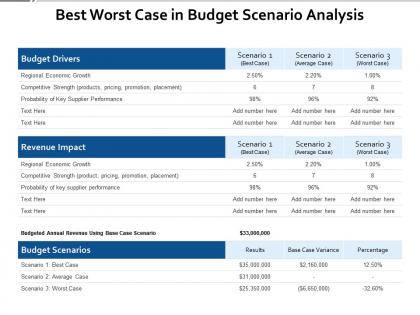
Best worst case in budget scenario analysis




Try Before you Buy Download Free Sample Product
 Impress Your
 Audience
 100%
100% Editable
 Save Hours
 of Time


Let our Best Worst Case In Budget Scenario Analysis be the electrodes. Charge the batteries of your team with your thoughts.
People who downloaded this PowerPoint presentation also viewed the following :
Best worst case in budget scenario analysis with all 5 slides:
Get folks involved in combined effort with our Best Worst Case In Budget Scenario Analysis. Give them an incentive to join forces.


FAQs for Best worst case in
Focus on three things: realistic scenarios (best/worst/likely cases), identifying your key variables like revenue drivers and major expenses, and - this is where people mess up - actually writing down your assumptions. I can't tell you how many times I've seen someone get grilled in a meeting because they couldn't explain their growth projections. Build some sensitivity analysis in there too so you can see what happens when one thing changes. Start with your most likely scenario since that's what everything else branches off from. Oh, and if you're presenting to executives, throw some probability weighting on those scenarios.
So basically you're creating different versions of your financial projections - like what happens if there's a mild recession vs total economic meltdown. First, figure out what actually changes when things go south: customer spending, your pricing power, supply costs, all that stuff. Then build 3-4 scenarios with different assumptions. Honestly, most companies are way too rosy even in their "worst case" - don't be those guys. The whole point is stress-testing your budget so you can see cash problems coming months ahead. That way you're not scrambling when shit hits the fan.
Think of historical data as your reality check when building budget scenarios. Pull 3-5 years of financials if you've got them - this stuff reveals actual patterns instead of wishful thinking. Look for seasonal trends, how costs move when revenue changes, growth rates over time. Without it, you're basically throwing darts blindfolded. Start with creating your baseline scenario from real data, then tweak it up or down. Oh, and don't just look at one good year - multiple years show you how your business actually behaves during different market conditions.
Honestly, scenario analysis is a game changer for figuring out where to put your money. You can map out best-case, worst-case, and realistic situations to see which investments actually hold up no matter what happens. Those are the ones you want. I've found it also shows you where you might blow cash if things get ugly – which happens more than we'd like to admit. Building in flexibility early saves you later. Short version: run three different scenarios before your next big spending decision. It's way better than just winging it and hoping for the best.
Honestly, most people mess up by being way too rosy with their base case - like assuming everything will go perfectly. Bad idea. Your scenarios need to actually be different too, not just tweaking a few numbers here and there. I see this all the time where people create three "scenarios" that are basically identical. Also skip the fantasy stuff like zero market volatility or hitting every single target. Make your scenarios stress-test things for real. Oh and actually use them to decide stuff - don't just build them because your boss said to.
So sensitivity analysis is basically stress-testing your budget before life does it for you. Pick like 3-5 variables that could realistically swing 20-30% either way - revenue, major costs, whatever keeps you up at night. Then see what happens to your bottom line when they move around. Honestly, it's one of those things that sounds boring but saves your ass later. You'll figure out which numbers actually matter vs which ones are just noise. That way you know what to watch closely and can build backup plans around the stuff that'll actually tank your budget if it goes sideways.
Honestly just stick with Excel for now - the scenario manager and data tables are clutch for budget stuff. Google Sheets works great too if you're collaborating with people. There are fancier tools like @RISK or Crystal Ball but they're expensive and probably overkill. I mean, Monte Carlo simulations sound cool but do you really need that? Excel handles like 90% of budget scenarios anyway. Build your base case first, then mess around with some what-if scenarios. You can always switch to something more powerful later if Excel starts driving you crazy.
Budget scenario analysis is basically your planning safety net - you can test different "what if" situations before making big moves. Think economic crashes, surprise growth spurts, market changes, that kind of thing. Honestly, I wish more companies did this properly because it shows you which strategies actually hold up under pressure. You'll figure out what investments matter most and when to pump the brakes. The trick is connecting your major goals to different budget scenarios. That way you're not scrambling when things shift. It's like having backup plans for your backup plans.
Dude, you can't just throw static numbers into your budget anymore - inflation will absolutely wreck you. I learned this the hard way last year when my "safe" 3% estimates got demolished by 8% reality. Now I always run multiple scenarios for the big external stuff that could tank my budget. Market volatility messes with everything, so I model best-case, worst-case, and realistic scenarios. Honestly? I do like 3-4 different inflation scenarios now because it's saved me so many times. Figure out what external factors hurt you most first. Then build your scenarios around those specific variables.
Honestly, waterfall charts or side-by-side comparisons work best - they make the financial differences super obvious. Color code everything (green for good scenarios, red for the scary ones). I've sat through way too many presentations where people jam everything into tiny tables that nobody can actually read. Pick maybe 3-4 key numbers per scenario and make those huge on your slides. Probability estimates help too if you've got them. Oh, and start with your worst-case scenario first, then build up to the optimistic stuff - it's weirdly more compelling that way.
Dude, scenario analysis is a game changer for budget meetings. Instead of just winging it with one forecast, you're showing what happens if sales tank 20% or costs go crazy. People actually trust you more when you've got multiple what-if situations mapped out with real numbers. Honestly, it's way better than those overly optimistic projections everyone usually presents. Your stakeholders will feel way more confident about decisions because you've clearly thought through the risks. Oh, and it gets buy-in so much faster! Try running best case, worst case, and realistic scenarios for your next board thing.
Cash flow is everything - seriously, without it you're dead in the water. Track your revenue variance, expense ratios, and break-even points as your main three. Margin compression will bite you if you ignore it. Working capital changes matter too, plus debt service coverage if you've got loans to deal with. Oh, and honestly? The industry you're in totally changes what else you should watch. These basics will catch most problems though. Start there, then add whatever specific stuff actually matters for your type of business. Don't overcomplicate it at first.
Start with what actually scares your business - revenue hits, cost spikes, operational nightmares. Economic downturns, supply chain mess, competitors doing something crazy, new regulations. I always do three: best case, worst case, most likely. Honestly, more than 5 scenarios and people's eyes glaze over. Chat with your department heads about what's keeping them awake at 3am. Those conversations are gold. Model those specific risks that tie directly to your strategic goals and real vulnerabilities. Don't overthink it - you can always add more scenarios later if needed.
Basically, worst-case analysis shows you how bad things could get and if your business would actually survive. You'll spot which revenue streams are shakiest and where your cash flow dies first. Costs can spiral fast too - that part's always eye-opening. Look, it's depressing stuff honestly, but you need to know your early warning signs before you're scrambling. The whole point is building backup plans now while you're not panicking. Plus it helps you figure out how big of a safety net you actually need. My accountant always says most people underestimate this by like 40%.
So basically, risk assessment is what makes your budget scenarios actually mean something. You've got to identify your main risks first - supply chain issues, market changes, new regulations, whatever keeps you up at night. Then figure out how likely each one is and what it'd cost you. I usually tell people to focus on their top 5-7 risks and map them directly to budget line items. Without this step, your best/worst/likely case scenarios are just random numbers you pulled out of thin air. The risk weighting is what turns your models into something you can actually use for decisions. Start there and work backwards.
No Reviews