

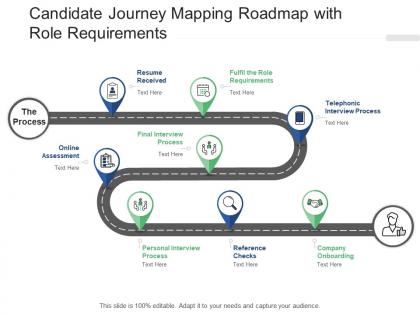
Candidate journey mapping roadmap with role requirements




Try Before you Buy Download Free Sample Product
 Impress Your
 Audience
 100%
100% Editable
 Save Hours
 of Time


Our Candidate Journey Mapping Roadmap With Role Requirements are topically designed to provide an attractive backdrop to any subject. Use them to look like a presentation pro.
People who downloaded this PowerPoint presentation also viewed the following :
Candidate journey mapping roadmap with role requirements with all 2 slides:
Use our Candidate Journey Mapping Roadmap With Role Requirements to effectively help you save your valuable time. They are readymade to fit into any presentation structure.
FAQs for Candidate journey mapping roadmap
You'll want to map out five main stages: Awareness (when they first hear about your company), Application (the actual applying bit), Interview/Assessment (all your screening stuff), Decision (offer and negotiation), and Onboarding (their first few weeks). Some people throw in a pre-awareness stage too, but that feels kind of pointless to me. What really matters is tracking the emotions and friction at each step - like, where are people getting frustrated or confused? That's where candidates drop off. Focus on those pain points first since they'll give you the biggest wins for improving your whole process.
Honestly, you've gotta dig deeper than just looking at your top performers' resumes. Sure, check their backgrounds and skills first. But here's where it gets interesting - actually talk to your recent great hires about their whole job search mess. What drove them crazy? Why'd they pick you over that other company? I'm telling you, the emotional stuff matters way more than people think. Like, were they burned out at their last place, or chasing growth opportunities? Build maybe 2-3 solid personas from all this, then test your messaging against them. Don't go overboard with too many profiles though.
Miro's probably your best bet - their journey mapping templates are actually pretty decent. Lucidchart's solid too if you want something a bit more polished. Your team already using Figma for design stuff? Then just stick with that, honestly. Google Drawings works fine if you're just testing the waters (though it feels kinda basic after a while). Main thing is making sure everyone can jump in and edit without it being a whole ordeal. I'd try Miro's free version first - worst case you'll know what you need before paying for anything.
Get feedback at all the big moments - applications, interviews, rejections, offers. Short surveys work best, just ask what sucked and what didn't. Honestly, most companies are trash at this so you'll already be ahead! Also talk to people who bailed on your process entirely - they're way more likely to tell you the brutal truth. Map out how candidates actually *feel* at each step, not just what they're doing. Then fix the worst stuff first. Usually it's radio silence or making people wait forever for no reason.
Look, your employer brand basically controls how candidates see you from day one. It affects whether people even bother applying, how they feel during interviews, and - here's the thing - what they tell their friends if you reject them. Strong branding builds trust right away. Weak or inconsistent messaging? Total turnoff before you even shake hands. The trick is matching your actual interview process to whatever you're promising online. Otherwise you'll just create a bunch of disappointed people who'll trash you on Glassdoor later.
So touchpoints are literally every single interaction candidates have with your company - job posting, application, interviews, the whole thing. Here's what's annoying though: one crappy experience (like a broken application system or ghosting someone) can wreck everything else you did right. Candidates remember the bad stuff way more than the good. It's frustrating but true. I'd honestly just go through your whole process step by step and pretend you're the candidate. Where does it suck? Those are your problem spots that need fixing first.
Honestly, start with time-to-hire and candidate drop-off rates - those'll tell you where people are bailing. Application completion rates are massive too. I've literally seen companies lose 60% of candidates because their forms were nightmare fuel. Track your offer acceptance rate and maybe throw in some post-application surveys for satisfaction scores. Quality of hire after 6-12 months is solid but takes forever to get useful data. Oh, and don't sleep on source effectiveness since different channels work better at different stages. Pick like 3-4 metrics that match your biggest headaches first, then build from there.
Dude, journey mapping is a game-changer for finding where you're bleeding candidates. Track your drop-off points first - that's your starting data. Then walk through what candidates actually experience step by step. You'll catch the obvious stuff like nightmare application forms, but honestly? The subtle things are worse. One company I know was ghosting people for two weeks after phone screens and couldn't figure out why everyone vanished. The visual really helps prioritize what's broken most. Sometimes it's just weird communication gaps between interview rounds that seem minor but totally kill momentum.
The biggest mistake? Mapping what you *think* happens instead of reality. You need actual candidate feedback, not your assumptions. Also don't make it too generic - a sales role is completely different from engineering. Most people only focus on the happy path, but honestly, candidates usually hit roadblocks somewhere. Oh, and creating this gorgeous map then never updating it is pointless. Get input from everyone who actually talks to candidates, not just HR folks. I'd start by interviewing recent hires and people who bailed mid-process. They'll tell you what really went down.
Mapping out your candidate journey is a game changer for catching bias you didn't even know existed. Track where different groups drop off - job descriptions might sound too aggressive, or maybe your interview panels are all dudes in polo shirts (happens more than you'd think). Different sourcing channels bring totally different types of people too. LinkedIn versus community job boards? Night and day difference. Break down your conversion rates by demographics at each step. You'll spot patterns that were invisible before. Honestly wish I'd done this years ago - would've saved so much headache.
Check your candidate journey map quarterly at minimum - monthly if you're in tech or another crazy fast industry. Survey people who just got hired and folks who bailed mid-process first. That'll show you where the real drop-off points are vs where you think they happen. Update pain points from recent feedback, tweak things when you roll out new tools or change processes. Your candidate personas probably need refreshing too since roles change so much these days. Honestly, what people wanted even three months ago might be completely different now. Market's wild right now.
Your recruiting team is honestly where you should start - they're dealing with candidates every single day and hear all the complaints firsthand. They know exactly when your application system crashes or when interview scheduling turns into chaos. What you think is working probably isn't, and recruiters can tell you the real story. Candidates vent to them about confusing processes and frustrating dead ends. I'd sit down with your recruiting team first and ask what pain points they see most. Then fix those areas before worrying about the fancy stuff that looks good but doesn't actually help anyone.
So here's the thing - data analytics shows you exactly where people are bailing on your application process. Track stuff like how long it takes to apply, completion rates at each step, and feedback scores. You'll spot the friction points fast. Mobile data is honestly wild - if your forms aren't mobile-friendly, candidates just give up. It also reveals which communication actually matters to people versus what you think matters. Find patterns in your best hires' journeys and copy that experience. Map your current conversion rates first, then fix whatever's causing the biggest drop-off.
Honestly, when HR and marketing team up on candidate journey mapping, it's kind of magical. Marketing brings all their user experience wizardry - they know exactly where people bail out and can visualize the whole funnel. Meanwhile, HR has the real talk on what actually goes down during interviews and onboarding. You can't get that insight from spreadsheets alone. Marketing spots the gaps, HR knows the messy reality of candidate experiences. My advice? Get both teams in a room and audit your current process together. Way better than either team trying to figure it out solo.
Honestly, personalization makes or breaks the whole thing. Software engineers want totally different stuff than sales people, you know? Start by customizing job descriptions and how you reach out initially. During interviews, tailor your questions to their actual background instead of using the same script for everyone. Even rejection emails shouldn't feel like you copy-pasted them - and trust me, candidates can tell when you did. The whole point is making people feel like you actually looked at their resume instead of just dumping it into your system. It's really about seeing them as actual humans, not just another application to process.
-
Easily Understandable slides.
-
Great quality product.