


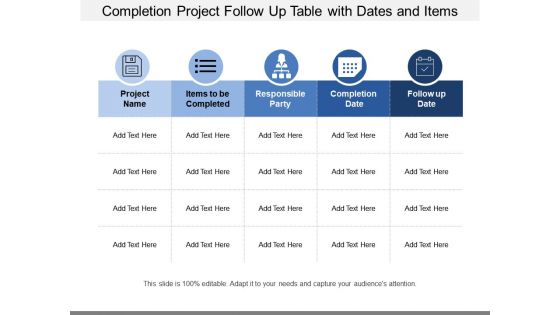
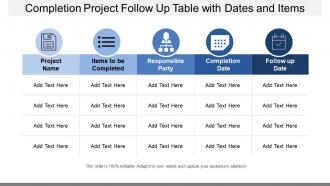
Completion project follow up table with dates and items





Try Before you Buy Download Free Sample Product
 Impress Your
 Audience
 100%
100% Editable
 Save Hours
 of Time


Your best will emerge with our Completion Project Follow Up Table With Dates And Items. Your excellent attributes will come to the fore.
People who downloaded this PowerPoint presentation also viewed the following :
Completion project follow up table with dates and items with all 5 slides:
Our Completion Project Follow Up Table With Dates And Items ensure enough time is on hand. Give yourself the break you deserve.


FAQs for Completion project follow up table with
So there's basically 5 phases: initiation, planning, execution, monitoring/controlling, and closure. First you figure out what you're actually trying to do and why. Then you plan out timelines, who's doing what, all that stuff. Execution is the real work - honestly where most projects either crush it or completely tank. You're constantly checking progress and tweaking things as you go. Closure wraps it up with handoffs and figuring out what went wrong (there's always something lol). Here's the thing though - it's not really linear. You'll bounce between planning and doing as things change. Pro tip: nail down your success criteria early or you'll hate yourself later.
Think of scope, time, and budget like a triangle - mess with one side and the others shift too. Be honest upfront about trade-offs instead of trying to be the hero who promises everything (learned that one the hard way). If they want extra features, something's gotta give on timeline or budget. Document every decision with reasoning so you're covered later. Catch scope creep early with regular reviews and stick to your change control process. Keep talking to your team and sponsors about where things stand. When it gets messy, make stakeholders pick their top priority.
Honestly, stakeholder engagement can make or break your whole project. Map out everyone who's affected or has influence - sponsors, users, team members, even the people who'll probably hate the changes. I've watched "perfect" projects crash because someone missed a key person who swooped in last minute to kill everything. Pretty brutal when that happens. Communication is everything here. You'll want to start early with expectations and keep everyone in the loop with regular updates. Create a plan that actually addresses what each group cares about, not just generic updates.
So the main ones are Waterfall, Agile, and Scrum. Waterfall's super linear - finish one phase, then move to the next. Works well when requirements are solid but gets messy if stuff changes mid-project. Agile's the opposite - all about adapting quickly with short development cycles. Scrum falls under Agile but has specific roles like Scrum Master. There's also Kanban which is basically visual workflow management (I actually love watching tasks move across those boards, weirdly satisfying). Your best bet? Figure out if you need more structure or flexibility first, then pick based on that.
Honestly, you've gotta bake risk planning right into the beginning instead of scrambling later. During your initial scope meetings, list out what could go wrong and rate each risk by how likely it is and how bad it'd be. I learned this the hard way - skipping this step always bit me later! Assign someone to own each risk and come up with actual plans to deal with them. Build extra time and money into your schedule for the stuff that'll probably happen. Oh, and make risk updates a standing item in your team meetings. Things change fast, so you need to keep reassessing as you go.
Honestly, start with Asana or Trello for tasks - both are pretty intuitive. Slack's amazing for team chat once you ditch the email madness (though I'm still partial to Teams if you're already in the Microsoft world). Google Workspace works great for sharing docs and real-time editing. Zoom's fine for video calls, nothing fancy needed there. Oh, and don't go crazy implementing everything at once. Pick one tool per area first. Your team will hate you if you dump five new platforms on them simultaneously. Trust me on that one.
Honestly, just stick to the basics - scope, schedule, and budget. Are you hitting what you promised, on time, without going over? I used to make these crazy complicated dashboards that collected dust. Nobody cared. Simple charts work better - show progress vs milestones, how fast you're burning budget, plus any roadblocks. Traffic light colors are your friend here (green/yellow/red status). Executives love that stuff. Update weekly and keep the same format so people actually know where to look. Trust me, boring consistency beats flashy chaos every time.
Honestly, get everything in writing first - scope, expectations, all of it. Then make stakeholders actually sign off before you start anything. Trust me on this one: "just a tiny change" is how projects go to die. Set up some kind of formal process where any new requests have to get approved and someone has to look at the impact. Weekly check-ins help catch this stuff early too. The hardest part? Learning to say no when people ask for things that weren't in the original plan. But your budget will thank you later.
Honestly, team dynamics make or break projects. When people click, communication flows and problems get solved fast. But dysfunction? Total nightmare - everything takes forever and quality suffers. You've got to nail down clear roles first so nobody's confused about who does what. Create space where people actually feel safe speaking up about mistakes or roadblocks. I learned this the hard way - address conflicts immediately before they turn toxic. Oh, and those regular check-ins aren't just busy work. Try asking your team what's blocking them at your next meeting. You'll probably uncover stuff you had no clue about.
Honestly, you've gotta bake flexibility right into your plan from the start. Add buffer time around major milestones and check in with stakeholders constantly. I totally bombed my first big project because I didn't have backup plans ready! Communicate changes fast and be transparent with your team - they'll appreciate it way more than you think. Agile works great if you can swing it since it's built for when stuff goes sideways. Track absolutely everything so you catch problems while they're still small. Oh, and start every week asking "what's gonna mess us up this time?"
Honestly, timing matters way more than people think - do it within a week or two max while everything's still fresh. I always stick to those three basics: what worked, what sucked, what we'd do differently. Document it somewhere your team actually checks (not buried in some random drive folder lol). Here's the thing though - most teams just complain and call it a day. You gotta assign actual people to fix the problems with real deadlines. Otherwise it's pointless. Oh, and circle back in like a month to see if anyone actually changed anything. Trust me on this one.
You don't have to blow up your whole process overnight. Try breaking those massive waterfall phases into smaller pieces with feedback built in. Weekly check-ins during requirements? Perfect start. Design sprints in planning? Even better. I've actually seen this work great in construction projects - wasn't expecting that. Get teams talking to each other more, make progress visible somehow, and create spots where you can pivot when you learn something new. Really it's about sneaking iterative thinking into whatever you're already doing. Short bursts, regular reviews, course corrections. Way less scary than a complete overhaul.
Think of a project charter like your project's official permission slip from the boss. You literally can't do anything meaningful without it - trust me on this one. You'll need the basics: why you're doing this project, what you're actually building, success metrics, rough budget and timeline. Don't forget key stakeholders and who's running the show. It's basically getting everyone on the same page before things get messy. The real trick? Get signatures from all the important people first. Otherwise you'll be fighting scope creep battles without any ammunition later.
Honestly, communication can totally make or break your project. Without it, teams just work in their own bubbles and everything falls apart. I'd set up weekly check-ins and maybe a shared dashboard where everyone can see what's actually happening. That way you catch problems before they get huge. Your stakeholders won't be constantly asking "what's going on?" either - which is honestly the worst. Being upfront about delays and roadblocks saves so much headache later. Oh, and don't skip the regular updates even when things are going smoothly. Future you will definitely appreciate it.
Look, PM work changes crazy fast - new tools and methods drop all the time. You'll get left behind if you don't keep up. Most companies want those PMP or Agile certs for senior spots now anyway. But honestly? The real value isn't just the credentials. Training and conferences actually teach you better approaches, plus you meet tons of useful contacts. I learned more at one three-day workshop than I did in six months on the job, no joke. Shoot for one big learning thing yearly - certification, workshop series, whatever works for your schedule and budget.
-
Excellent products for quick understanding.
-
Nice and innovative design.