

Control System Powerpoint Presentation Slides





Try Before you Buy Download Free Sample Product
 Impress Your
 Audience
 100%
100% Editable
 Save Hours
 of Time


Provide a better understanding of the various business processes or models with the help of our interactive Control System PowerPoint Presentation Slides. By using this content ready input-process-output model PPT theme, you can present the basic structure of the business information. With the help of the IPO model PowerPoint graphic, you can describe how to transfer the data between the devices. Use the networked control system PowerPoint graphic and outline the system requirements and its measures. Take the assistance of control system analysis presentation slides and portray the tasks & functions of a system in an efficient manner. Employ this professionally designed SIPOC model and explain how to monitor the business-related processes or activities. Use a networked control system PPT visual and talk about the overall input-process-output model. Therefore, download our ready-to-use system development model PowerPoint complete deck and list out the different tools for the evaluation of a new system.
People who downloaded this PowerPoint presentation also viewed the following :
Content of this Powerpoint Presentation
Slide 1: This slide introduces the Control System. Add your Company Name to begin.
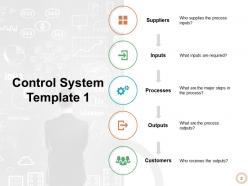
Slide 2: This slide contains the Control System Template- Suppliers, Inputs, Processes, Outputs, Customers.
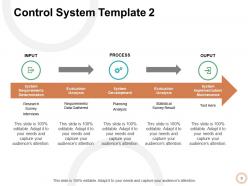
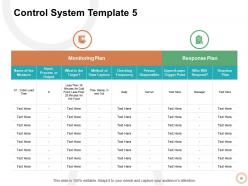
Slide 3: This slide contains the Control System Template.
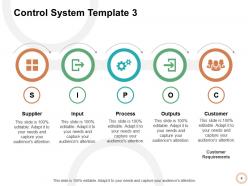
Slide 4: This slide contains the Control System Template.
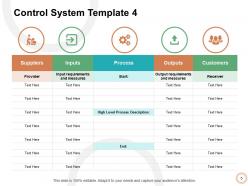
Slide 5: This slide contains the Control System Template.
Slide 6: This slide also contains the Control System Template.
Slide 7: This Template contains the Control System Icons Slide.
Slide 8: This slide is titled as Additional Slides for moving forward.
Slide 9: This slide comprises an editable Stacked chart showing the MARKET SHARE of products.
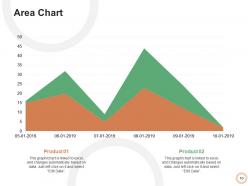
Slide 10: This slide comprises an editable Area chart showing the MARKET SHARE of products.
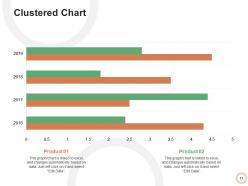
Slide 11: This slide comprises an editable Clustered chart showing the MARKET SHARE of products.
Slide 12: This slide reveals the Financial information.
Slide 13: This slide reveals the Magnifying Glass.
Slide 14: This slide reveals Our Goals.
Slide 15: This slide reveals Venn diagrams.
Slide 16: This slide reveals a Puzzle.
Slide 17: This is a Thank You slide consisting of Address, Contact numbers and email Address.
Control System Powerpoint Presentation Slides with all 17 slides:
Our Control System Powerpoint Presentation Slides can be your hallmark. Customers have faith in their guarantee.







FAQs for Control System
Control systems comprise sensors, controllers, actuators, and feedback loops that work together to maintain desired performance parameters. These components interact by continuously monitoring system outputs, comparing them against setpoints, and making real-time adjustments, with industries like manufacturing, aerospace, and automotive finding that this integrated approach delivers enhanced precision, operational efficiency, and automated responsiveness.
Feedback maintains system stability by continuously monitoring output performance, comparing it against desired setpoints, and automatically adjusting input parameters to correct deviations. Through negative feedback loops, control systems in manufacturing plants, HVAC installations, and process automation can minimize oscillations, reduce steady-state errors, and enhance operational reliability, ultimately delivering consistent performance and preventing costly system failures.
Open-loop control systems operate without feedback, executing predetermined commands based on input signals, while closed-loop systems continuously monitor output and adjust operations through feedback mechanisms. Closed-loop systems deliver greater accuracy and adaptability, with manufacturing processes, HVAC systems, and automated production lines finding that feedback-driven control ultimately enhances operational efficiency and maintains consistent performance standards.
Digital control systems enhance traditional analog systems by delivering superior precision, programmable flexibility, advanced data processing capabilities, and seamless integration with modern networks. These systems enable manufacturers and process industries to achieve faster response times, reduce maintenance costs, and implement predictive analytics, while organizations across sectors like automotive and pharmaceuticals find significantly improved quality control and operational efficiency.
PID controllers function by continuously calculating error values between desired setpoints and actual process variables, then applying proportional, integral, and derivative corrections to minimize deviations. These systems enhance industrial automation across manufacturing, chemical processing, and robotics by maintaining precise temperature control, pressure regulation, and motor speed management, ultimately delivering consistent product quality and operational efficiency.
Robust control system design challenges include parameter uncertainties, external disturbances, modeling errors, sensor noise, and time-varying dynamics in unpredictable environments. These complexities require advanced techniques like adaptive control and robust optimization, with industries such as aerospace and automotive manufacturing finding that strategic uncertainty management ultimately delivers enhanced system reliability, improved performance consistency, and significant competitive advantage.
State-space methods represent systems using internal state variables and matrix equations, while traditional transfer function approaches use input-output relationships in the frequency domain. State-space methods enable multi-input, multi-output system analysis, handle time-varying parameters, and provide deeper insights into system behavior, with many aerospace and automotive engineers finding that this approach delivers enhanced control precision and system optimization capabilities.
The Nyquist stability criterion determines closed-loop system stability by analyzing open-loop frequency response, enabling engineers to assess stability margins without solving characteristic equations directly. Through graphical analysis of complex plane plots, control engineers can evaluate gain and phase margins, predict oscillatory behavior, and optimize controller parameters, ultimately delivering robust system performance and preventing instability in critical applications like aerospace and manufacturing automation.
Modern machine learning techniques integrate into control system design through adaptive algorithms, predictive modeling, neural network controllers, reinforcement learning optimization, and real-time pattern recognition capabilities. These approaches enable manufacturing plants, autonomous vehicles, and smart grid systems to automatically adjust parameters, predict system failures, and optimize performance dynamically, ultimately delivering enhanced precision, reduced downtime, and significantly improved operational efficiency.
System modeling serves as the foundation for control system simulation and testing by creating mathematical representations that predict system behavior, validate design choices, and identify potential issues before physical implementation. Through detailed models, engineers can simulate various operating conditions, test controller performance across different scenarios, and optimize parameters without costly physical prototypes, with industries like aerospace, automotive, and manufacturing finding that robust modeling significantly reduces development time, minimizes risks, and ultimately delivers more reliable control systems.
Control systems in automotive engineering enhance vehicle performance through engine management systems, anti-lock braking systems, electronic stability control, adaptive cruise control, and transmission control modules. These technologies optimize fuel efficiency, improve safety, and deliver smoother driving experiences by automatically adjusting engine parameters, braking force, and suspension settings, with many manufacturers finding that integrated control systems ultimately provide competitive advantages in performance and reliability.
Nonlinear control systems require specialized analysis techniques like phase plane analysis, describing functions, and Lyapunov stability theory, while linear systems utilize simpler superposition principles and frequency domain methods. These advanced approaches enable engineers in aerospace, robotics, and chemical processing to handle complex dynamics, variable operating points, and saturation effects, ultimately delivering more robust performance and enhanced operational stability across diverse industrial applications.
Time delays in control systems create stability challenges, oscillations, reduced performance margins, and potential system instability, particularly affecting real-time applications in manufacturing and process control. These delays can be mitigated through predictive control algorithms, delay compensation techniques, and advanced filtering methods, with many industrial facilities finding that strategic implementation ultimately delivers enhanced system responsiveness and operational reliability.
Networked control systems enhance industrial efficiency by enabling real-time monitoring, predictive maintenance, centralized control, and rapid response to operational changes. Through integrated sensors and communication networks, manufacturing plants, power grids, and chemical facilities streamline resource allocation, minimize downtime, and optimize production schedules, ultimately delivering reduced operational costs and improved process reliability.
Key trends include AI-powered adaptive control, edge computing integration, collaborative robotics platforms, predictive maintenance systems, and digital twin technologies. These innovations enhance robotics by enabling real-time decision-making, seamless human-robot collaboration, and autonomous optimization, with manufacturing and logistics sectors finding that intelligent control systems deliver significantly improved efficiency, reduced downtime, and enhanced operational flexibility.
No Reviews