


Cybersecurity Risk And Incident Management Dashboard




Try Before you Buy Download Free Sample Product
 Impress Your
 Audience
 100%
100% Editable
 Save Hours
 of Time


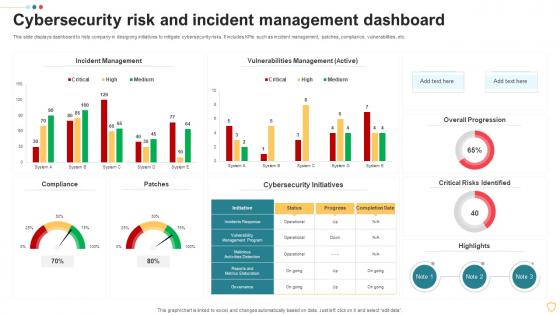
This slide displays dashboard to help company in designing initiatives to mitigate cybersecurity risks. It includes KPIs such as incident management, patches, compliance, vulnerabilities, etc.
People who downloaded this PowerPoint presentation also viewed the following :
Cybersecurity Risk And Incident Management Dashboard with all 7 slides:
Use our Cybersecurity Risk And Incident Management Dashboard to effectively help you save your valuable time. They are readymade to fit into any presentation structure.





FAQs for Cybersecurity Risk And
A cybersecurity dashboard should display threat detection rates, incident response times, vulnerability assessments, network traffic anomalies, and compliance status metrics. These indicators enable security teams to identify emerging threats, streamline response protocols, and maintain regulatory compliance, with many organizations finding that comprehensive visibility ultimately delivers faster threat mitigation and enhanced operational security.
Visualizations enhance cybersecurity data understanding by transforming complex threat patterns, network traffic flows, and vulnerability assessments into intuitive charts, heat maps, and real-time dashboards. Through interactive graphics and color-coded alerts, security teams can quickly identify anomalies, track incident progression, and prioritize responses, ultimately enabling faster threat detection and more strategic resource allocation across enterprise networks.
Essential cybersecurity dashboard components include real-time threat monitoring, vulnerability assessments, incident response tracking, compliance status indicators, and network traffic analysis. These elements work together by providing comprehensive visibility into security posture, enabling faster threat detection and response, while helping organizations maintain regulatory compliance and ultimately delivering enhanced protection against evolving cyber threats.
Real-time alerts from cybersecurity dashboards dramatically reduce incident response times by providing instant threat notifications, automated escalation protocols, and immediate access to contextual threat data. Through centralized monitoring systems, security teams can detect anomalies within minutes rather than hours, prioritize threats by severity levels, and coordinate response efforts seamlessly, ultimately minimizing potential damage and system downtime.
User access and permissions serve as critical security layers in cybersecurity dashboards, controlling who can view sensitive threat data, modify security configurations, implement incident responses, and access compliance reports. Through role-based access controls, organizations ensure that security analysts, IT administrators, and executives receive appropriate dashboard privileges while maintaining data integrity, preventing unauthorized modifications, and enabling effective threat management across different organizational levels.
A cybersecurity dashboard facilitates regulatory compliance by providing real-time monitoring of data access, automated audit trails, breach detection alerts, and comprehensive reporting capabilities that align with GDPR and HIPAA requirements. These dashboards streamline compliance workflows by centralizing security metrics, enabling rapid incident response, and generating detailed documentation for regulatory audits, ultimately delivering enhanced data protection and reduced compliance risks.
Common pitfalls include information overload, poor visual hierarchy, lack of real-time data integration, insufficient role-based customization, and unclear threat prioritization metrics. These design challenges can overwhelm security teams with irrelevant alerts, delay incident response times, and reduce operational efficiency, with many organizations finding that streamlined, context-aware dashboards significantly enhance threat detection and decision-making capabilities.
Machine learning integrates into cybersecurity dashboards through anomaly detection algorithms, behavioral analytics, threat pattern recognition, and predictive modeling capabilities that analyze network traffic in real-time. These AI-driven systems enable security teams to identify potential breaches before they occur, automatically prioritize threats based on risk levels, and reduce false positives, ultimately delivering faster incident response and enhanced organizational security posture.
Effective cybersecurity dashboards incorporate heat maps for threat intensity visualization, real-time line graphs for monitoring attack patterns, geographic maps for location-based threats, gauge charts for risk metrics, and network topology diagrams for infrastructure monitoring. These visual elements enhance operational efficiency by enabling rapid threat identification, streamlining incident response workflows, and delivering comprehensive situational awareness, with many organizations finding that strategic dashboard design ultimately accelerates security decision-making and minimizes response times.
Cybersecurity dashboards can be customized through role-based access controls, personalized metrics displays, adjustable alert thresholds, and stakeholder-specific visualizations that prioritize relevant data for each user's responsibilities. IT administrators might focus on threat detection metrics, while executives view high-level risk assessments and compliance status, ultimately enabling more targeted decision-making and faster incident response across organizational levels.
Incident trend analysis on cybersecurity dashboards enables organizations to identify patterns, predict potential threats, and allocate security resources more strategically by analyzing attack frequencies, types, and timing. Through this analytical approach, security teams can proactively strengthen vulnerable systems, reduce response times, and enhance overall security posture, with many enterprises finding that trend-based insights ultimately deliver competitive advantage through improved threat prevention.
Cybersecurity dashboards support proactive security strategies by providing real-time threat intelligence, predictive analytics, and comprehensive risk assessments that enable early threat detection and prevention. These platforms streamline security operations by centralizing vulnerability management, automating incident response workflows, and delivering actionable insights, with many organizations finding that enhanced visibility ultimately reduces response times and strengthens overall security posture.
Cybersecurity dashboards enable executives to visualize threat landscapes, compliance status, incident trends, and risk metrics through intuitive graphics and real-time data feeds. By translating complex technical vulnerabilities into business impact assessments, these tools help leadership understand financial exposure, regulatory implications, and operational risks, ultimately facilitating informed decision-making around security investments and strategic resource allocation.
**INPUT**: What are best practices for ensuring data integrity and accuracy on a cybersecurity dashboard? **OUTPUT**: Best practices include implementing real-time data validation, establishing automated verification protocols, maintaining consistent data sources, conducting regular accuracy audits, and deploying multi-layered authentication systems. These approaches streamline threat detection by minimizing false positives, enhancing incident response capabilities, and ensuring reliable security metrics, with many organizations finding that validated dashboards ultimately deliver faster threat resolution and improved operational confidence. **Word count: 60 words**
Organizations can measure cybersecurity dashboard effectiveness through incident response time reduction, threat detection accuracy rates, security team productivity metrics, and stakeholder engagement levels. By tracking these performance indicators alongside user feedback and system utilization data, companies can optimize their dashboards for better security outcomes, ultimately delivering enhanced organizational resilience and more efficient threat management capabilities.
-
Professional and unique presentations.
-
Thank you for showering me with discounts every time I was reluctant to make the purchase.