


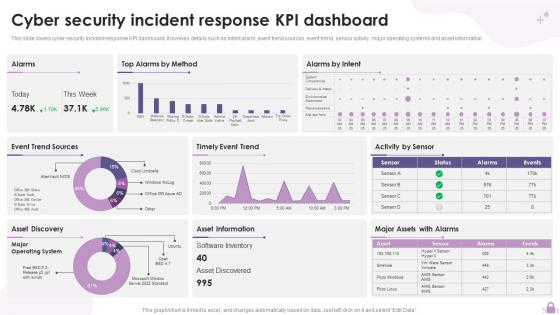
Cyber Security Incident Response KPI Dashboard




Try Before you Buy Download Free Sample Product
 Impress Your
 Audience
 100%
100% Editable
 Save Hours
 of Time


This slide covers cyber security incident response KPI dashboard. It involves details such as intent alarm, event trend sources, event trend, sensor activity, major operating systems and asset information.
People who downloaded this PowerPoint presentation also viewed the following :
Cyber Security Incident Response KPI Dashboard with all 7 slides:
Use our Cyber Security Incident Response KPI Dashboard to effectively help you save your valuable time. They are readymade to fit into any presentation structure.





FAQs for Cyber Security Incident
Focus on MTTD and MTTR first - how fast you spot threats and kill them. Those two alone tell you tons about your security posture. Then add vulnerability fix rates, training completion stats, and incident trends if you want the full picture. Honestly, most companies overthink this stuff. Pick 2-3 metrics that actually match your biggest risks instead of tracking everything under the sun. Set realistic baselines (perfect scores don't exist anyway) and just watch for improvement over time. Way better than drowning in dashboards nobody looks at.
So basically, just match your KPIs to whatever compliance stuff you're dealing with - HIPAA, SOX, PCI, you know the drill. Figure out what security controls they actually require first. Then build your metrics around those specific things. Healthcare folks should track PHI breach response times, encryption rates, that kind of stuff. Financial companies? More like transaction monitoring and fraud detection metrics. Honestly the regulators pretty much spell out what they want you to measure if you dig into the requirements. Just make sure every KPI you're tracking can back up your audit reports later - trust me on that one.
Oh man, user training KPIs are seriously underrated but they're the backbone of everything security-wise. Track your phishing sim click rates and training completion percentages first. Monthly works best. Most data breaches happen because someone clicks the wrong thing anyway, so when your people get better at spotting threats, everything else improves too. Honestly, I've seen places where phishing test results drop like crazy once people actually do the training. Also watch how often people report sketchy emails - that's huge. Better trained users = fewer incidents across the board.
Quarterly reviews are the bare minimum, but honestly? Most places I know are switching to monthly because threats move crazy fast now. Your metrics from six months ago might be completely useless today - new regulations, different attack vectors, whatever. I'd do a quick monthly pulse check to see if your numbers still make sense, then go deeper every quarter to actually swap out the dead weight KPIs. The thing is, it's super easy to procrastinate on this stuff until you realize you're tracking yesterday's problems. Set that reminder now or you'll forget.
Dude, incident response time is absolutely critical - like, it literally makes or breaks your cybersecurity game. The quicker you catch and respond to threats, the less they'll wreck your systems. I'm telling you, breaches can spiral insanely fast. You'll want to track MTTD (mean time to detection) and MTTR (mean time to response) as your main KPIs. They directly tie to damage control and keeping recovery costs down. Measure from that first alert all the way to containment. Oh, and set realistic baseline targets your team can actually hit and build on - no point setting impossible goals that'll just demoralize everyone.
So basically track your security costs against what you're saving from avoided incidents. Look at stuff like how much downtime you're preventing, response costs, compliance audit scores. The weird part? You're trying to measure things that didn't happen, which is honestly kind of a headache. I usually tell people to use industry breach cost averages as your baseline - gives you something concrete to work with. Track detection times and false positive rates too. Start with what incidents currently cost you, then see how your security spending chips away at those numbers over time. The math isn't always clean but it works.
Look for weird login patterns first - like someone accessing stuff at 3am when they're usually a 9-to-5er. Failed login attempts are obvious red flags. Track data downloads too, especially if Bob from accounting suddenly needs the entire customer database. Email forwarding rules changes are sneaky but super telling. Setting baselines is honestly the hardest part since everyone's got different work habits. USB activity matters if you allow those things (we don't, thankfully). Don't try to monitor everything at once though. Pick maybe 3-4 things that match your biggest vulnerabilities and expand from there.
So you'll want to focus on detection rate first - basically how many real threats you're actually catching. False positives are huge too because chasing fake alerts will drive you insane. Mean time to detection matters - how fast do you spot the bad stuff once it's in your network? Oh, and dwell time is critical. That's how long threats just sit there undetected. Under 24 hours is ideal but honestly most places struggle with that. Dashboard all this stuff so you can see patterns and tweak your rules when needed.
So you wanna track vulns found vs fixed? Smart move. Here's the thing - if you're finding 100 new ones monthly but only patching 60, that gap keeps growing and becomes a real headache down the road. Think of it like dishes piling up in the sink (ugh, hate when that happens). The ratio tells you if your team's drowning or keeping pace. Plus it's gold when you need to argue for more staff or resources. Set up a simple monthly comparison and watch for those gaps getting wider - that's your red flag right there.
Check out NIST, ISO 27001, or CIS Controls first - they've got decent baseline metrics you can work with. Industry reports are super helpful too. Verizon's DBIR and IBM's security studies have tons of comparative data. But honestly? The best intel comes from actually talking to other security folks through ISACA or (ISC)² groups. That's where people share what they're really measuring, not just what looks good on paper. Pick maybe 3-5 KPIs that actually matter to your business first. Don't go crazy trying to benchmark everything - you'll just overwhelm yourself. Focus on the stuff that'll move the needle on real security outcomes.
Track your vendor risk scores and how fast they fix audit findings - that response time is everything, honestly. Also watch what percentage of third parties actually complete your security questionnaires (spoiler: it's never 100%). Monitor any incidents that come from vendor systems and check contract compliance rates for security stuff. Certifications like SOC 2 or ISO 27001 are worth tracking too. Set up a monthly dashboard so you're not panicking when audit season hits. Trust me, having this data ready makes those conversations way smoother.
Definitely run simulated phishing tests before and after training - that's your bread and butter metric. Click rates should drop over time if it's working. But here's the thing, you also want to watch reported suspicious emails go UP initially (sounds backwards but it means people are actually paying attention). Password resets and malware infections are good to track too. Obviously completion rates and quiz scores matter, but the real behavior changes are what count. Oh and set up some kind of monthly dashboard thing so you can show your boss actual numbers - they love that stuff. Quarter-over-quarter comparisons work great.
Dude, you absolutely need automated tools for cybersecurity KPIs. Manual tracking is a nightmare - way too much data flying around constantly. These tools monitor your network 24/7 and pull all those security metrics into dashboards that don't look like gibberish. Trust me, counting incident response times or vulnerability patches by hand? That's like... well, counting raindrops in a thunderstorm. You'll miss half of it and probably mess up the other half. Just make sure whatever you pick plays nice with your current security setup. Oh, and the real-time visibility thing is clutch for making quick decisions when stuff hits the fan.
So you know how security teams always complain nobody cares about their work? KPIs totally fix that. Start measuring stuff like how many people click phishing emails or how fast you respond to incidents - suddenly everyone pays attention. Teams actually get competitive about it (which is hilarious but works). Training completion rates, patch times, whatever connects to real business impact. Skip the super technical metrics though - executives just tune out. The whole point is showing that security isn't just some IT black hole where money disappears. People finally see it matters.
Look, good cybersecurity KPIs are like having a dashboard for your security health. You can catch problems early instead of scrambling when everything's on fire. When budget meetings come up, you've got actual numbers to show what's working and what isn't - way better than just crossing your fingers. Industry benchmarks help too, especially during those dreaded compliance audits. The cool part is shifting from always reacting to actually planning ahead. Trust me, six months from now you'll be glad you can point to real data about risk reduction instead of just hoping your stuff works.
-
Easy to use and customize templates. Helped me give a last minute presentation.
-
You know what? I'm so glad I opted for this PPT design. It has been a total game-changer for me and my presentations. Thank you!