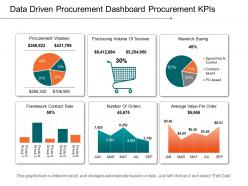
Data driven procurement dashboard snapshot procurement kpis example of ppt
Try Before you Buy Download Free Sample Product
Audience
Editable
of Time
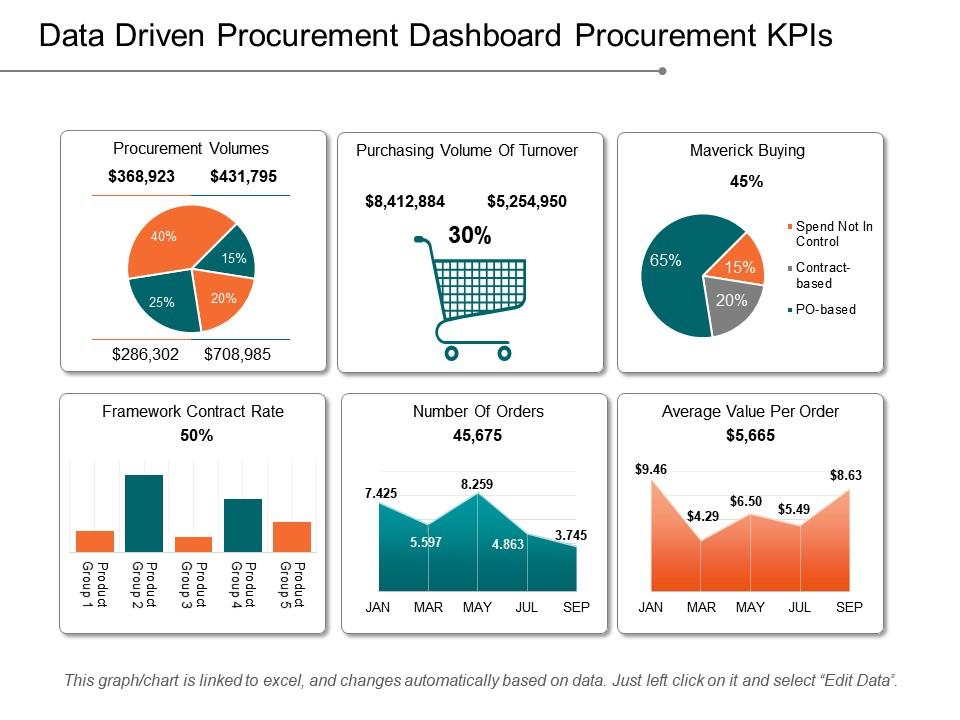
Share your business data in the most professional way with our data driven procurement dashboard snapshot procurement Kpis example PPT design. Our dedicated designing team has made this brilliant procurement dashboard PowerPoint visual possible. Representing the data can sometimes be problematic as you need to ensure that all the numbers are shown in the correct way. If the data is not showing in the right format then you may not be able to make your team understand as where you are and what all needs to be done to achieve your targets. Our six staged procurement dashboard presentation template enables you to share your data in the most efficient manner. This readymade looking presentation design can be part of your Kpis presentation and you can highlight all your numerical data using this PPT slide. All you have to do is just insert data and share it whenever required. The dashboard PPT slideshow can also be useful for highlighting your product procurement features. So, create the procurement and Kpis process for your procurement activities and then work towards completing it. Stir your ideas in the cauldron of our Data Driven Procurement Dashboard Procurement Kpis Example Of Ppt. Cast a magic spell on your audience.
People who downloaded this PowerPoint presentation also viewed the following :
Data driven procurement dashboard snapshot procurement kpis example of ppt with all 5 slides:
Establish guidelines for the job with our Data Driven Procurement Dashboard snapshot Procurement Kpis Example Of Ppt. Encourage adherence to instructions.
FAQs for Data driven procurement dashboard snapshot procurement kpis
Honestly, start with cost savings - both the obvious stuff and soft savings. Track supplier performance too, like delivery times and quality scores. Contract compliance is where companies bleed money without realizing it, so definitely watch that one. Oh, and cycle times from when someone requests something to actually cutting the PO - that metric will expose bottlenecks fast. Supplier diversity matters if your company cares about that. But don't go crazy tracking everything day one. Pick maybe 3-4 that match your biggest headaches right now and build from there.
So basically, set up dashboards tracking your main supplier metrics - delivery times, quality scores, cost changes, stuff like that. Way better than waiting for quarterly reviews to realize someone's been screwing up for months. I'd focus on maybe 3-5 key metrics first, don't go crazy trying to track everything. The cool part is setting alerts when things dip below your standards. You'll catch patterns early, like quality dropping or late deliveries becoming a habit. Honestly once you see the data laid out it's pretty obvious which suppliers are reliable and which ones... aren't.
So predictive analytics is like having a crystal ball for your procurement KPIs. It digs through your old data to spot trends and warn you about future problems - supplier delays, crazy cost swings, demand surges, whatever. Way better than scrambling after your metrics already went to hell. My old boss swore by this stuff. You'll catch issues weeks or months early instead of finding out your cost savings are toast when it's too late. I'd start with your messiest KPIs first and get your data people to build some forecasting models around those.
Track your acquisition costs and supplier performance scores first - that's the easy stuff. Then dig into maintenance, support, and disposal expenses. Training costs always get forgotten, plus downtime fees and compliance stuff will destroy your budget if you're not careful. I learned this the hard way on my last project. Contract compliance rates matter too since unreliable suppliers = higher total costs. Build a dashboard covering purchase costs AND operational expenses across the whole lifecycle. Honestly, just start with your biggest cost drivers and expand from there.
Set up dashboards that pull your procurement data automatically - line charts for cost savings, heat maps for supplier stuff, trend arrows for cycle times. Tableau and Power BI are solid options, though honestly a good Excel dashboard can work wonders if that's all you've got. Real-time updates are key so you catch problems early. I'd set alerts when your KPIs hit certain levels. Share everything with stakeholders to keep everyone on the same page about performance trends. Google Data Studio's decent too if you want something free.
Focus on four key areas: spend data (total costs, supplier breakdowns), supplier performance (delivery times, quality scores), process efficiency (cycle times, approval flows), and cost savings you've actually captured. Getting clean data from your ERP is honestly such a pain - way messier than anyone warns you about. But it's worth the headache because once that data flows consistently, you can finally tell if your procurement moves are working. My advice? Start with whatever data you can grab easily right now, then slowly add more. Don't try to boil the ocean on day one.
So KPI benchmarking is basically your reality check - shows you how your procurement stacks up against everyone else in your industry. Maybe your contract cycles are dragging on forever while competitors wrap theirs up in half the time. Or your cost savings look pretty weak compared to the average. It's honestly like getting a report card that tells you exactly what needs work. The cool part? You can steal winning strategies from other industries and make them work for you. I'd start with just 3-5 KPIs that matter most and hunt down solid benchmark data for your sector.
Map your procurement KPIs straight to what your company actually cares about - cost cuts, supplier consolidation, whatever the priority is. Get finance, ops, and leadership involved when you're setting these up so nobody's confused later. Don't fall into the vanity metrics trap! I've watched teams obsess over numbers that look impressive but mean nothing for the business. Skip measuring activities and focus on real outcomes instead. Like, track how supplier performance affects production, not just how fast contracts get signed. Oh and do quarterly reviews - helps you adjust when priorities inevitably shift.
Oh man, seasonal stuff will mess with your procurement numbers so badly. I'd pull like 2-3 years of old data to see what's actually normal for each season - holidays always kill lead times, demand spikes jack up prices, you know the drill. Rolling 12-month averages work way better than raw numbers. We learned this after getting roasted in Q4 meetings when everything looked awful but was totally expected. Set your alerts based on seasonal variance instead of hard thresholds. Honestly saves you from so many pointless "performance dropped" conversations where you're just explaining winter exists.
Honestly, the data mess is your biggest headache. Everything's scattered across different systems and half of it's wrong or old. Getting people to actually use the dashboard? Good luck with that - procurement folks hate changing how they work. Oh, and don't fall into the trap of tracking metrics just because they're easy to pull. Focus on what actually moves the needle. Start simple though. Pick one or two KPIs, fix the data behind them first, then show some quick wins to get everyone excited about it.
OK so first thing - get your data validation locked down. Automate checks for dumb stuff like negative savings or orders that blow past budgets. Define what each KPI actually means too, because I swear every team I've worked with has their own version of "cost savings" and it's chaos. You'll want someone owning each data source so there's actual accountability. Regular audits help catch weird stuff early. Oh and document any manual fixes you make - future you will thank you. Cross-check between systems when possible since your reports are basically worthless if the underlying data is garbage.
Honestly, SAP Ariba or Coupa are probably your best bet - they're made for procurement and come with solid dashboards already built in. Procurify's another good one. If you're trying to save money though, Power BI or Tableau work fine, just more of a pain to set up. Oracle and NetSuite have decent options too if you're already using them for other stuff. The real trick is finding something that plays nice with whatever systems you've got now. Your IT people will thank you for that. Figure out which metrics actually matter first, then go from there. Way easier than picking a fancy tool that tracks stuff you don't even care about.
You know what's crazy? Your procurement KPIs are basically useless if you don't get buy-in from the other teams. Finance cares about cost savings while operations just wants suppliers who actually show up on time - if you're only tracking one, you're missing the point. I learned this the hard way at my last job. Regular check-ins with stakeholders help you figure out which metrics actually move the needle. Honestly, quarterly reviews work best. Gets everyone on the same page and you'll stop wasting time on vanity metrics that look impressive but don't change anything.
Honestly, AI and machine learning are total game-changers for this stuff. You can predict supplier risks, optimize spending, and track KPIs automatically. Blockchain's getting pretty solid for supply chain transparency too. RPA will save your sanity - no more manually pulling data from like 10 different systems. Advanced analytics platforms spot patterns you'd never catch yourself (or would take forever finding). My advice? Start small though. Pick whatever tech fixes your biggest KPI headache first and test it out. Don't go crazy with everything at once - learned that one the hard way.
Pick 2-3 KPIs that actually matter for each project - measuring everything just creates chaos, honestly. Start by recording your baseline numbers before you change anything. Say you're consolidating suppliers - track how it affects cost savings and performance scores each month. Set targets that aren't completely unrealistic (learned that one the hard way). Review quarterly to see if you're moving the needle. The whole point is making sure your improvement work translates into real business wins, not just busy work that looks good on paper.
-
Nice and innovative design.
-
Great quality slides in rapid time.