


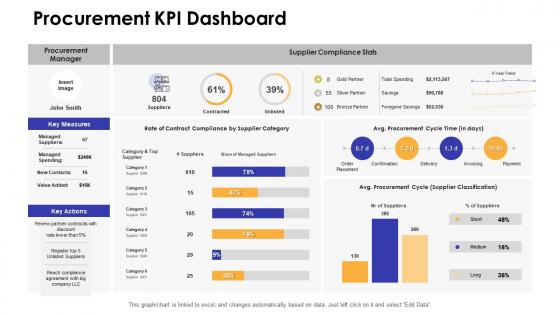
Procurement kpi dashboard dashboards by function




Try Before you Buy Download Free Sample Product
 Impress Your
 Audience
 100%
100% Editable
 Save Hours
 of Time


Our Procurement Kpi Dashboard Dashboards By Function are topically designed to provide an attractive backdrop to any subject. Use them to look like a presentation pro.
People who downloaded this PowerPoint presentation also viewed the following :
Procurement kpi dashboard dashboards by function with all 7 slides:
Use our Procurement Kpi Dashboard Dashboards By Function to effectively help you save your valuable time. They are readymade to fit into any presentation structure.






FAQs for Procurement kpi dashboard
Focus on these four metrics: cycle time (requisition to PO), cost savings percentage, supplier performance scores, and contract compliance rates. Cycle time's where you'll spot approval bottlenecks fast. Cost savings shows actual dollars saved against your baseline spend. For suppliers, track their quality, delivery times, and service - pretty straightforward stuff. Contract compliance matters way more than people think because rogue spending just destroys all those deals you worked hard to negotiate. Honestly, if you nail these four, you'll know whether procurement's helping or just slowing everyone down.
Honestly, just pick 4-5 metrics that actually move the needle for your business. Quality stuff like defect rates, delivery performance, costs, and how responsive they are when things go sideways. I've seen companies track like 20 KPIs and it's just noise at that point. Set up dashboards if you can swing it - saves so much time. Review quarterly with your main suppliers, but here's the thing: use these numbers to have real conversations about getting better together, not just to beat them up over performance. That's where you'll see actual improvement happen.
Yeah, most procurement teams live and die by cost savings - leadership loves seeing those numbers because it's money straight back to the company. Track both hard savings (actual dollars you can prove) and soft savings (avoided costs, efficiency stuff). Some teams get crazy obsessed with hitting percentage targets though, which honestly drives me nuts. You'll want to balance those cost metrics with quality and supplier performance too, or you'll end up with cheap garbage. Oh, and definitely nail down what actually "counts" as savings upfront - that conversation gets messy real quick if you don't.
Honestly, you've gotta figure out what your company actually gives a damn about first. Growth? Cutting costs? Happy customers? Once you know that, build your procurement metrics around those priorities. Cost reduction focus means tracking savings and spend optimization. Innovation-driven? Look at supplier diversity and how fast you're getting to market. I used to just measure the easy stuff - total waste of time. The real trick is chatting with leadership regularly so your numbers actually matter to them. Otherwise you're just creating pretty dashboards that nobody cares about.
Start with supplier risk scores - that's your base layer. Financial health matters, but don't sleep on geographic spread either (learned that one the hard way). Contract compliance rates tell you who's actually reliable. Track how often disruptions hit and recovery times. Honestly, the companies that bounce back fast are worth their weight in gold. Procurement lead time spikes? Red flag. Also measure what percentage of spend has backup suppliers - you'll thank yourself later. Audit completion rates and how fast they fix issues rounds it out nicely.
Honestly, tech just handles all that tedious manual tracking you're probably drowning in. Real-time data on spend, supplier performance, contract stuff - procurement software pulls it automatically instead of you spending hours on spreadsheets. The dashboards look pretty decent now too. AI catches things you'd totally miss, like suppliers who are always late or certain categories going over budget. I'd figure out which KPIs take forever to report on first, then find tools that automate those. Way better than doing it by hand every month.
Yeah, most procurement KPIs are pretty useless tbh. They only look backwards and obsess over cost savings - like purchase price variance or how many suppliers you have. But that stuff doesn't actually show if you're creating real value or making strategic impact. The worst part? They completely miss relationship quality with suppliers and innovation benefits. Those matter way more than people realize. Teams end up optimizing for metrics instead of what's actually good for the business. I'd throw in some forward-looking stuff around supplier collaboration and risk management. Way better picture of what's happening.
So quantitative KPIs are your easy wins - delivery rates, cost savings, cycle times. All that measurable stuff. Qualitative ones though? Way harder to pin down. We're talking supplier relationships, team satisfaction, how well departments actually work together. Pain in the ass to track consistently, but you can't ignore them. Surveys and feedback sessions help, rating scales too. Here's the thing - you need both. Numbers tell you what happened, but the touchy-feely metrics explain why it happened. Without that context, you're kind of flying blind on the actual health of your procurement process.
Dude, lead time tracking is absolutely critical for procurement. You're basically measuring how long it takes from ordering something to actually getting it in your hands. This stuff directly affects whether you can keep things running without breaking the bank. Shorter lead times are amazing - you don't need as much safety stock sitting around, you can pivot faster when demand shifts, and your carrying costs drop. Consistent timing also makes forecasting way less of a headache. Honestly, I'd start by tracking average lead times for each supplier and product category. You'll figure out pretty quick which vendors have their act together and which ones... well, don't.
Check out those CAPS Research reports - they're solid for procurement benchmarks. Deloitte and PwC do annual studies too with KPI breakdowns by industry. Your procurement software probably has benchmarking built in (actually pretty decent these days). Trade associations sometimes share data, though it can be hit or miss. Here's the thing - don't compare yourself to some massive global company if you're mid-size. Match revenue and complexity as close as possible. Oh, and once you spot the gaps? Pick maybe two KPIs to focus on first. I've seen teams try to fix everything and just burn out.
Start with supplier diversity percentage and carbon footprint reduction - those are your heavy hitters. Waste diversion rates matter too. Don't go crazy tracking everything at once though, you'll burn out your team. The sustainable sourcing ratio is clutch - what percent of your spend actually goes to suppliers hitting environmental and social standards. Getting good data from suppliers is honestly the hardest part, so bake those reporting requirements into contracts from day one. Pick metrics that make sense for your industry. Like, water usage tracking is huge for manufacturing but pretty useless if you're in tech.
Honestly, those stakeholder surveys are super important for figuring out your procurement KPIs. You can't just obsess over cost savings and think you're done - your internal customers actually care more about response times, quality, and whether you're easy to work with. I've watched procurement teams get perfect compliance scores while everyone's annoyed with their slow processes (kind of defeats the purpose, right?). The surveys show you which metrics actually matter and help set realistic targets. Run them yearly, then use that feedback to adjust how you weight your KPIs. Sometimes you'll need to add completely new ones based on what people tell you.
Yeah, procurement KPIs can totally help with supplier relationships if you do it smart. Don't just obsess over cost cuts - track stuff like how innovative they are, delivery consistency, relationship quality. Most suppliers actually love knowing exactly how you're measuring them, weirdly enough. Makes them feel less in the dark, you know? Being transparent is huge here. Share your top 2-3 metrics with key suppliers and get their take on what's realistic. Just don't make everything about price because that'll kill any chance of innovation real quick. You want partners, not just vendors fighting over pennies.
Quarterly reviews are your best bet for most procurement KPIs - that's what I'd stick with. Annual deep dives are where you actually question if you're tracking the right stuff in the first place. Monthly can work if your industry moves crazy fast, but honestly? I've watched teams burn themselves out obsessing over monthly metrics. Quarterly hits that sweet spot. Whatever schedule you pick, just be consistent about it. Your quarterly check-ins should focus on trends and tweaking targets. Oh, and set those calendar reminders right now - I'm serious, it won't happen otherwise. Trust me on this one.
Honestly, the biggest game-changer is just being super clear about what each KPI actually measures - sounds basic but so many people mess this up. Automate your data feeds when you can because manual entry is where errors creep in. I'd also sync up with finance quarterly to catch weird discrepancies before they become problems. Make sure everyone's pulling from the same system too, otherwise you'll have five different versions of "the truth." Oh, and document how you calculate stuff! Trust me, you'll forget your own methods and someone will definitely question your numbers later. Single source of truth is key.
-
Excellent Designs.
-
Enough space for editing and adding your own content.
-
The Designed Graphic are very professional and classic.
-
Great product with highly impressive and engaging designs.