


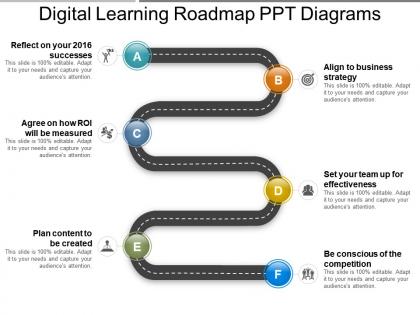
Digital learning roadmap ppt diagrams





Try Before you Buy Download Free Sample Product
 Impress Your
 Audience
 100%
100% Editable
 Save Hours
 of Time


Adopt a circumspect approach with our Digital Learning Roadmap Ppt Diagrams. Act after careful consideration.
People who downloaded this PowerPoint presentation also viewed the following :
Digital learning roadmap ppt diagrams with all 5 slides:
Ensure directions are comprehensively conveyed with our Digital Learning Roadmap Ppt Diagrams. Be able to give clear instructions.
FAQs for Digital learning
You'll need learning objectives first - figure out where your people are skill-wise before anything else. Content delivery strategy comes next, plus the tech setup (seriously, don't cheap out on infrastructure like everyone does). Assessment methods are crucial too. Build in engagement stuff and ways to track progress. Oh, and feedback loops - people need to know how they're doing. Timeline milestones help keep things moving, and you've gotta plan for when stuff breaks or someone needs extra help. Resource allocation sounds boring but it matters. Map out those current skill levels first though - saves you tons of headaches later.
So first thing - audit what you've got now. Check your tech, content library, engagement numbers, and team skills. Survey everyone too, not just leadership, because they're usually totally out of touch with reality. Your LMS data will show you where people are actually dropping off vs where they think they are. Don't forget the unsexy stuff like compliance and data policies (learned that one the hard way). Budget and infrastructure matter more than anyone wants to admit. Once you know your actual weak spots, you can fix those instead of buying whatever flashy new platform just launched.
Think of learner feedback as your reality check - it'll show you what's actually working versus what you think is working. Collect it through surveys, completion rates, casual conversations, whatever works. Some of my favorite "aha moments" happened when someone wrote "this makes zero sense" on a feedback form. Sounds harsh but it's gold. The trick isn't just gathering all this info though - you've gotta actually use it to tweak your content and approach. Set up those feedback loops and don't be afraid to change direction when learners tell you something isn't clicking.
Honestly, tech can completely change how your learning programs work. AI adapts stuff to different learning styles, which is pretty cool. VR and AR create those immersive experiences everyone talks about. Real-time analytics help you track who's actually making progress. Gamification works surprisingly well - badges, leaderboards, all that. People get weirdly competitive even during training! Mobile learning lets your team study whenever, wherever. Collaborative tools are great for peer learning too. My advice? Figure out your biggest learning headaches first. Then grab one or two tech solutions that'll actually fix those specific problems. Don't overthink it.
Mix up your content formats - videos, podcasts, interactive stuff. Don't just throw everything into boring text modules like most people do (seriously, who has time to read walls of text?). Give people choices in how they absorb the material. Discussion forums work great for people who learn by talking things out. Self-paced options are clutch for independent learners. Map each learning goal to 2-3 different formats minimum. I'd start by looking at what you have now and figuring out where you're missing variety.
Honestly, you gotta track both sides of this. Completion rates and time spent are cool, but they're pretty meaningless if nobody's actually getting better at their job. The real stuff to watch? Skill improvements through assessments and how people perform afterward. I'd also look at things like faster onboarding or fewer mistakes - that's where you see actual ROI. Don't go crazy measuring everything though. Pick 3-4 metrics that actually matter to your business goals and stick with those. Oh, and definitely grab user feedback scores too since people will tell you straight up if the training sucks.
Honestly, budget's gonna be your first nightmare. Leadership thinks they can just buy a platform once and call it done - wrong. Getting ongoing investment is brutal. Employee pushback is real too because people hate change, especially when it comes to learning new systems. ROI measurement? Good luck with that in year one. Results take forever to show up clearly. The tech moves so fast you'll feel like you're always playing catch-up. Plus finding content that actually engages people instead of being another boring compliance thing to click through. My advice? Start with small pilots first. Prove it works before going big.
Honestly, you've gotta tie your learning stuff directly to what your company's actually trying to accomplish over the next few years. Figure out those big strategic goals first. Then build training around the exact skills people need to hit those targets. Innovation push? Focus on creative problem-solving and tech training. Going for operational excellence instead? Hit them with process improvement courses. I see so many places just dump random training on employees and wonder why nothing changes - don't be that company! Track everything back to real business results so you can show it's actually working.
Canvas or Moodle are solid starting points for your main platform. Kahoot's been a game-changer for me - kids actually get excited about quizzes, which is wild. Mentimeter works great too for polls and stuff. Oh, and Loom is perfect for quick screen recordings when you need to explain something tricky. I'd throw in Padlet for group projects since it's super intuitive. Maybe add Slack if you want that community vibe going. Here's the thing though - stick to like 3 or 4 tools max. I made the mistake of trying everything at once and it was chaos.
Honestly, the biggest thing is making communication ridiculously easy for people. Regular virtual check-ins help a ton. Slack or Teams work great for ongoing chats, plus you'll want shared digital spaces where everyone can actually work together on stuff. I've watched so many online programs completely bomb because people just felt alone! Breakout rooms are clutch for peer learning. Discussion forums too. The trick is making it feel natural rather than like... forced corporate team building, you know? Map out where collaboration actually makes sense first, then pick tools that won't make people want to hide.
Okay so definitely try microlearning - those 3-5 minute chunks work great when people are swamped. Interactive simulations are solid for soft skills stuff, way better than just talking at people. Gamification can be hit or miss though - badges motivate some folks but others think it's corny. Audio content is surprisingly popular now since people can listen during commutes. Oh and peer learning platforms are having a moment. Live virtual sessions still work well too. Honestly I'd just ask your learners what they actually want first - saves you from building something nobody uses.
Don't try to slap accessibility on afterward - build it in from the start. Captions on every video, make sure screen readers work, offer content in different formats. Here's the thing though - those formal accessibility audits? They miss half the actual problems. Get real users with disabilities to test your stuff instead. Oh, and don't forget about crappy internet connections and older devices. Not everyone's got fiber and the newest laptop. The best move is setting up regular check-ins with different types of learners. They'll straight up tell you what's broken.
Look, CPD is what keeps you from becoming obsolete in this field. New tools pop up constantly - honestly, stuff from five years ago looks prehistoric now. You can't just wing it anymore. Block out actual time in your roadmap for learning new instructional design software, analytics, maybe some AI stuff. Don't make it an afterthought like most people do. Pick one skill you're weak at right now and dedicate time this month to fix it. Trust me, staying current isn't optional if you want to keep up.
Honestly, data analytics is a game-changer for figuring out what's actually working in your digital training programs. You'll see completion rates, engagement patterns, where people are dropping off - all the good stuff. What's really interesting is discovering that your sales team might love videos while ops folks prefer interactive stuff. Track knowledge retention too, because that's where you catch gaps before they turn into real problems. Oh, and you can spot patterns in how different groups learn best. My advice? Pick 2-3 metrics that matter to your business goals first. Don't try to measure everything right away - you'll just overwhelm yourself with data.
Honestly, mobile-first is where it's at since we're all glued to our phones anyway. AI personalization and microlearning are getting pretty solid now. VR/AR stuff is cool but still feels a bit gimmicky to me - though that'll probably change soon. Skills-based paths are replacing those boring traditional courses, which makes way more sense. Better analytics are finally showing if people actually remember what they learned instead of just completed modules. Oh, and social learning features are blowing up - collaborative spaces, peer sharing, all that. Just build flexibility into whatever you're planning so you can adapt when things shift.
-
Great product with effective design. Helped a lot in our corporate presentations. Easy to edit and stunning visuals.
-
The content is very helpful from business point of view.