


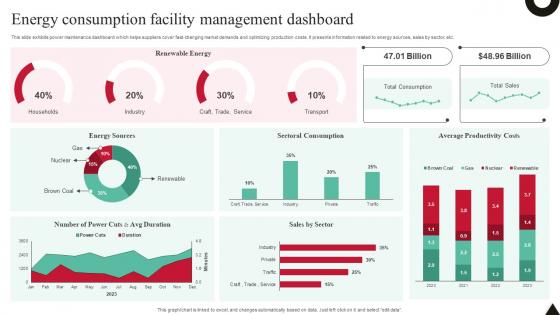
Energy Consumption Facility Management Dashboard




Try Before you Buy Download Free Sample Product
 Impress Your
 Audience
 100%
100% Editable
 Save Hours
 of Time


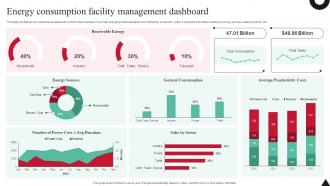
This slide exhibits power maintenance dashboard which helps suppliers cover fast changing market demands and optimizing production costs. It presents information related to energy sources, sales by sector, etc.
People who downloaded this PowerPoint presentation also viewed the following :
Energy Consumption Facility Management Dashboard with all 7 slides:
Use our Energy Consumption Facility Management Dashboard to effectively help you save your valuable time. They are readymade to fit into any presentation structure.





FAQs for Energy Consumption
Key energy dashboard metrics include real-time consumption rates, peak demand periods, energy costs by department, efficiency ratios, and carbon footprint measurements. These metrics enable organizations to identify usage patterns, optimize resource allocation, and reduce operational costs, with many manufacturing facilities and commercial buildings finding that comprehensive monitoring delivers 15-20% energy savings annually.
Real-time data integration enhances energy dashboard functionality by providing instant consumption monitoring, immediate anomaly detection, automated alerts for system irregularities, and dynamic performance optimization capabilities. Through continuous data streams, organizations can identify energy inefficiencies within minutes rather than days, enable predictive maintenance scheduling, and reduce operational costs by up to 20%, ultimately delivering competitive advantage in increasingly sustainability-focused markets.
Data visualization transforms complex energy consumption data into clear, actionable insights through charts, graphs, heat maps, trend analyses, and interactive dashboards that stakeholders can quickly interpret. These visual tools enable facility managers, executives, and operations teams to identify peak usage periods, spot inefficiencies, and communicate conservation strategies effectively, ultimately delivering faster decision-making and significant cost reductions across organizations.
Machine learning algorithms enhance energy dashboards by analyzing historical consumption patterns, identifying seasonal trends, and detecting anomalies in real-time usage data. These predictive models enable utilities and facilities managers to forecast demand spikes, optimize resource allocation, and prevent costly outages, with many energy companies finding that ML-driven predictions reduce operational costs while delivering more reliable services.
Essential components include real-time energy consumption monitors, demand forecasting analytics, cost tracking modules, equipment efficiency meters, and carbon footprint calculators. These integrated systems streamline operational oversight by identifying consumption patterns, predicting peak usage periods, and optimizing resource allocation, with manufacturing facilities and processing plants finding significant cost reductions and enhanced sustainability performance.
Energy dashboards support sustainability initiatives by providing real-time visibility into consumption patterns, identifying inefficiencies, and tracking progress toward environmental goals. Through automated monitoring and analytics, organizations across manufacturing, retail, and healthcare sectors can reduce energy waste, optimize resource allocation, and demonstrate measurable sustainability outcomes, ultimately delivering cost savings while enhancing their environmental stewardship and competitive positioning.
Effective energy dashboard UI principles include intuitive data visualization, real-time monitoring capabilities, customizable layouts, clear hierarchical information architecture, and responsive design for multiple devices. These design elements enhance user experience by streamlining energy data interpretation, enabling quick decision-making, and facilitating proactive energy management, with many utilities and facilities finding that well-designed interfaces significantly improve operational efficiency and cost reduction.
Mobile accessibility transforms energy dashboards into powerful on-the-go monitoring tools by enabling real-time alerts, remote system controls, and instant data visualization from any location. Through responsive design and intuitive interfaces, facility managers, technicians, and executives can track energy consumption patterns, respond to equipment failures, and make critical operational decisions while traveling, ultimately delivering faster response times and enhanced operational efficiency across distributed energy infrastructure.
Common challenges include data integration from disparate systems, ensuring real-time accuracy across multiple meters, managing complex user permissions, and training staff on dashboard interpretation. Large facilities often struggle with legacy equipment compatibility, network connectivity issues, and establishing consistent data standards, while balancing comprehensive monitoring needs with system performance, ultimately requiring strategic planning and phased implementation approaches.
Energy dashboards can be customized through role-based access controls, configurable KPIs, personalized visualizations, and stakeholder-specific reporting modules tailored to individual responsibilities and priorities. For facility managers, dashboards emphasize operational metrics and maintenance alerts, while executives access strategic cost analyses and sustainability targets, ultimately enabling faster decision-making and enhanced organizational alignment across energy management initiatives.
Energy benchmarking within energy dashboards enables organizations to compare their consumption against industry standards, historical performance, and peer facilities, establishing baseline metrics for improvement. Through comparative analytics, companies can identify inefficiencies, set realistic reduction targets, and track progress toward sustainability goals, ultimately delivering cost savings and competitive advantage in increasingly regulated energy markets.
Regulatory requirements significantly shape energy dashboard design through mandatory reporting features, compliance tracking mechanisms, real-time monitoring capabilities, and standardized data formats for government submissions. These requirements drive enhanced functionality in areas like emissions tracking, renewable energy certificates, and audit trails, with utilities and industrial facilities finding that compliance-focused dashboards ultimately deliver operational transparency and streamlined regulatory reporting processes.
Gamification elements can be incorporated through leaderboards comparing energy savings across departments, achievement badges for reaching efficiency milestones, progress bars tracking consumption targets, and point systems rewarding sustainable behaviors. These interactive features enhance user engagement by creating friendly competition, with many organizations finding that gamified dashboards increase participation rates and ultimately deliver measurable reductions in energy costs while fostering environmental awareness.
When deploying energy dashboards, key privacy considerations include data encryption, user access controls, anonymization of personal consumption patterns, compliance with regulations like GDPR, and secure third-party integrations. These measures protect sensitive energy usage data while enabling utilities and organizations to maintain operational transparency, with many finding that robust privacy frameworks ultimately enhance customer trust and regulatory compliance.
Energy dashboards facilitate energy efficiency audits by providing real-time consumption data, historical usage patterns, equipment performance metrics, and automated anomaly detection capabilities. These comprehensive visualization tools enable auditors to quickly identify inefficiencies, benchmark performance across facilities, and prioritize improvement opportunities, with many organizations finding that dashboard-driven assessments reduce audit timeframes while delivering more accurate, actionable recommendations.
-
What a stunning collection of customizable templates! Really a time-saver..
-
SlideTeam is the way to go when you are in a time crunch. Their templates have saved me many times in the past three months.