

Energy Industry Value Chain Analysis Powerpoint Ppt Template Bundles




Try Before you Buy Download Free Sample Product
 Impress Your
 Audience
 100%
100% Editable
 Save Hours
 of Time


Introducing our comprehensive PowerPoint presentation on Energy Industry Value Chain Analysis. Uncover the intricacies of the energy sector with this insightful presentation, meticulously crafted to provide a deep understanding of the entire energy value chain. From resource extraction and production to distribution and consumption, this PPT offers strategic insights, key challenges, and opportunities within the energy industry. Rich in visual aids, case studies, and analytical frameworks, this presentation equips professionals and enthusiasts with the knowledge to navigate the dynamic landscape of energy production and delivery. Whether youre a seasoned industry expert or a student delving into the field, this resource is an indispensable guide to mastering the complexities of the energy value chain.
People who downloaded this PowerPoint presentation also viewed the following :
Energy Industry Value Chain Analysis Powerpoint Ppt Template Bundles with all 22 slides:
Use our Energy Industry Value Chain Analysis Powerpoint Ppt Template Bundles to effectively help you save your valuable time. They are readymade to fit into any presentation structure.











FAQs for Energy Industry Value Chain Analysis Powerpoint
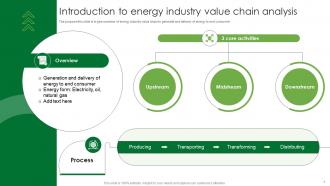
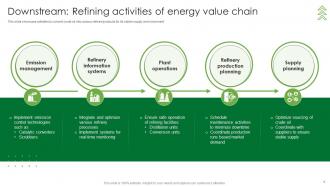
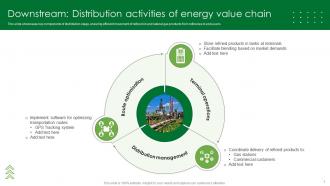
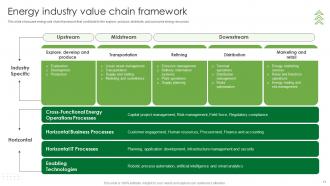
The primary components of the energy industry value chain include upstream exploration and production, midstream transportation and storage, downstream refining and distribution, and retail marketing to end consumers. These interconnected segments streamline operations by optimizing resource extraction, enhancing logistics efficiency, and delivering integrated services, with many energy companies finding that vertical integration across multiple components provides significant competitive advantages and operational cost reductions.
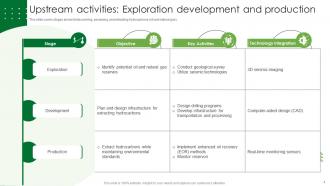
Upstream activities vary significantly by energy source, with oil and gas requiring exploration, drilling, and extraction, while renewable sources like solar and wind focus on site assessment, equipment manufacturing, and installation. Coal involves mining and initial processing, nuclear requires uranium mining and enrichment, and geothermal emphasizes geological surveys and well drilling, with each delivering distinct operational timelines and capital requirements.
Technology revolutionizes energy value chain efficiency through smart grid systems, predictive analytics, IoT sensors, automation platforms, and blockchain solutions. These innovations streamline operations by optimizing resource allocation, reducing downtime, and enhancing transparency, with many energy companies finding that strategic technology integration delivers significantly lower operational costs and improved competitive advantage.
Regulatory frameworks significantly impact energy value chains by shaping operational standards, environmental compliance requirements, safety protocols, and market access conditions across exploration, production, and distribution phases. These regulations drive infrastructure investments, influence pricing mechanisms, and determine competitive positioning, with many energy companies finding that proactive compliance strategies ultimately deliver enhanced operational efficiency and sustainable competitive advantage.
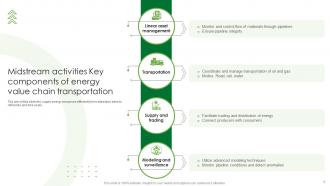
The midstream sector faces infrastructure bottlenecks, regulatory compliance complexities, transportation cost volatility, pipeline capacity constraints, and storage optimization challenges. These issues significantly impact operational efficiency and profitability, with many energy companies finding that strategic infrastructure investments and advanced logistics management ultimately deliver enhanced throughput capacity and competitive advantage.
Market dynamics influence energy pricing through supply-demand fluctuations, regulatory changes, geopolitical events, and seasonal variations that create ripple effects across extraction, refining, and distribution stages. These factors enable companies to implement dynamic pricing strategies, hedge against volatility through futures contracts, and optimize profit margins at each value chain segment, with many energy firms finding that real-time market analysis ultimately delivers competitive advantage and enhanced operational efficiency.
Logistics and transportation are critical backbone elements that connect upstream production with downstream consumption, ensuring seamless energy flow across global markets through pipelines, tankers, rail networks, and storage facilities. These systems enable energy companies to optimize supply chains, reduce operational costs, and maintain reliable delivery schedules, while strategic transportation infrastructure investments deliver competitive advantages in increasingly complex international energy markets.
Renewable energy sources fundamentally reshape value chain dynamics by decentralizing generation, reducing transmission distances, and enabling prosumer models where consumers also produce energy. These technologies streamline operations by minimizing fuel costs, automating grid management, and accelerating maintenance cycles, with utilities, manufacturers, and residential sectors finding enhanced efficiency and competitive advantage.
Consumer behavior significantly influences energy demand patterns through usage timing, conservation efforts, technology adoption, and price sensitivity, directly affecting supply planning and infrastructure investments. Energy companies increasingly adjust production schedules, grid management, and renewable integration based on consumer preferences for sustainable options, with utilities finding that behavioral shifts toward electric vehicles and smart home technologies require strategic supply chain adaptations, ultimately reshaping market dynamics and investment priorities.
Data analytics enhances energy value chain decision-making by providing real-time operational insights, predictive maintenance capabilities, demand forecasting, and risk assessment tools. Through advanced algorithms and machine learning, energy companies streamline exploration decisions, optimize production schedules, and improve distribution efficiency, while reducing operational costs and enhancing asset performance across upstream, midstream, and downstream operations.
Emerging energy trends include renewable integration, digitalization through IoT and AI, energy storage advancement, decentralized generation, and electrification of transportation sectors. These technologies streamline operations by enhancing grid flexibility, optimizing resource allocation, and enabling predictive maintenance, with many utilities finding that strategic combinations of solar, wind, and smart infrastructure ultimately deliver competitive advantages and operational efficiency.
International trade agreements significantly influence energy sector cross-border value chains by reducing tariffs on equipment and fuels, streamlining regulatory frameworks, and establishing standardized safety protocols. These agreements enable energy companies to optimize global sourcing, accelerate project timelines, and enhance operational efficiency, with many multinational corporations finding that harmonized trade rules ultimately deliver cost reductions and expanded market access opportunities.
Partnerships and alliances enable energy companies to share risks, leverage complementary expertise, access new markets, reduce capital requirements, and accelerate technological innovation across exploration, production, and distribution stages. These strategic collaborations help organizations optimize resource allocation, enhance operational efficiency, and navigate regulatory complexities, with many companies finding that joint ventures ultimately deliver faster project execution and improved competitive positioning.
Sustainability influences energy value chain decisions by driving investments in renewable technologies, reshaping supply chain partnerships, and prioritizing environmental compliance across operations. Through strategic sustainability frameworks, energy companies enhance operational efficiency, reduce regulatory risks, and capture emerging market opportunities, with many organizations finding that sustainable practices ultimately deliver competitive advantage and improved stakeholder confidence.
Key performance indicators for energy value chain efficiency include capacity utilization rates, transmission and distribution losses, operational expenditure ratios, asset turnover metrics, and energy conversion efficiency percentages. These KPIs enable energy companies to streamline operations by identifying bottlenecks, minimizing waste, and optimizing resource allocation, with many utilities finding that integrated performance monitoring ultimately delivers reduced costs and enhanced grid reliability.
-
Professional and unique presentations.
-
Professionally designed slides with color coordinated themes and icons. Perfect for enhancing the style of the presentations.