

Finance And Accounting Digital Transformation Program Powerpoint Presentation Slides




Try Before you Buy Download Free Sample Product
 Impress Your
 Audience
 100%
100% Editable
 Save Hours
 of Time


Finance and Accounting Transformation might include restructuring and implementing the finance operating model, accounting and finance organizations, accounting and finance processes, financial capabilities, and platforming finance and accounting systems. Here is an efficiently designed template on Finance and Accounting Digital Transformation Program that provides the details on primary objectives of accounting and finance transformation and significant accounting aims and finance transformation. At present, the company wants to highlight the key steps, roadmap, and strategies for finance and accounting transformation and cover all the artifacts included in the transformation. Also, this presentation provides details on various key artifacts included in the accounting and finance transformation such as transformation roadmap and business case, finance transformation change management plan, financial software vendor scan, mini-profiles, finance transformation project plan, and finance transformation program RACI matrix. Additionally, this powerful template provides details on the finance transformation program checklist, finance transformation program success metrics, finance transformation training plan for different teams, finance transformation program significant reasons for failure, and critical challenges in achieving objectives of financial transformation. Get access to it now.
People who downloaded this PowerPoint presentation also viewed the following :
Content of this Powerpoint Presentation
Slide 1: This slide introduces Finance and Accounting Digital Transformation Program. State Your Company Name and begin.
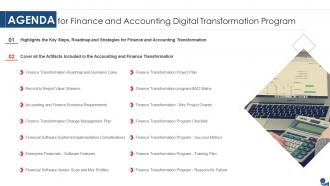
Slide 2: This slide states Agenda of the presentation.
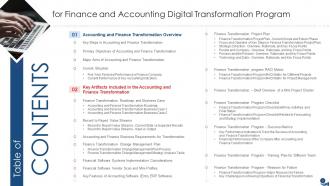
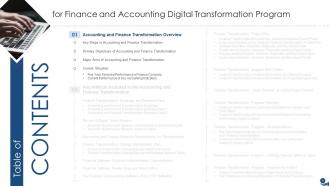
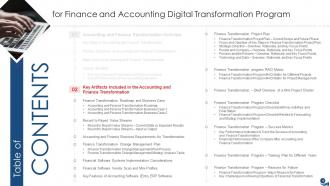
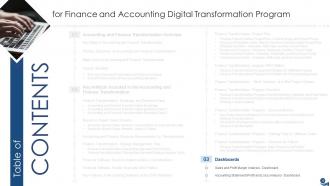
Slide 3: This slide presents Table of Content for the presentation.
Slide 4: This slide highlights title for topics that are to be covered next in the template.
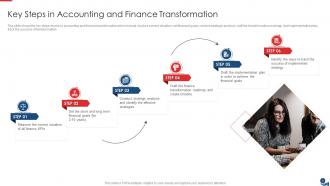
Slide 5: This slide displays Key Steps in Accounting and Finance Transformation.
Slide 6: This slide represents Primary Objectives of Accounting and Finance Transformation.
Slide 7: This slide shows Major Aims of Accounting and Finance Transformation.
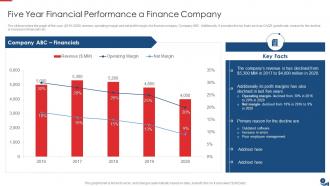
Slide 8: This slide presents Five Year Financial Performance a Finance Company.
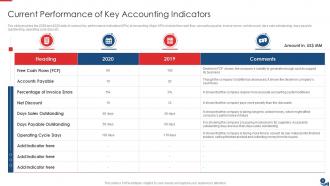
Slide 9: This slide shows Current Performance of Key Accounting Indicators.
Slide 10: This slide highlights title for topics that are to be covered next in the template.
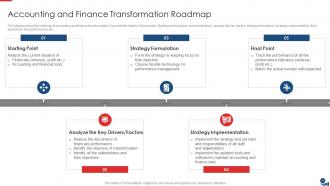
Slide 11: This slide represents Accounting and Finance Transformation Roadmap.
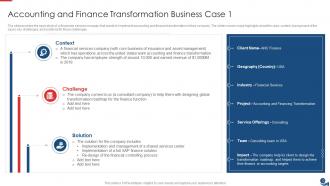
Slide 12: This slide shows financials services company that wants to implement accounting and finance transformation in their company.
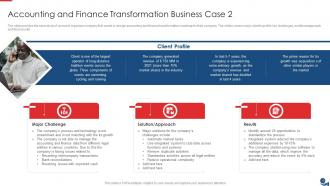
Slide 13: This slide presents case study of an event organizer company that wants to design accounting and finance transformation roadmap.
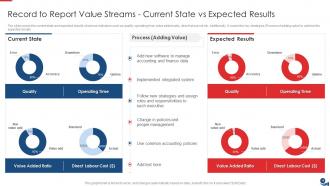
Slide 14: This slide shows Record to Report Value Streams – Current State vs Expected Results.
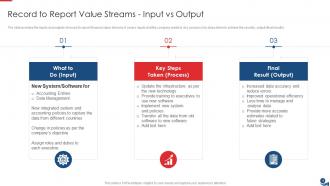
Slide 15: This slide displays inputs and outputs of record to report (finance) value streams.
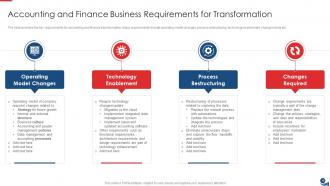
Slide 16: This slide represents Accounting and Finance Business Requirements for Transformation.
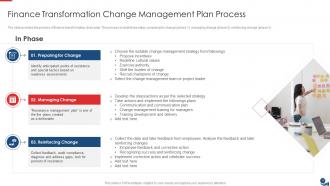
Slide 17: This slide shows Finance Transformation Change Management Plan Process.
Slide 18: This slide presents Finance Transformation Change Management Strategy Analysis Table.
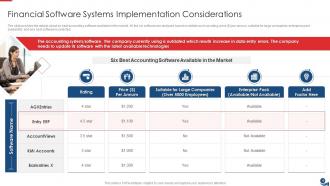
Slide 19: This slide shows Financial Software Systems Implementation Considerations.
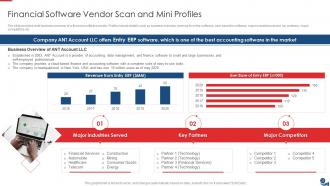
Slide 20: This slide displays Financial Software Vendor Scan and Mini Profiles.
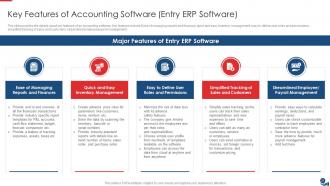
Slide 21: This slide represents key features of an accounting software.
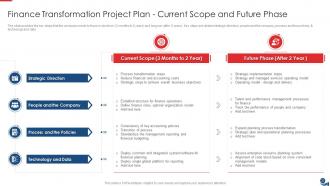
Slide 22: This slide shows Finance Transformation Project Plan – Current Scope and Future Phase.
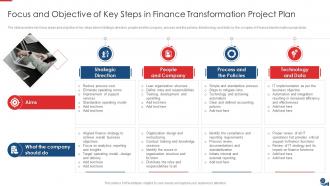
Slide 23: This slide presents key focus areas and objective of key steps taken.
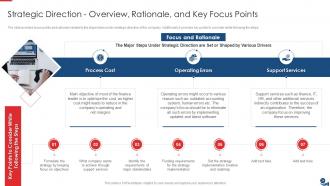
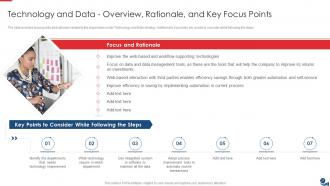
Slide 24: This slide shows focus points and rationale related to the steps taken under strategic direction of the company.
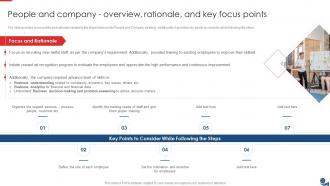
Slide 25: This slide displays Key Points to Consider While Following the Steps.
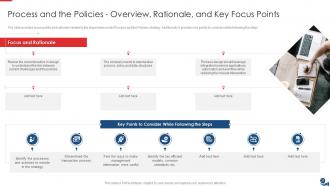
Slide 26: This slide represents Process and the Policies – Overview, Rationale, and Key Focus Points.
Slide 27: This slide shows Key Points to Consider While Following the Steps.
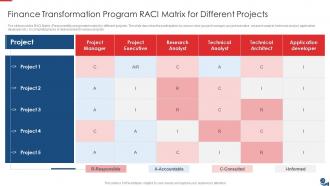
Slide 28: This slide presents Finance Transformation Program RACI Matrix for Different Projects.
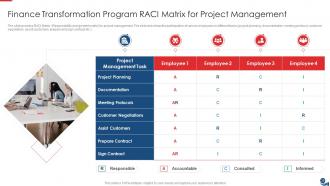
Slide 29: This slide shows Finance Transformation Program RACI Matrix for Project Management.
Slide 30: This slide displays Finance Transformation – Brief Overview of a Mini Project Charter.
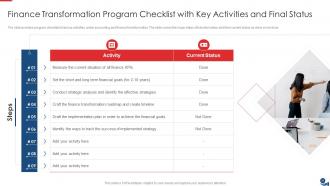
Slide 31: This slide represents Finance Transformation Program Checklist with Key Activities and Final Status.
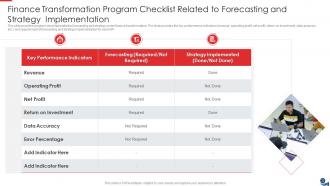
Slide 32: This slide shows Finance Transformation Program Checklist Related to Forecasting and Strategy Implementation.
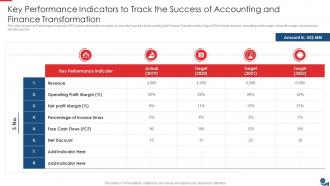
Slide 33: This slide presents Key Performance Indicators to Track the Success of Accounting and Finance Transformation.
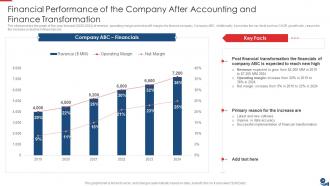
Slide 34: This slide shows Financial Performance of the Company After Accounting and Finance Transformation.
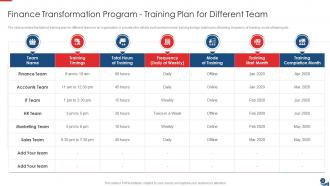
Slide 35: This slide displays table of training plan for different teams in an organization.
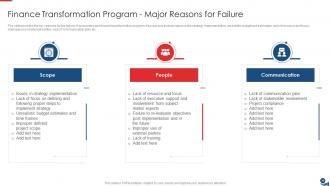
Slide 36: This slide represents key reasons for the failure of accounting and finance transformation program.
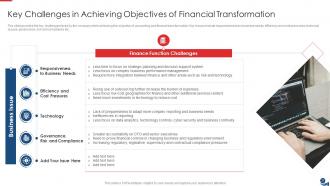
Slide 37: This slide shows Key Challenges in Achieving Objectives of Financial Transformation.
Slide 38: This slide highlights title for topics that are to be covered next in the template.
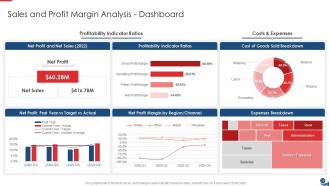
Slide 39: This slide shows Sales and Profit Margin Analysis Dashboard.
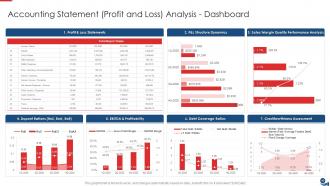
Slide 40: This slide displays Accounting Statement Profit and Loss Analysis Dashboard.
Slide 41: This slide showcases Icons for Finance and Accounting Digital Transformation Program.
Slide 42: This slide is titled as Additional Slides for moving forward.
Slide 43: This is Our Team slide with names and designation.
Slide 44: This is About Us slide to show company specifications etc.
Slide 45: This is Our Mission slide with related imagery and text.
Slide 46: This is Our Goal slide. State your firm's goals here.
Slide 47: This slide shows Post It Notes. Post your important notes here.
Slide 48: This slide contains Puzzle with related icons and text.
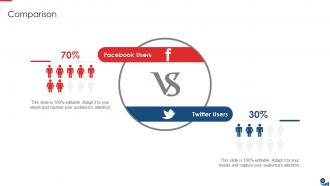
Slide 49: This is a Comparison slide to state comparison between commodities, entities etc.
Slide 50: This slide displays Column chart with two products comparison.
Slide 51: This slide describes Line chart with two products comparison.
Slide 52: This is a Thank You slide with address, contact numbers and email address.
Finance And Accounting Digital Transformation Program Powerpoint Presentation Slides with all 57 slides:
Use our Finance And Accounting Digital Transformation Program Powerpoint Presentation Slides to effectively help you save your valuable time. They are readymade to fit into any presentation structure.















FAQs for Finance And Accounting Digital Transformation Program
So you'll want cloud-based ERP systems and automation tools that handle boring stuff like invoice processing. Real-time dashboards are pretty clutch too. AI helps with forecasting and catching fraud, plus digital workflows kill all that paper approval nonsense. API integrations are everywhere now - honestly, they're kind of essential for getting your finance systems to actually communicate. But here's the thing: robotic process automation for month-end close is what'll really blow your mind. Cuts closing time in half, no joke. My advice? Start with whatever manual processes are eating up most of your time. That's where you'll see the biggest return when you automate.
Honestly, cloud computing is a total game-changer for financial stuff. You'll get real-time access to all your data from anywhere, which makes reporting so much easier. Manual processes? Most of that gets automated. Your team can collaborate instantly too - no more waiting around for someone to email spreadsheets back and forth (ugh). The analytics tools are actually insane now, you can spot trends super fast. Everything stays backed up automatically, and you don't need to buy a bunch of expensive hardware to scale up. I'd probably test it out with just one reporting process first though, see how it goes.
So AI handles all that boring stuff that kills your productivity - invoice processing, sorting expenses, matching transactions. Honestly, it's pretty wild how fast it scans receipts and posts entries compared to doing everything by hand. The best part? It spots weird patterns and flags potential screwups before they bite you later. Don't get me wrong, it's not flawless yet, but damn it's getting good. I'd start simple - grab an AI tool for expenses or invoices first. You'll be shocked how much time you get back.
Honestly, data analytics is a total game-changer for finances. Instead of staring at boring spreadsheets, you're getting real insights that actually help you make decisions. The predictive stuff? Amazing - you can catch cash flow problems before they wreck your day. I love how it shows which investments are actually worth it versus the ones that just drain money. You'll spot cost-saving opportunities and optimize where your budget goes. Way better than just going with your gut all the time. Just make sure your data's clean first - garbage in, garbage out, you know? Focus on metrics that matter to your goals, not random stuff.
Data breaches and ransomware are your biggest headaches - especially when you're moving financial stuff to the cloud. API vulnerabilities get nasty fast too. Your attack surface just explodes when you connect all these systems together, which honestly keeps me up at night sometimes. Watch out for insider threats during transitions because access controls get sloppy. Those real-time payments and AI tools? More doors for hackers. Run pen tests regularly and have your incident response ready before going live with anything new.
Honestly, you've got to bake compliance right into the whole thing from the start. Map out what regulations you're dealing with first, then loop your compliance people into every big decision about new systems. I've watched companies try to slap compliance on afterward - total disaster and costs way more. Your new digital stuff needs audit trails and data governance that actually works for regulators, not just fancy features that look good in demos. Basically, treat it like a must-have requirement when you're designing everything, not something you'll deal with later.
Honestly, just start with a data audit to see what you're working with first. Map out your current setup and find where everything needs to connect. APIs are way better than manual transfers - learned that the hard way on my last project. Real-time sync for the important stuff like GL transactions, but batch processing is totally fine for reports. Build in data validation and error handling right away or you'll hate yourself later. Test everything in sandbox mode obviously. Pick one core integration, nail it completely, then move to the next. Don't try connecting everything at once - that's a nightmare.
Honestly, it's a game changer once you ditch the spreadsheet nightmare. You'll get real-time dashboards pulling data straight from your systems instead of chasing down every department for updates. No more waiting weeks for budget cycles either – everything becomes continuous planning. Way more accurate forecasts since you're using actual data flows, not old snapshots. The collaboration piece is huge too, everyone can jump into the same cloud models and make updates. Oh, and that annual budgeting circus? Pretty much dead. I'd start by finding your biggest manual headaches and automate those first – you'll see results fast.
Dude, you definitely need to get into data analytics - Excel, SQL, maybe some Python if you're feeling ambitious. The whole "just know debits and credits" thing? That's dead now. RPA tools are becoming pretty standard too, which is honestly kind of annoying but whatever. Data visualization is huge - Tableau, Power BI, stuff like that. Communication skills matter more than ever since you'll be translating finance-speak for people who don't get it. My advice? Pick one analytics tool and get really good at it first. Then expand from there.
Track the obvious stuff first - cost savings, faster processing, fewer screw-ups, maybe some headcount changes. But honestly? The real wins are usually the softer things like making decisions faster and not pissing off customers. I'd set your baseline numbers before you even start, then check monthly how you're doing. Oh and don't forget implementation costs - that bit me once. Create some simple dashboard showing both the money stuff and operational wins. Makes it way easier when you're presenting to the suits who only care about numbers.
Data quality is probably your biggest headache - that stuff gets messy fast. Your finance team will fight you on it too because Excel is their comfort zone, which I totally get. Legacy systems? Yeah, those are a nightmare to integrate with. Budget's always tighter than you think, and good luck finding people who actually know both finance AND tech. Oh, and everything costs way more than the initial estimate. Start small though - pick one process, get a win, then expand. Don't try to overhaul everything at once or you'll lose your mind.
So blockchain basically ditches the middleman - no more banks verifying every little thing. You get this distributed ledger that everyone can see and trust, which is pretty cool honestly. Once something's recorded, you can't mess with it later. Transactions are faster and way cheaper too since there's less red tape. We're still figuring everything out, but smart contracts are where you should start looking. They'll automate your payment stuff automatically. My buddy's company saw results pretty quick once they got it set up. The whole space is still kinda wild west though.
Honestly, ML is a game-changer for catching fraud. It picks up on weird patterns in huge datasets that would fly right past human eyes - stuff like duplicate payments or sketchy vendor connections. The cool part? It learns from every fraud case, so it gets better at spotting new tricks. You can have it automatically flag suspicious transactions instead of your team doing everything manually. Works around the clock too, which is clutch since fraudsters don't exactly keep business hours. I'd start with whatever area has your highest transaction volume - that's where you'll see the biggest impact right away.
Dude, AI and machine learning are literally everywhere in fintech now - fraud detection, automated reconciliation, you name it. Real-time payments are becoming standard (finally). Blockchain's actually getting useful beyond just crypto - think supply chain finance and smart contracts. Here's what's wild: non-financial companies can now offer banking services through embedded finance. Cloud platforms are crushing those old legacy systems, and regulatory tech is getting way better at compliance stuff. Honestly, I'd start by figuring out which of these could fix your biggest headaches first.
Honestly, it's a game changer for CFOs. All that tedious manual reporting? Gone. Automation handles the grunt work now, which means you can actually dig into what the numbers are telling you about where the business is headed. Way more strategic than being stuck in spreadsheet purgatory all day. You'll find yourself at the table for big decisions instead of just cranking out reports afterward. The trick is getting ahead of it early - I've seen too many finance folks playing catch-up because they waited too long to jump on these tools.
-
SlideTeam has helped me take my presentation to the next level. Everyone at the office is impressed! I’ll be using their designs for a long-long time.
-
Kudos to SlideTeam for achieving the high success rate in delivering the top-notch slides.