

Finance Close Process Flow With Departmental Mapping




Try Before you Buy Download Free Sample Product
 Impress Your
 Audience
 100%
100% Editable
 Save Hours
 of Time


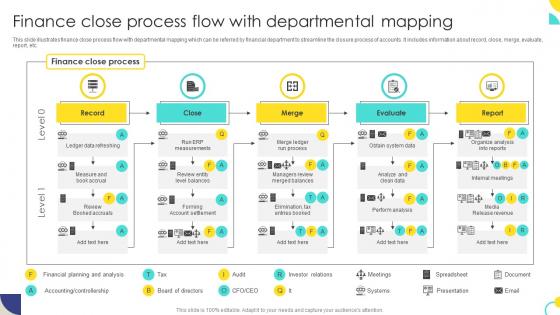
This slide illustrates finance close process flow with departmental mapping which can be referred by financial department to streamline the closure process of accounts. It includes information about record, close, merge, evaluate, report, etc.
People who downloaded this PowerPoint presentation also viewed the following :
Finance Close Process Flow With Departmental Mapping with all 6 slides:
Use our Finance Close Process Flow With Departmental Mapping to effectively help you save your valuable time. They are readymade to fit into any presentation structure.





FAQs for Finance Close Process Flow
The finance close process includes journal entry recording, account reconciliations, variance analysis, financial statement preparation, and management review cycles. These stages streamline month-end operations by ensuring data accuracy, identifying discrepancies early, and accelerating reporting timelines, with many finance teams finding that automated reconciliation tools ultimately deliver faster closes and enhanced operational efficiency.
Technology streamlines the finance close process by automating data collection, enabling real-time reconciliation, and providing centralized reporting dashboards. Through cloud-based platforms and AI-driven analytics, finance teams accelerate month-end closures, reduce manual errors, and enhance compliance tracking, with many organizations finding that automated workflows cut closing time by 40-60 percent.
Common month-end close challenges include manual data entry errors, delayed reconciliations, version control issues with spreadsheets, incomplete accruals, and coordination difficulties across departments. These operational bottlenecks significantly extend closing timelines, with many finance teams finding that automated workflows, standardized templates, and real-time collaboration tools streamline processes, ultimately delivering faster closes and enhanced accuracy.
Teams ensure data accuracy during the close process through automated reconciliations, real-time data validation, segregation of duties, comprehensive review workflows, and standardized documentation protocols. These controls streamline verification by eliminating manual errors, flagging discrepancies immediately, and creating audit trails, with many finance organizations finding that automated systems deliver faster closes while maintaining regulatory compliance and improving stakeholder confidence.
Collaboration streamlines finance close by enabling real-time communication between accounting, operations, and leadership teams, ensuring accurate data collection, and facilitating faster issue resolution. Through integrated platforms and cross-functional workflows, organizations enhance transparency, minimize errors, and accelerate monthly reporting cycles, with many finance teams finding that collaborative approaches reduce close time significantly.
Automation reduces financial closing time by streamlining data collection, automating journal entries, and eliminating manual reconciliations across multiple systems. Through robotic process automation and integrated software platforms, finance teams accelerate month-end processes from weeks to days, minimize errors significantly, and enable real-time reporting, ultimately delivering faster decision-making capabilities and enhanced operational efficiency.
**INPUT**: What metrics should be monitored to assess the finance close process? **OUTPUT**: Key metrics include close cycle time, accuracy rates, variance analysis completion, reconciliation timeliness, and error resolution speed. These indicators enable finance teams to streamline operations, reduce month-end bottlenecks, and enhance reporting accuracy, with many organizations finding that consistent monitoring ultimately delivers faster closes and improved stakeholder confidence.
Companies should conduct comprehensive finance close process reviews quarterly, with annual deep-dive assessments examining automation opportunities, control effectiveness, and workflow optimization. Many organizations also implement monthly mini-reviews focusing on specific pain points, while financial institutions and public companies increasingly adopt continuous monitoring approaches that identify bottlenecks in real-time, ultimately reducing close cycles and enhancing reporting accuracy.
A slow closing process delays critical financial insights needed for strategic planning, budgeting, and investment decisions, while creating uncertainty that hampers leadership's ability to respond quickly to market opportunities. This ultimately reduces competitive advantage, as management lacks timely data for resource allocation, performance evaluation, and stakeholder communications, with many organizations finding delayed decisions cost significantly more than process improvements.
Organizations can implement standardized timelines, automated reconciliations, real-time data validation, cross-functional collaboration protocols, and documented procedures for smoother closes. These practices streamline monthly workflows by reducing manual errors, accelerating variance analysis, and enabling faster reporting cycles, with many finance teams finding that automation and clear accountability ultimately deliver 30-50% faster close times.
Regulatory changes significantly impact the finance close process by requiring updated accounting standards, enhanced documentation requirements, and modified reporting timelines. These changes often necessitate system updates, staff retraining, and revised internal controls, with many finance teams finding that proactive compliance planning and automated workflows help streamline adaptation while maintaining accuracy and meeting deadlines.
Essential finance close tools include automated reconciliation software, enterprise resource planning (ERP) systems, cloud-based consolidation platforms, variance analysis dashboards, and collaborative workflow management solutions. These technologies streamline month-end processes by reducing manual data entry, accelerating reconciliations, and enhancing cross-departmental visibility, with many finance teams finding that integrated platforms ultimately deliver faster closes and improved accuracy.
Finance teams can prepare for unexpected disruptions by implementing contingency planning, maintaining robust backup systems, establishing clear communication protocols, and cross-training staff across multiple closing functions. These strategies enable organizations to pivot quickly during disruptions, maintain regulatory compliance, and ensure accurate financial reporting, with many companies finding that diversified skill sets and automated backup processes significantly reduce closing delays and operational risks.
The finance close process provides the verified historical data that serves as the foundation for accurate financial forecasting, with actual results from monthly, quarterly, and annual closes informing future projections. This strategic combination enables finance teams to identify trends, validate assumptions, and refine forecasting models, ultimately delivering more reliable budgets and enhanced decision-making capabilities for organizations across industries.
Cultural differences significantly influence finance close processes through varying communication styles, reporting preferences, hierarchical structures, and regulatory compliance approaches across regions. Multinational companies often find that Asian subsidiaries may require more consensus-building time while European divisions prioritize detailed documentation, and American offices focus on speed, ultimately requiring tailored close procedures and extended timelines to accommodate these diverse operational styles.
-
Great templates that you can use in your next keynote or conference. They are perfect for quick and visually-engaging delivery.
-
Great templates that you can use in your next keynote or conference. They are perfect for quick and visually-engaging delivery.