

Hedge Fund Risk And Return Analysis Powerpoint Presentation Slides






Try Before you Buy Download Free Sample Product
 Impress Your
 Audience
 100%
100% Editable
 Save Hours
 of Time


Hedge funds are limited partnerships made up of private investors whose money is managed by experienced fund managers. Here is a professionally designed Hedge Fund Risk and Return Analysis template. At first, the module covers the problems related to investment decisions that generate low ROI it includes company investment preference and the present value of investments with impacts of unsuitable investment. Further, it includes the global hedge fund performance, which showcases why companies should invest in hedge funds, hedge fund structure with liquidity, and redemption period with the comparison with hedge and mutual funds. Additionally, it covers the investment strategies of hedge funds, including relative value investment strategy, Event-driven, directional trading, long-short equity, short selling, and other strategies in hedge funds. Moreover, it includes the risk management for hedge funds which includes fund managers role, manager toolkit, and hedge fund diversity with asset class instruments. At last, it covers the hedge fund portfolio selection with the selection of funds using SWOT analysis, sector-wise portfolio structure, and selection of private equity and hedge fund investment with the evaluation of the monthly performance of hedge funds. Get access now.
People who downloaded this PowerPoint presentation also viewed the following :
Content of this Powerpoint Presentation
Slide 1: This slide introduces Hedge Fund Risk and Return Analysis. State your company name and begin.
Slide 2: This slide states Agenda of the presentation.
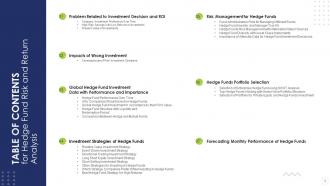
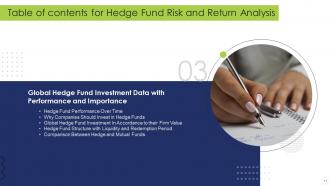
Slide 3: This slide shows Table of Content for the presentation.
Slide 4: This slide depicts title for three topics that are to be covered next in the template.
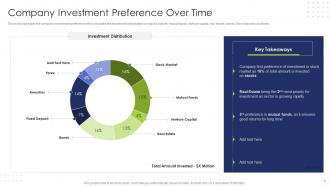
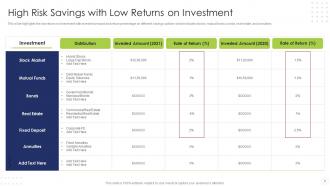
Slide 5: This slide highlights the company investment preference which includes the investment distribution on stocks market, mutual funds, etc.
Slide 6: This slide highlights the low return on investment with invested amount and return percentage on different savings options.
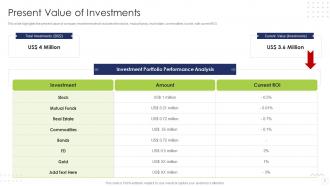
Slide 7: This slide highlights the present value of company investment which includes the stocks, mutual funds, real estate, commodities, bonds, with current ROI.
Slide 8: This slide depicts title for two topics that are to be covered next in the template.
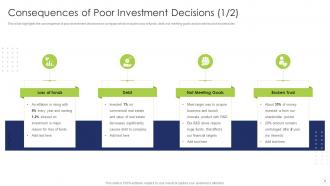
Slide 9: This slide highlights the consequence of poor investment decisions on company which includes loss of funds, debt, etc.
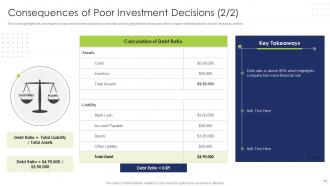
Slide 10: This slide highlights the consequence of poor investment causes high debt ratio.
Slide 11: This slide depicts title for five topics that are to be covered next in the template.
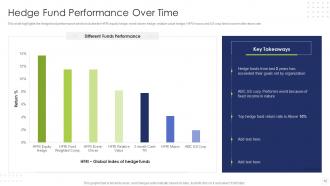
Slide 12: This slide highlights the hedge fund performance which includes the HFRI equity hedge, event driven hedge, relative value hedge, etc.
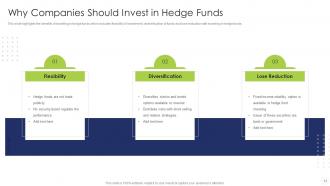
Slide 13: This slide highlights the benefits of investing in hedge funds which includes flexibility of investment, diversification of funds, etc.
Slide 14: This slide highlights the hedge fund investment by company in accordance to their firm value which includes nine categories of firm with their net worth.
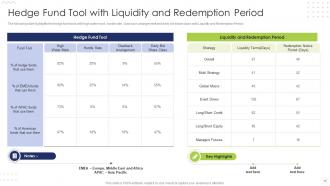
Slide 15: This slide highlights the hedge fund tools with high water mark, hurdle rate, claw back arrangement and early bid share class.
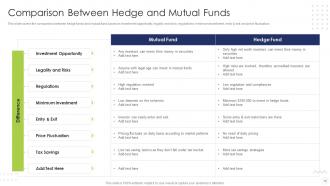
Slide 16: This slide covers the comparison between hedge funds and mutual fund on the basis of investment opportunity, legality and risks, regulations, etc.
Slide 17: This slide depicts title for eight topics that are to be covered next in the template.
Slide 18: This slide highlights the various strategies to invest in hedge funds which includes relative value, event driven, directional trading, etc.
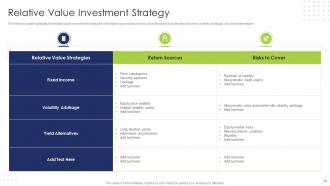
Slide 19: This slide highlights the relative value investment strategies with return sources and risks to consider which includes fixed income, etc.
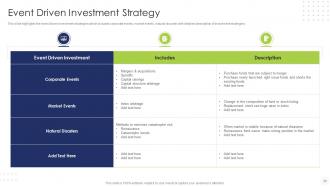
Slide 20: This slide highlights the event driven investment strategies which includes corporate events, market events, natural disaster.
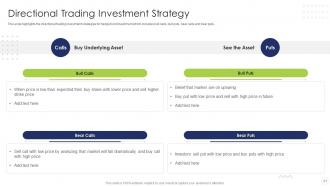
Slide 21: This slide highlights the directional trading investment strategies for hedge fund investment which includes bull calls, bull puts, bear calls and bear puts.
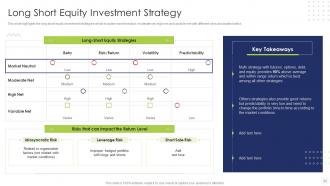
Slide 22: This slide highlights the long short equity investment strategies which includes market neutral, moderate net, high net and variable net.
Slide 23: This slide highlights the short selling investment strategies with process flow of five steps and also showcase the key risks associated with short selling.
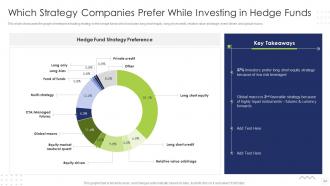
Slide 24: This slide showcases the graph of enterprise trading strategy in the hedge funds which includes long short equity, long short credit, etc.
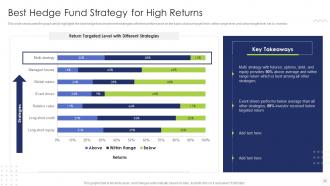
Slide 25: This slide showcases the graph which highlights the best hedge fund investment strategies with their performance.
Slide 26: This slide depicts title for five topics that are to be covered next in the template.
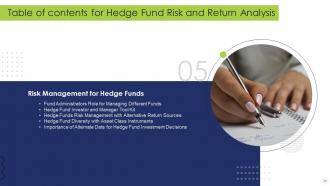
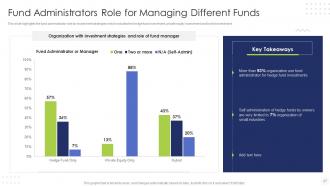
Slide 27: This slide highlights the fund administrator role for investment strategies which includes the hedge fund investment, etc.
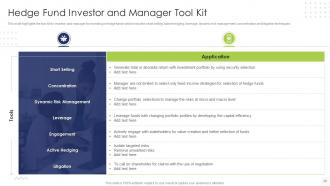
Slide 28: This slide highlights the tool kit for investor and manager for investing in hedge funds which includes short selling, active hedging, etc.
Slide 29: This slide showcases the various alternative return sources with hedge fund risk management which include bi directional security, deal risk premium, etc.
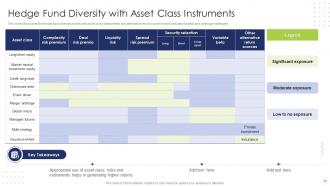
Slide 30: This slide showcases the hedge fund diversity model with asset class instruments and alternative return sources.
Slide 31: This slide highlights the alternative data for hedge fund investment decision which includes data sources, data types, potential analysis, etc.
Slide 32: This slide depicts title for three topics that are to be covered next in the template.
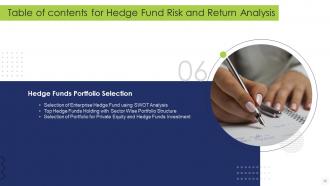
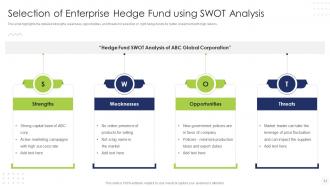
Slide 33: This slide highlights the detailed strengths, weakness, opportunities, and threats for selection of right hedge funds.
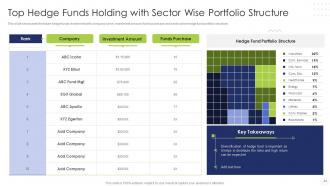
Slide 34: This slide showcases the future hedge funds investment with company name, investment amount, funds purchase, etc.
Slide 35: This slide showcases the portfolio of private equity and hedge fund investment which includes the venture capital, leveraged buyout, etc.
Slide 36: This slide depicts title for one topic that is to be covered next in the template.
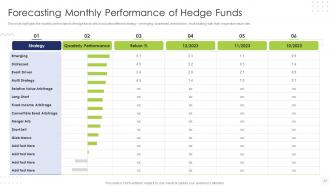
Slide 37: This slide highlights the monthly performance of hedge funds which includes different strategy – emerging, distressed, event driven, etc.
Slide 38: This slide contains all the icons used in this presentation.
Slide 39: This slide presents title for additional slides.
Slide 40: This slide presents your company's vision, mission and goals.
Slide 41: This slide shows about your company, target audience and its client's values.
Slide 42: This slide shows details of team members like name, designation, etc.
Slide 43: This slide highlights goals of the company.
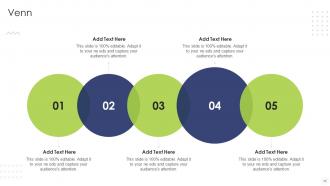
Slide 44: This slide depicts Venn diagram with text boxes.
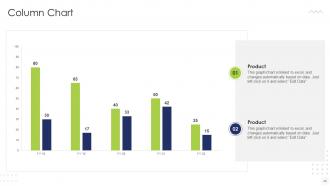
Slide 45: This slide displays Column chart with two products comparison.
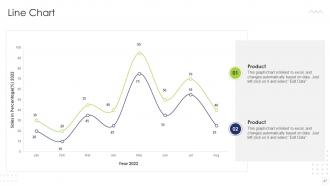
Slide 46: This slide describes Line chart with two products comparison.
Slide 47: This is a Thank You slide with address, contact numbers and email address.
Hedge Fund Risk And Return Analysis Powerpoint Presentation Slides with all 53 slides:
Use our Hedge Fund Risk And Return Analysis Powerpoint Presentation Slides to effectively help you save your valuable time. They are readymade to fit into any presentation structure.





















FAQs for Hedge Fund Risk And Return Analysis
Look at what strategy they're running first - long/short equity is way different from merger arbitrage, totally different risk levels. Your manager's track record matters a ton since they're the ones actually making trades. Also check how much they borrow (some funds go crazy with debt), whether they're diversified enough, and honestly? Their redemption terms can screw you if you need money fast. Oh and make sure their back-office stuff isn't a mess - you'd be surprised how many funds have operational issues. Just really dig into their process before throwing money at them.
Hedge fund strategies are totally different beasts when it comes to risk. Long/short equity usually moves with the market but stays less volatile since you're hedged. Event-driven stuff? Completely different story - it'll cruise along fine then suddenly blow up when deals collapse during market freak-outs. I learned this the hard way looking at returns that seemed steady for months, then bam. Don't compare them using the same metrics either. You'll get way better insights checking strategy-specific benchmarks instead of those generic hedge fund indices that lump everything together.
So basically hedge funds borrow money to make bigger bets, which can be awesome or terrible depending on how things play out. When their trades work out, they're making bank on someone else's cash. But man, when they don't... those losses hit way harder too. Most funds try to be smart about it - they'll spread risks around and set limits on how much they can borrow. The real question is whether they actually stick to those limits when things get crazy. I'd definitely ask about their borrowing ratios and what safeguards they have before putting money in.
So here's the deal with liquidity risk - you basically need higher returns to make up for being stuck in something you can't easily sell. Hedge funds with long lock-ups are risky because what if you need that money during a market crash? Everyone's panicking and you're just... waiting. Smart investors know this, so they demand better returns from funds that tie up their cash longer. I learned this the hard way honestly. The less liquid the fund, the more they'll need to pay you to invest. Just make sure you're cool with their redemption terms before jumping in.
Don't just look at raw returns - that's rookie stuff. Focus on risk-adjusted metrics like Sharpe ratio and alpha instead. Maximum drawdown shows you the worst-case scenario, which honestly matters way more than people think. Volatility and how correlated they are to the broader market tells you a lot too. Since hedge funds are supposed to actually hedge (crazy concept, I know), check how they perform in different market conditions. Downside deviation is usually more revealing than upside metrics. Once you're comfortable with those basics, you can get fancy with Calmar or Sortino ratios.
Market conditions completely change how hedge funds perform. Bull markets? They'll give you steadier returns but nothing crazy exciting. Bear markets are where it gets wild though - that's when you see which funds actually know how to hedge and protect your money while everything else tanks. But here's the thing - some strategies that absolutely kill it during trending markets (momentum stuff) can get totally wrecked when volatility spikes. Honestly, I learned this the hard way watching a fund I liked. Bottom line: don't just look at their overall numbers. Check how they did across different market cycles.
Look at the Sharpe ratio first - shows you risk-adjusted returns. Maximum drawdown is crucial too, that's your worst possible loss from peak to bottom. Volatility tells you how wild the swings get. I'd also check beta to see how much it moves with the market. Value at Risk covers tail risk scenarios. Drawdown honestly hits the hardest when you're living through it. Don't just look at one time period either - see how it performed across different market cycles. Oh, and definitely ask for monthly returns so you can crunch the numbers yourself instead of trusting their marketing materials.
So diversification in hedge funds basically spreads your bets across different assets and strategies - you know, don't put everything in one basket. Works pretty well most of the time since you're not screwed if one position tanks. But here's what's annoying: when markets really freak out, everything starts moving together anyway. Your "diversified" portfolio suddenly acts like one big trade. I learned this the hard way in 2020 - correlations just spike during stress. You really need to test how your stuff performs in worst-case scenarios, not just look at normal market data.
Dude, those hedge fund fees are insane - 2% management plus 20% of profits. The math is pretty depressing when you actually run it. Your fund has to absolutely crush the market just to break even after fees, which honestly most don't do consistently. And here's the thing that bugs me - sometimes managers take crazy risks trying to justify those high costs, which could backfire on you. I'd definitely compare what you'd actually take home versus just throwing money in an index fund. Way simpler and you'll probably come out ahead.
Honestly, investor behavior is probably the biggest killer of hedge fund returns. People always chase what's hot, buying at the worst possible times when trades get crowded. Then when things go south? Everyone panics and pulls their money out at once. That forces managers to dump positions during the worst markets - brutal for anything illiquid. I've seen solid long-term strategies get wrecked just from bad redemption timing. My advice? Pick your allocation and stick with it. Don't get emotional when things look ugly. The money gets made during those uncomfortable stretches when nobody else wants to hold.
Regulatory stuff can totally flip a fund's risk overnight, so definitely dig into that. Check what jurisdictions they're operating in, their SEC status, and if they've had compliance issues before. The rules change crazy fast these days - I swear there's new requirements every month. You'll also want to see if they're bumping up against borrowing limits or dealing with fresh reporting rules that might mess with their strategy. Oh and this matters because when funds have to pivot or deal with higher costs from regulatory changes, guess who feels it in their returns? Yep, you.
Derivatives are basically financial steroids - they amplify everything, good and bad. You can use them to protect against specific risks or boost your returns. But here's the thing - they create weird, non-linear payoffs that mess with traditional risk measures. Your fund might look totally fine until market conditions flip, then boom, massive losses out of nowhere. I've seen this happen way too often. The key isn't whether they use derivatives (most do), but HOW they're using them. Always ask for specifics about their derivative strategy before putting money in.
Look, stocks and bonds are pretty straightforward - they generally go up over time with some bumps along the way. Hedge funds are totally different though. They're doing wild stuff like short selling and using derivatives to make money whether markets go up OR down. Way more unpredictable than your standard portfolio. The whole point is these fund managers think they can beat the market through skill, not just buying and holding. Honestly, the volatility can be crazy - I'd make sure you really get their strategy first. Some of these guys are genuinely brilliant, others... not so much.
So basically, grab like 5-7 years of monthly data and look for patterns - how funds behaved during crashes like 2008 or COVID. Rolling returns and drawdown periods are your friends here. I always focus more on consistency stuff like Sharpe ratios instead of just chasing the highest returns (learned that one the hard way). Yeah, past performance doesn't predict future results - total cliche but whatever, it's still true. Run some scenario testing based on similar historical periods. The volatility cycles and how things correlate with major market events will give you decent insight for building your models.
Dude, hedge fund evaluation is tricky because of all these mental traps. Survivorship bias is huge - databases only show the funds that didn't blow up, so returns look way better than reality. Then there's recency bias where you focus too much on last quarter's numbers instead of the whole track record. Anchoring bias locks you into your first impressions even when things change. But honestly? The worst is herding - everyone piles into the same "genius" trades until they crash. I learned this the hard way watching friends chase hot funds. Always dig into the full history, not just their glossy pitch decks.
-
Great designs, really helpful.
-
Awesome presentation, really professional and easy to edit.