


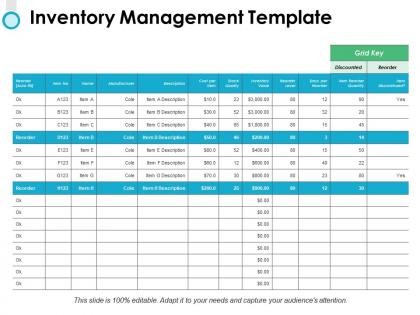
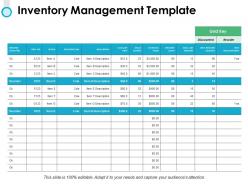
Inventory management template table ppt powerpoint presentation icon images




Try Before you Buy Download Free Sample Product
 Impress Your
 Audience
 100%
100% Editable
 Save Hours
 of Time


Discover extremely affordable deals with our Inventory Management Template Table Ppt Powerpoint Presentation Icon Images. They assure you a good bargain.
People who downloaded this PowerPoint presentation also viewed the following :
Inventory management template table ppt powerpoint presentation icon images with all 5 slides:
Find bargains by the dozen with our Inventory Management Template Table Ppt Powerpoint Presentation Icon Images. Discover an array of exciting deals.
FAQs for Inventory management template table ppt powerpoint
Honestly, start with inventory turnover - that's your bread and butter for seeing how fast stuff moves. Stockout frequency is clutch too, plus carrying costs as a percentage of what you've got sitting there. Days sales outstanding will tell you how long products just... sit around before someone buys them (which can be depressing but useful). Fill rate's pretty important - basically how often you can actually fulfill orders without scrambling. Lead time variability messes with your reorder timing, so track that. But seriously, don't try to track everything at once. Pick maybe 2-3 that match whatever's keeping you up at night, then add more later.
Honestly, tech is a game-changer for inventory accuracy. Those barcode scanners and RFID systems track everything automatically - no more relying on manual counts or spreadsheets (we both know how messy those get). Your inventory software can alert you when stock's low, track expiration dates, even catch discrepancies right away. Everything syncs with your POS system too, which is pretty sweet. I'd say start with basic barcode scanning if you haven't - easiest way to see immediate results. Way better than the old-school clipboard method my dad still swears by.
So with just-in-time inventory, you're basically only ordering stuff right when you need it instead of hoarding everything in a warehouse. Cuts your storage costs like crazy - we're talking 20-50% savings on carrying costs. No more paying for insurance on mountains of inventory or having all your cash tied up in products sitting around. The catch? Your demand forecasting has to be spot-on. Screw that up and you're either scrambling with stockouts or back where you started with too much inventory. Honestly, I'd test it out with your easiest items first - the stuff that moves fast and predictably. Once you get the hang of it, then roll it out wider.
Track your sales patterns for a few months first - that's your starting point. Then figure out what it actually costs you to hold inventory versus running out of stuff. Storage, insurance, all that adds up fast. Most people keep way too much stock because running out feels terrifying, but honestly? Sitting on dead inventory is expensive too. Do an ABC analysis so you're not treating your bestsellers the same as random slow movers. Calculate your safety stock instead of just winging it. You'll probably be surprised how much less you actually need once you crunch the real numbers.
Dude, inventory is such a pain. You'll either buy too much and have cash tied up in stuff nobody wants, or run out of your bestsellers right when people actually want to buy them. I swear, half the time you're just guessing what'll sell. Bad tracking makes everything worse too - like when your system says you have 30 widgets but there's literally 3 on the shelf. Manual counting takes forever and you could be doing way better things with that time. Get some basic inventory software and figure out when to reorder your popular items. Trust me, it'll save your sanity.
Dude, seasonal stuff totally messes with normal inventory planning. Start prepping 3-4 months early or you'll be scrambling later. Stock up before peak seasons - like buying winter coats in August (feels weird but trust me). The hardest part? Getting your forecasting right so you don't end up with a warehouse full of Christmas sweaters in February. Look into flexible supplier deals and maybe rent extra storage during busy periods. Honestly, I learned this the hard way when I worked retail - nothing's worse than running out of swimsuits in July because you didn't plan ahead.
So here's what's worked for me - start with demand forecasting using your sales history and market data to actually predict what you'll need. Don't rely on just one supplier either, that's basically setting yourself up for disaster when things go sideways. JIT delivery is pretty solid for cutting storage costs, but keep safety stock for your must-have items. Honestly, the whole game is balancing enough inventory to hit demand without your cash just sitting there collecting dust. I'd dig into your turnover rates first - that'll show you which products are the real problem children.
Yeah, so retail's all about predicting those crazy holiday rushes and turning inventory fast. Manufacturing? They're laser-focused on just-in-time delivery because production can't wait. Healthcare gets super paranoid about expiration dates - makes sense, expired meds are a nightmare. Food service juggles spoilage with unpredictable demand, which honestly sounds stressful. Tech companies race against products becoming obsolete overnight. You've gotta figure out what keeps your industry up at night first. Spoilage? Running out of stock? Storage costs eating profits? Build around those headaches instead of borrowing someone else's playbook.
Honestly, the real-time tracking is a game changer - no more guessing what's in stock. Your ordering gets way smarter too since it learns your patterns and reorders stuff automatically. I love that you catch theft and mistakes right away instead of those awful quarterly surprises (ugh, the worst). Time savings alone usually covers the cost pretty quick. Oh, and most connect to your accounting software so no double entry nonsense. I'd say write down your biggest inventory nightmares first - makes it easier to figure out which features you actually need vs the fancy bells and whistles.
So basically you want to start with your sales data from the past year or two - look for patterns, seasonal stuff, growth trends. That's your foundation. Then throw in external factors like what's happening in the market, economic conditions, any promos you're planning, new products coming out. Honestly, I've seen people get way too fancy with this - even Excel beats just winging it. Machine learning is cool but not always necessary. Oh, and don't forget supplier lead times when you're planning everything out. Pro tip: focus on your top 20% of products first since those will make or break your accuracy anyway.
Ugh, inventory management is such a pain but here's the deal - too much stock just sits there burning through your cash and storage costs. Not enough? You'll lose sales and piss off customers who'll just go elsewhere. Both scenarios totally wreck your margins in different ways. I learned this the hard way honestly. The trick is analyzing your sales patterns and how long suppliers take to deliver, then finding that sweet spot where you can actually serve customers without drowning in excess products. It's basically about parking your money smart instead of letting it collect dust.
Start with better demand forecasting - cuts down on overstock waste like crazy. Find suppliers who actually care about green practices too. Honestly, the companies doing this right are saving serious cash, not just helping the planet. Try circular stuff like refurbishment programs and optimize your packaging to use less materials. Your inventory turnover ratios will tell you everything - slow movers = waste. Oh, and set up take-back programs for products at end of life. Pick one thing first, see how it affects both your costs and environmental impact, then expand from there. You'll be surprised how much it helps.
Dude, e-commerce inventory is a total mess compared to the old warehouse-to-store thing. You've got like 10x more products to track, everything moves faster, and customers expect stuff to be available instantly everywhere. Real-time stock visibility becomes crucial - you need to know what's sitting in fulfillment centers, what drop-ship partners have, all of it. Returns are constantly flowing backward too which just adds to the chaos. Oh and don't even get me started on managing multiple sales channels at once. You'll definitely need some solid integrated systems that can actually handle all this complexity and give you decent data to work with.
So basically data analytics stops you from just guessing what to order and actually shows you patterns you'd miss otherwise. You can see demand spikes coming, catch slow products before they sit forever, and figure out real reorder timing. The seasonal stuff is wild - like you might discover umbrellas randomly sell better in March than November (who knew?). It also shows which suppliers are always late or what makes you the most money. Honestly, just start with your top 20% of products and look at the last year's data. That's where you'll get quick wins without drowning in numbers.
Oh man, analytical skills are huge - your team needs to read data and catch trends before they bite you. Detail-oriented people are a must because one screw-up ripples everywhere. Tech skills aren't optional anymore either, so make sure they can handle inventory software and Excel (databases are a nice bonus). Don't forget communication since they're constantly talking to purchasing, sales, warehouse... basically everyone. Cross-training saves your butt when people call out sick. Honestly, I'd just look at where your team's weakest right now and tackle that first.
No Reviews