


Investment Research Report Powerpoint Presentation Slides





Try Before you Buy Download Free Sample Product
 Impress Your
 Audience
 100%
100% Editable
 Save Hours
 of Time


Investment Research Report PowerPoint Presentation Slides features an audience-friendly format for entrepreneurs to create a stunning presentation within minutes. Securities analysts can benefit from the thoroughly-researched and content-driven design of our investment analysis PPT theme. The impactful data visualization tools of our stock valuation PowerPoint slideshow help in effortlessly facilitating the consolidation of sophisticated data. Using this equity research PPT deck you can present a comparative annual analysis of the company's revenue generation. Comparing your organization with competitors using key parameters is also possible by the means of this investment assessment PowerPoint presentation. Demonstrate financial performance through balance sheet, income statement, and vertical and horizontal company analysis via our investment planning PPT slideshow. Users can portray historical share price performance for equity research with the help of this financial analysis PowerPoint theme. Download our investment presentation ppt decks to represent the health of the target company through valuation analysis, and financial ratio analysis.
People who downloaded this PowerPoint presentation also viewed the following :
Content of this Powerpoint Presentation
Slide 1: This slide introduces Investment Research Report. Mention Your Company name.
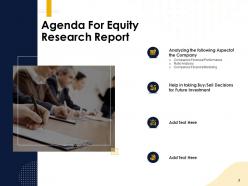
Slide 2: This slide displays Agenda.
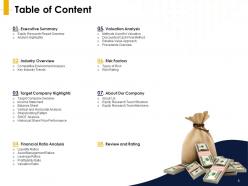
Slide 3: This slide depicts Table of Content of the presentation.
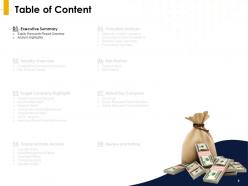
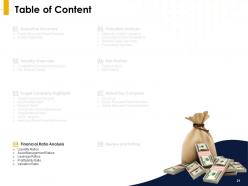
Slide 4: This slide displays Table of Content.
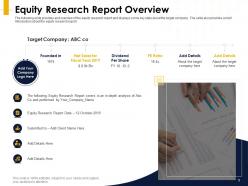
Slide 5: This slide provides and overview of the equity research report and displays some key stats about the target company . The slide also provides a brief Introduction about the equity research report.
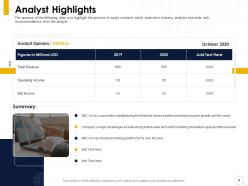
Slide 6: The purpose of the following slide is to highlight the process of equity research which starts from Industry analysis and ends with recommendations from the analyst.
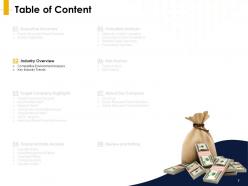
Slide 7: This slide display Table of Content.
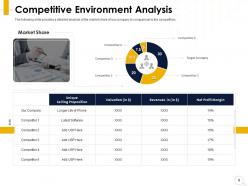
Slide 8: This slide provides a detailed analysis of the market share of our company in comparison to the competition.
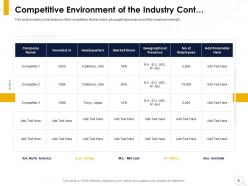
Slide 9: This slide provides a brief analysis of the competitors Market share, geographical presence and their employee strength.
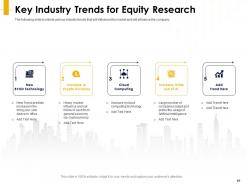
Slide 10: This slide to enlists various Industry trends that will influence the market and will influence the company.
Slide 11: This slide displays Table of Content.
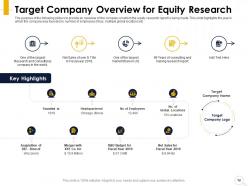
Slide 12: The purpose of the slide is to provide an overview of the company on which the equity research report is being made.
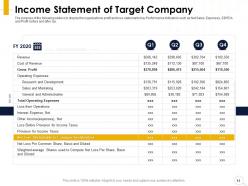
Slide 13: The purpose of this slide is to display the organizations profit and loss statements Key Performance Indicators such as Net Sales, Expenses , EBITDA and Profit before and after tax.
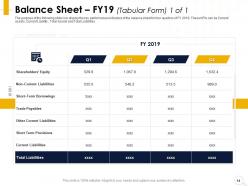
Slide 14: The purpose of the following slide is to display the key performance indicators of the balance sheet for four quarters of FY 2019. These KPIs can be Current assets, Current Liability , Total Assets and Total Liabilities
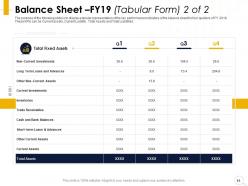
Slide 15: The purpose of the following slide is to display a tabular representation of the key performance indicators of the balance sheet for four quarters of FY 2019. These KPIs can be Current assets, Current Liability , Total Assets and Total Liabilities.
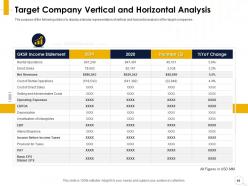
Slide 16: The purpose of the following slide is to display a tabular representation of vertical and horizontal analysis of the target companies .
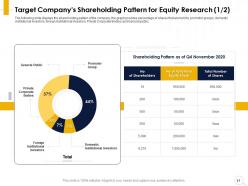
Slide 17: This slide displays the share holding pattern of the company, the graph provides percentage of shares that are held by promotor groups, domestic institutional investors, foreign Institutional investors, Private Corporate Bodies and General public.
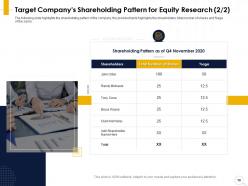
Slide 18: This slide highlights the shareholding pattern of the company, the provided table highlights the shareholders, total number of shares and %age of the same .
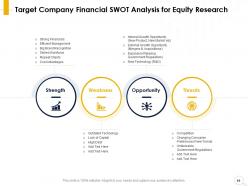
Slide 19: This slide represents Target Company Financial SWOT Analysis for Equity Research.
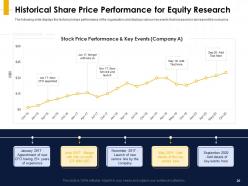
Slide 20: This slide displays the historical share performance of the organization and displays various key events that increased or decreased the sock price.
Slide 21: This slide displays Table of Content.
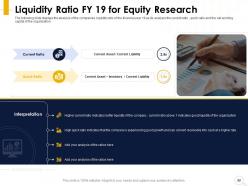
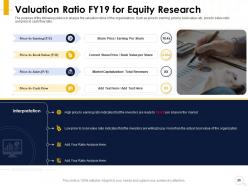
Slide 22: This slide displays the analysis of the companies liquidity ratio of the financial year 19 as its analysis the current ratio , quick ratio and the net working capital of the organization.
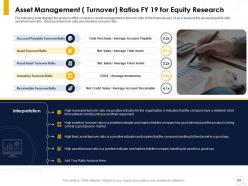
Slide 23: This slide displays the analysis of the company's asset management or turnover ratio of the financial year 19 as it analysis the account payable ratio, asset turnover ratio , fixed asset turnover ratio and inventory turnover ratio.
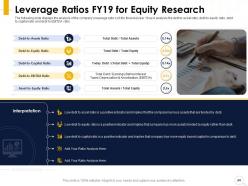
Slide 24: This slide displays the analysis of the company’s leverage ratio o of the financial year 19 as it analysis the debt to asset ratio, debt to equity ratio, debt to capital ratio and debt to EBITDA ratio.
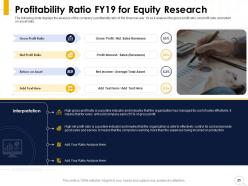
Slide 25: This slide displays the analysis of the company’s profitability ratio of the financial year 19 as it analysis the gross profit ratio, net profit ratio and return on asset ratio.
Slide 26: The following slide displays the analysis of the company’s profitability ratio of the financial year 19 as it analysis the gross profit ratio, net profit ratio and return on asset ratio.
Slide 27: This slide shows Table of Content.
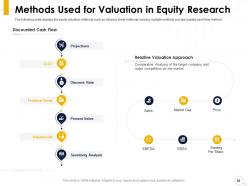
Slide 28: This slide displays the equity valuation methods such as balance sheet methods, earning multiple methods and discounted cash flow method.
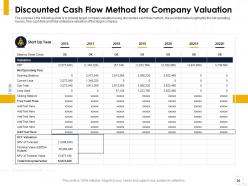
Slide 29: The purpose of the following slide is to provide target company valuation using discounted cash flow method, the provided table hoighlights the net operating losses , free cash flow and total enterprise valuation of the target company.
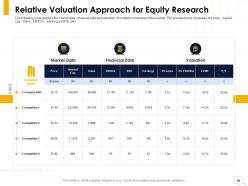
Slide 30: This slide displays the market data, financial data and valuation of multiple companies of the market. The provided table compares the price , market cap , Sales , EBITDA , earning and P/E ratio.
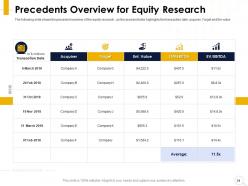
Slide 31: The following slide shows the precedent overview of the equity research, as the provided table highlights the transaction date, acquirer, Target and the value.
Slide 32: This slide displays Table of Content.
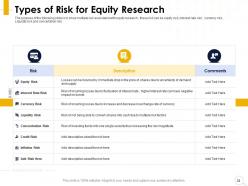
Slide 33: The purpose of the following slide is to show multiple risk associated with equity research, these risk can be equity risk, interest rate risk , currency risk , Liquidity risk and concertation risk .
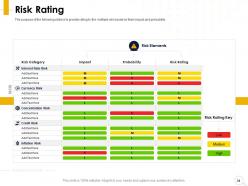
Slide 34: The purpose of the following slide is to provide rating to the multiple risk based on their impact and probability.
Slide 35: This slide depicts Table of Content.
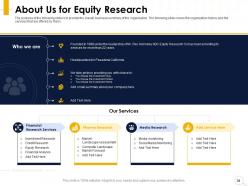
Slide 36: The purpose of the following slide is to provide the overall business summary of the organization. The following slide covers the organization history and the services that are offered by them .
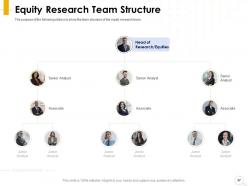
Slide 37: The purpose of the following slide is to show the team structure of the equity research team.
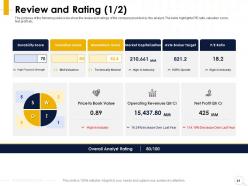
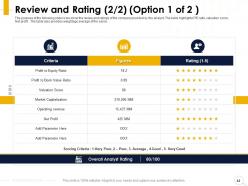
Slide 38: The purpose of the slide is to show the review and ratings of the company provided by the analyst. The table highlights P/E ratio, valuation score, Net profit . The table also provides weightage average of the same.
Slide 39: The purpose of the following slide is to show the equity research team of the organization as it highlights the key credentials of the team members, their names and their designation.
Slide 40: This slide displays Table of Content.
Slide 41: The purpose of the following slide is toe show the review and ratings of the company provided by the analyst. The table highlights P/E ratio, valuation score, Net profit etc.
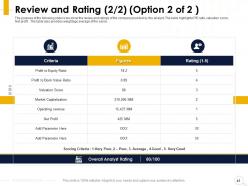
Slide 42: The purpose of the following slide is toe show the review and ratings of the company provided by the analyst. The table highlights P/E ratio, valuation score, Net profit . The table also provides weightage average of the same.
Slide 43: The purpose of the following slide is toe show the review and ratings of the company provided by the analyst.
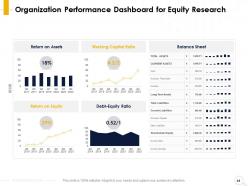
Slide 44: This slide shows Organization Performance Dashboard for Equity Research
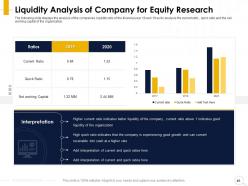
Slide 45: The following slide displays the analysis of the companies liquidity ratio of the financial year 18 and 19 as its analysis the current ratio , quick ratio and the net working capital of the organization.
Slide 46: This is Icons Slide for Investment Research Report.
Slide 47: This slide is titled as Additional Slides for moving forward.
Slide 48: This is About us slide to showcase Company specifications.
Slide 49: This is Our Mission slide with Vision, Mission and Goal.
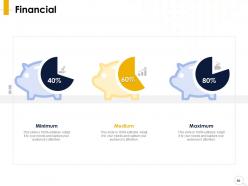
Slide 50: This is Financial slide. Showcase finance related stuff.
Slide 51: This slide displays Targets of the Company.
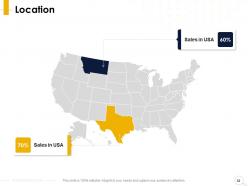
Slide 52: This slide displays Location.
Slide 53: This is Venn slide.
Slide 54: This slide is titled as Post It Notes for posting important notes.
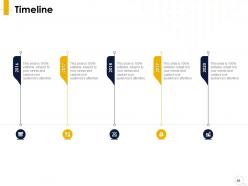
Slide 55: This slide shows Timeline process.
Slide 56: This is Idea Generation slide to highlight important ideas and facts.
Slide 57: This is Thank you slide with Address, Email address and Contact number.
Investment Research Report Powerpoint Presentation Slides with all 57 slides:
Use our Investment Research Report Powerpoint Presentation Slides to effectively help you save your valuable time. They are readymade to fit into any presentation structure.





FAQs for Investment Research Report
Start with the basics - P/E ratio, revenue growth, profit margins, debt-to-equity. Those are your bread and butter. For valuation, grab price-to-book and EV/EBITDA. ROE and ROA show how well they're actually using their money (this stuff matters way more than people think). But here's the thing - you need forward-looking metrics too. Analyst estimates, guidance changes, market share trends. Risk stuff like beta is clutch. Honestly, I'd probably stick to 8-10 total metrics max. Any more and you'll just confuse everyone, including yourself.
So basically, industry trends are huge for investment calls. Analysts love upgrading when they see good stuff happening - more demand, helpful regulations, that kind of thing. But market saturation or new competitors? Yeah, that usually means downgrades. Short-term, these bigger trends actually matter more than how well individual companies are doing, which is kinda wild if you think about it. I always check what macro themes they're highlighting first. That's where you'll find the really good insights that everyone else might miss.
So quantitative stuff gives you the hard numbers, but qualitative analysis is where you actually figure out if a company's worth investing in. Two companies can have identical financials but totally different futures - that's the thing people miss. You're digging into management quality, how strong their competitive position really is, industry trends, whether their business model makes sense long-term. Honestly, this is where you'll catch red flags that financial statements won't show you. Leadership track record matters. Corporate governance, brand strength, market dynamics - all that stuff. Start with recent earnings call transcripts though. Management's tone during Q&A tells you everything about what's coming.
Honestly, charts can be way more persuasive than just talking fundamentals all day. Pick 2-3 solid technical signals - support/resistance levels, moving averages, volume stuff. Don't go crazy with every indicator though, it just looks messy. Your audience gets it faster when they can actually see the price action happening. Make sure you're explaining what the charts mean in normal language, not trader speak. Oh and always connect it back to why you're actually recommending the stock. Sometimes I think people forget that part. Charts show clear entry/exit points which makes your whole thesis feel more concrete.
Don't cherry-pick data that fits your story while ignoring stuff that doesn't. Bias is your worst enemy here. Also, avoid those crazy complex models that nobody can follow - I've read reports that felt like doctoral dissertations instead of actual investment advice. Keep your assumptions realistic and spell them out clearly. Never extrapolate growth forever (companies don't grow to infinity, obviously). Always test different scenarios to see how your valuation holds up. Oh, and be honest about what could go wrong - admitting uncertainty actually makes you look more credible, not less.
Build three scenarios - base case, upside, and downside. Start with your most realistic projections for the base case. Then mess with the variables that actually matter: revenue growth, margins, market stuff. Honestly, the downside scenario teaches you way more than the others. Don't just nudge numbers by 10-20% - think about what would completely wreck your thesis. Like, what if the market tanks or a competitor shows up? Give each scenario rough probabilities and see if your returns still make sense. If you're only feeling good about the best-case scenario... that's probably not great.
Look, risk assessment is what makes or breaks a research report. Anyone can talk up the good stuff, but spotting what could actually screw you over? That's where the money is. You've got to dig into market risks, company problems, all that messy stuff that might kill your thesis. Honestly, I've seen too many reports that basically ignore the downside completely. Quantify it when you can - both how likely bad scenarios are and how much damage they'd do. Your clients need this to figure out position sizes and not blow up their portfolios.
Start with your big insight first - like "their margins are crushing competitors" - then back it up with data. Charts beat tables every time, and honestly? Only highlight 2-3 metrics that actually move the needle. I used to throw every calculation on slides thinking it looked smart... total disaster. Your audience needs to know what to DO with this info, not decode a spreadsheet. Tuck the nerdy details in appendices so execs get the headline fast. Oh, and if you can't explain your main points without the slides, you're probably overcomplicating things. Practice that part.
Bloomberg Terminal's amazing if you can afford it, otherwise Yahoo Finance does the job. FactSet's solid too but pricey. For company filings, just hit up SEC's EDGAR database - totally free and has all the 10-Ks you need. Excel's still your best friend for building models, though I know some people swear by Google Sheets now. Industry reports from IBISWorld are clutch but honestly can get expensive fast. Oh and grab earnings transcripts when you can. My take? Master one platform completely instead of bouncing around. I made that mistake early on and wasted so much time.
Honestly, SWOT analysis is what separates decent investment reports from the garbage ones. You get this clear breakdown of strengths, weaknesses, opportunities, and threats that shows investors you actually researched the company AND the market around it. Way better than those reports that just highlight the good stuff. The framework keeps you honest - forces you to look at potential problems too. I always think it's like showing your work in math class, you know? Back up each point with real data and recent examples. Red flags become obvious when you lay everything out like this. Makes your whole investment argument way more believable.
Look, you've gotta be upfront about conflicts of interest - like if your firm has banking relationships or owns stock in companies you're covering. That transparency thing isn't negotiable. Don't trade on insider info obviously, and watch out for selective disclosure when chatting with clients. Your research methodology needs to be solid and unbiased too. Honestly the whole industry can be sketchy sometimes, but just keep asking yourself: does this actually help investors or am I just chasing my firm's profits? Stay on the right side of that line and you'll be fine.
So macro factors are basically the backdrop for all your investment calls - think interest rates, inflation, job numbers, GDP stuff. They directly shape how sectors perform and what stocks are worth. Skip them and you're flying blind, honestly. Don't just throw macro data in your intro and call it a day though. Weave it through the whole analysis. The key is connecting those trends to actual investment moves, not just rattling off economic stats. Like, if inflation's rising, what does that mean for your energy picks vs tech names? That's where the real value is.
Start with your actual recommendation - don't make people dig for it! Hit the key numbers, valuation, and risks right in your executive summary with bullets. One clear sentence per point, that's it. Visuals help sell your numbers way better than walls of text. I'd put your strongest evidence first, then build from there. Honestly, I see too many reports where you can't even find what they're actually suggesting until page 3. End with specific price targets and timelines so everyone knows exactly what you're proposing. Makes decision-making so much faster when it's laid out clearly.
Look, peer comparisons are what separate legit analysis from total guesswork. You're basically checking if a stock is actually cheap or expensive compared to similar companies - P/E ratios, margins, growth rates, that stuff. Without it, you're just pulling numbers out of thin air. I've seen too many reports that skip this step and they always feel half-baked. The key is picking actual competitors though, not just random companies in the same sector. It grounds your whole thesis in reality and shows you actually understand what you're talking about. Makes your price targets way more credible too.
Honestly, waterfall charts are amazing for breaking down returns by different factors - nobody uses them enough. Keep your visuals super clean though. Line graphs for trends, bar charts when you're comparing stuff, and maybe pie charts for portfolio splits (but don't go crazy with those). Heat maps are perfect for sector performance over time. Here's the thing - ditch the 3D garbage and neon colors. Two colors max, three if you really need it. The secret sauce? Always tell people your main point first, then show the chart that backs it up. Don't make them hunt for the story.
-
Presentation Design is very nice, good work with the content as well.