Real estate property investment analysis powerpoint presentation slides
Try Before you Buy Download Free Sample Product
Audience
Editable
of Time
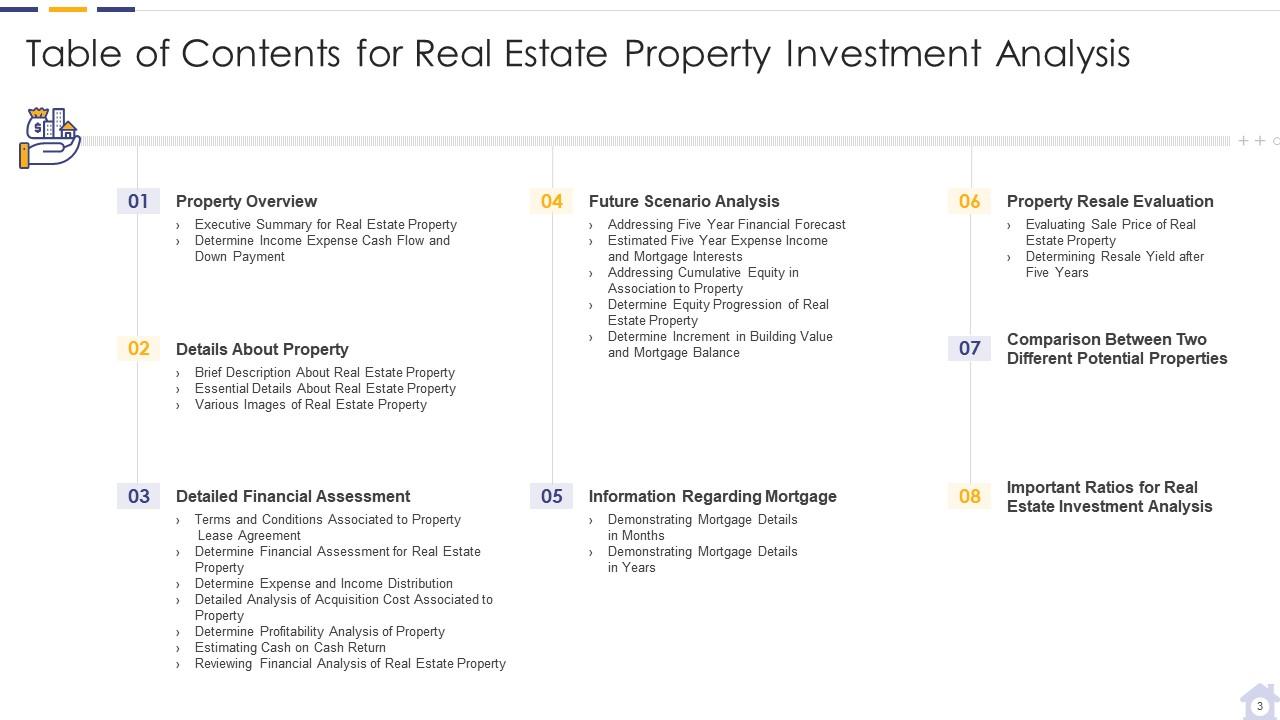
Real estate investment analysis caters to the systematic investigation of various factors and elements affecting the current and future value of the specific property. It caters to consideration of the relationship among factors and components associated with investment decisions. Here is an efficiently designed template on Real Estate Property Investment Analysis that will address the investment worthiness of real estate property by assessing it on specific parameters for real estate investors to determine total returns in terms of income or capital growth. The deck caters to slides about property overview in terms of the executive summary, income expense cash flow, and down payment. The deck covers details about financial assessment of property along with terms and conditions associated with the property lease agreement, expense and income distribution, profitability analysis, estimating cash on return, future scenario analysis, information regarding mortgage, property resale evaluation, comparison among potential properties, and essential ratios for real estate investment. Download this 100 percent editable and insightful template now.
People who downloaded this PowerPoint presentation also viewed the following :
Content of this Powerpoint Presentation
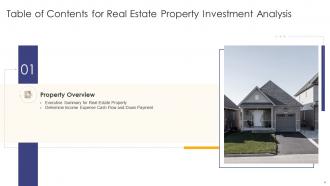
Slide 1: This slide introduces Real Estate Property Investment Analysis. State Your Company Name and begin.
Slide 2: This slide shows Agenda for Real Estate Property Investment Analysis.
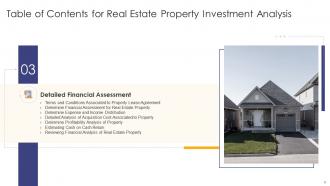
Slide 3: This slide presents Table of Contents for Real Estate Property Investment Analysis.
Slide 4: This slide displays title for topics that are to be covered next in the template.
Slide 5: This slide represents Executive Summary for Real Estate Property.
Slide 6: This slide showcases information regarding income, expenses, cash flow and down payment associated to real estate property.
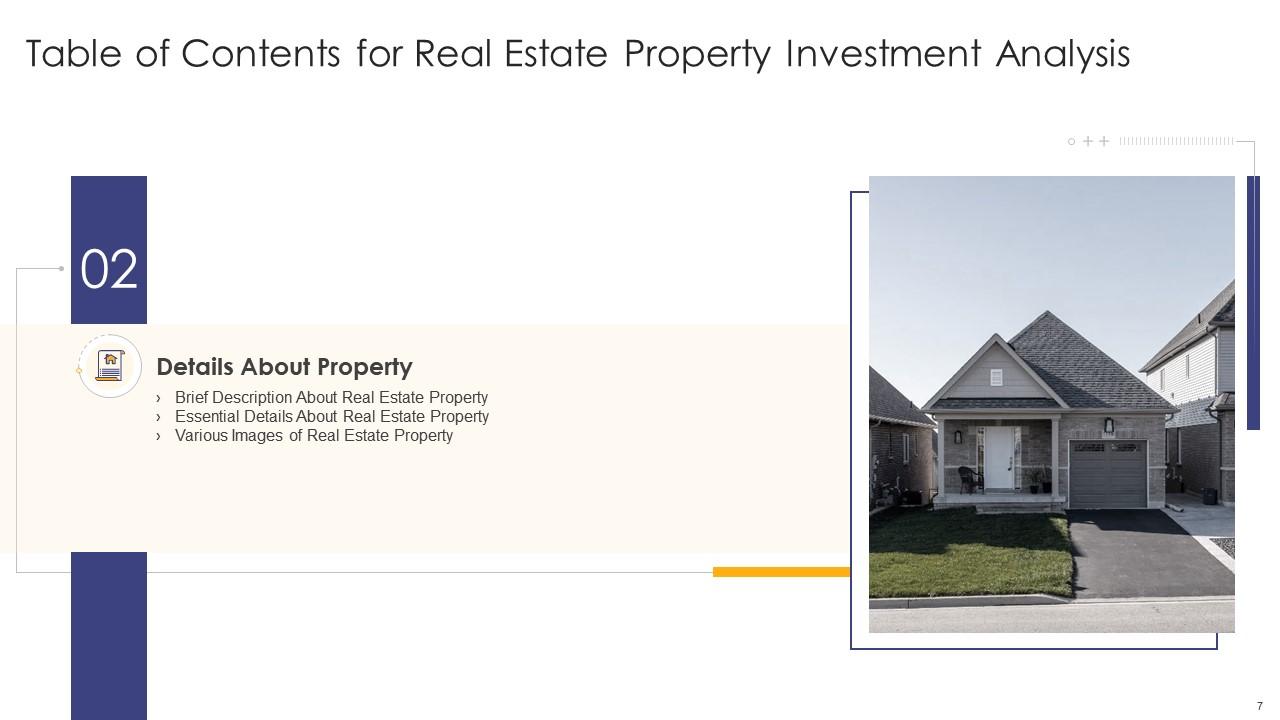
Slide 7: This slide shows title for topics that are to be covered next in the template.
Slide 8: This slide presents real estate property in terms of its location, owner, description, etc.
Slide 9: This slide displays real estate property in terms of its relevant details such as basic amenities, building dimensional, etc.
Slide 10: This slide represents real estate property images such as front view, back view, fireplace image, etc.
Slide 11: This slide showcases title for topics that are to be covered next in the template.
Slide 12: This slide shows Terms and Conditions Associated to Property Lease Agreement.
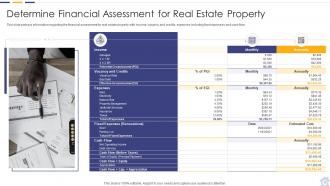
Slide 13: This slide presents Determine Financial Assessment for Real Estate Property.
Slide 14: This slide displays expense and income distribution sources associated to real estate property.
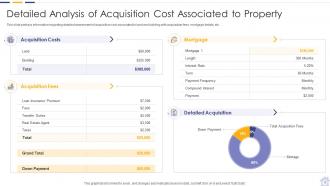
Slide 15: This slide represents Detailed analysis of acquisition cost associated to property.
Slide 16: This slide showcases detailed profitability analysis of property by determining acquisition cost and market value.
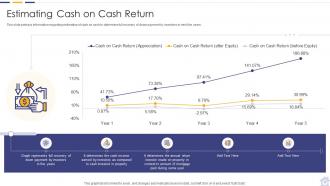
Slide 17: This slide shows estimation of cash on cash to determine full recovery of down payment.
Slide 18: This slide presents Reviewing Financial Analysis of Real Estate Property.
Slide 19: This slide displays overall financial analysis of real estate property in terms of income, operating expenses.
Slide 20: This slide represents title for topics that are to be covered next in the template.
Slide 21: This slide showcases estimation of five-year financial forecast for income and expenses.
Slide 22: This slide shows Estimated five year expense income and mortgage interests.
Slide 23: This slide presents assessment of cumulative equity in context to real estate property.
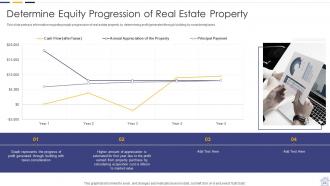
Slide 24: This slide displays Determine equity progression of real estate property.
Slide 25: This slide represents Determine increment in building value and mortgage balance.
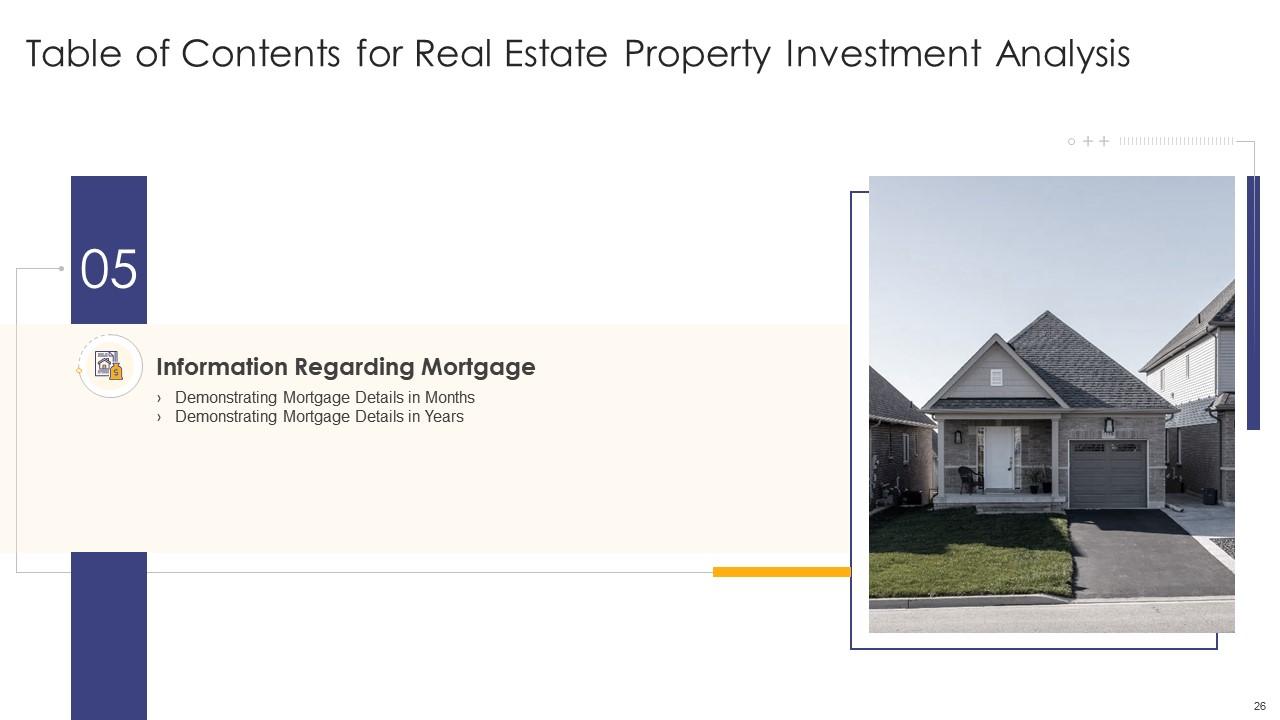
Slide 26: This slide showcases title for topics that are to be covered next in the template.
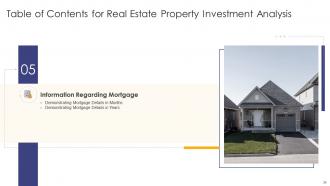
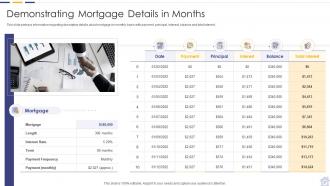
Slide 27: This slide shows descriptive details about mortgage on monthly basis with payment, principal, etc.
Slide 28: This slide presents descriptive details about mortgage on yearly basis with total payment, principal, etc.
Slide 29: This slide displays title for topics that are to be covered next in the template.
Slide 30: This slide represents evaluation of sale price for real estate property with debt service coverage ratio and down payment.
Slide 31: This slide showcases estimation of resale yield after five years with net assets, capital gain, tax, etc.
Slide 32: This slide shows title for topics that are to be covered next in the template.
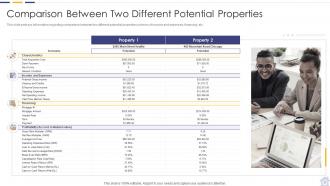
Slide 33: This slide presents Comparison Between Two Different Potential Properties.
Slide 34: This slide displays title for topics that are to be covered next in the template.
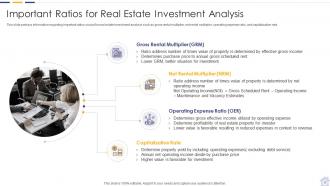
Slide 35: This slide represents Important Ratios for Real Estate Investment Analysis.
Slide 36: This slide showcases Multiple Projects Comparison for Real Estate Investment.
Slide 37: This slide shows Icons for Real Estate Property Investment Analysis.
Slide 38: This slide is titled as Additional Slides for moving forward.
Slide 39: This slide shows 30 60 90 Days Plan with text boxes.
Slide 40: This slide presents Roadmap with additional textboxes.
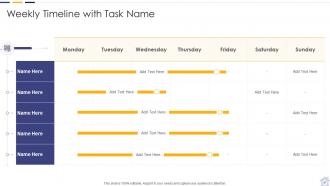
Slide 41: This slide shows Weekly Timeline with Task Name.
Slide 42: This is About Us slide to show company specifications etc.
Slide 43: This is Our Mission slide with related imagery and text.
Slide 44: This is Our Team slide with names and designation.
Slide 45: This slide shows Line chart with two products comparison.
Slide 46: This slide presents Venn diagram with text boxes.
Slide 47: This slide displays Mind Map with related imagery.
Slide 48: This slide represents Post It Notes. Post your important notes here.
Slide 49: This slide showcases Puzzle with related icons and text.
Slide 50: This is a Thank You slide with address, contact numbers and email address.
Real estate property investment analysis powerpoint presentation slides with all 58 slides:
Use our Real Estate Property Investment Analysis Powerpoint Presentation Slides to effectively help you save your valuable time. They are readymade to fit into any presentation structure.
FAQs for Real estate property investment analysis
Honestly, just nail down the big three first - cap rate, cash-on-cash return, and monthly cash flow. Cap rate shows what the property returns annually without any loans involved. Your cash-on-cash tells you what you're actually earning on whatever you put down. Monthly cash flow is huge though - negative numbers will stress you out fast! Also check the 1% rule real quick (rent should hit 1% of purchase price) and don't forget vacancy rates in your area. I learned that one the hard way lol. Run these on anything you're serious about and you'll know if it's even worth looking at.
So cash flow analysis just shows you if a property will actually put money in your pocket each month or if you'll be hemorrhaging cash. Take your rental income and subtract everything - mortgage, taxes, maintenance, vacancy time when nobody's renting. Too many new investors (myself included back in the day) totally forget about all those random expenses that pop up. Negative cash flow means you're literally paying to own this "investment" which is backwards. Always crunch these numbers before making an offer, and yeah, definitely pad it for surprise repairs because something will break.
Honestly, location and market trends are everything - they'll make or break your whole investment. Job growth and population data are huge. Check employment numbers and new construction permits too. Schools always matter for resale value, even if you're not going after families (learned that one the hard way). Look at comparable sales from this past year to see if you're buying at the right time. I always dig into what's actually driving the local economy. Sure, run your property numbers. But if you ignore the bigger picture, you're gonna get blindsided by risks you never saw coming.
Check the neighborhood first - crime stats, schools, job market, any new developments coming. Then crunch your numbers: cash flow, cap rates, debt ratios. Vacancy rates are huge too (wish someone told me that earlier lol). I always make a basic spreadsheet to compare deals side by side. Don't put all your eggs in one basket with analysis - look at multiple angles. Also think about your exit plan and how easy it'll be to sell later. The market liquidity matters more than people realize.
Honestly just start with Excel or Google Sheets - they'll cover like 90% of your cash flow and ROI stuff. BiggerPockets has some decent free calculators too if you want something ready-made. Once you get more serious, people seem to love REI/Wise and PropertyRadar, but they're not cheap. I use Zillow and Rentometer for quick rental comps even though they're kinda hit or miss sometimes. My advice? Master spreadsheets first. You can always upgrade to fancy paid software later when you actually know what features you need.
Okay so first thing - check out the neighborhood basics like schools, transit, jobs nearby. That stuff drives demand long-term. Then dig into recent sales data and price trends from the past few years. Fair warning though, the data part gets super boring but you gotta do it. Also look up any big infrastructure projects or zoning changes coming down the pipeline. I'd honestly just hit up multiple sources - MLS records, city planning docs, local market reports. The more angles you get, the better picture you'll have. It's kind of a pain but worth it.
So basically residential is way simpler - you're just looking at comparable sales, price per square foot, what houses nearby sold for recently. Commercial real estate is a totally different beast though. You've got to analyze cash flow, cap rates, lease terms, operating expenses... there's all these metrics like IRR and DSCR that honestly made my head spin when I first started looking into it. Plus commercial tenants usually sign way longer leases so the income's more stable. I'd definitely start with residential first - way less overwhelming and you can actually wrap your head around it.
Honestly, I swear by checking job market data every month - it's crazy how well it predicts rental demand. GDP growth and interest rates are obvious ones to watch. Population shifts and new businesses opening up? Those spots usually get hot fast. Inflation helps you guess where rents are headed, and construction permits warn you if there's gonna be too much supply. Oh, and set up Google alerts so you're not constantly hunting for info. Pick like 3-4 things that matter for your area and stick with those. You'll go nuts trying to track everything.
So there's basically three ways to figure out what a property's worth. Most people start with comparing recent sales of similar houses nearby - just adjust for stuff like size and how beat up it is. For rentals, look at the income it generates and cap rates, that's usually pretty reliable. The third way is estimating what it'd cost to rebuild minus depreciation, but honestly that's kinda tedious unless it's some weird unique property. Oh and definitely use two methods to double-check yourself - I learned that the hard way when I was way off on a duplex last year.
Oh man, zoning is huge - can totally make or break a deal. I got burned on a duplex once because I didn't check properly first. Basically determines what you can actually do with the property, rental restrictions, future development stuff. Violations mean fines or having to change things, which sucks. Always verify your intended use is allowed and check if any changes are coming down the pipeline. Call the planning department - they're surprisingly helpful most of the time. Free advice that'll save you major headaches later.
Honestly, just focus on three main numbers and you'll be fine. Cap rate is your NOI divided by what you paid - shoot for 6-10% but depends on your area. Cash-on-cash return matters more though since it shows what you're actually making on the money you put down. The 1% rule is kinda outdated now (rent should equal 1% of purchase price) but I still use it as a quick filter. Don't stress about hitting perfect numbers on everything. Pull these stats on a few properties around you first - you'll get a feel for what's actually realistic vs what the books say.
Look at historical data to spot trends and patterns - like which neighborhoods consistently appreciate or when rental demand peaks seasonally. You'll see how past market crashes and interest rate shifts played out too. Market cycles repeat themselves more than people think. But don't just rely on old numbers since real estate has so many moving pieces. Current conditions matter just as much. Check what's happening now - new developments coming in, job growth, stuff like that. Honestly, the best approach mixes historical patterns with what's actually going on today.
Dude, don't trust those income statements from sellers - they're basically fantasy novels half the time. Run your own numbers and be conservative as hell. Vacancy and repairs will eat you alive if you don't budget for them properly. I learned this the hard way lol. Also those online rent estimates? Pretty much garbage. You gotta actually check what places are renting for in that exact neighborhood. Capital expenses are sneaky too - AC units die, roofs leak, shit happens. Always pad your calculations with at least 10-15% extra. And never, EVER skip the inspection to save a few hundred bucks.
Using debt basically amplifies everything - your gains AND your losses. You're putting less cash down upfront, so your returns can look amazing when things go well. But you've also got those monthly mortgage payments no matter what happens. I learned this the hard way on my second property tbh. Higher break-even point means you're more screwed if you hit vacancy issues or rents drop. What I do now is run different loan scenarios - like 75% vs 85% financing - to see how badly my returns get hit if things go south. Just don't get too greedy with the debt amount.
Your exit plan needs to match your timeline and what the market's doing. Main options: sell to regular buyers for top dollar, flip to other investors for fast cash, refi and hold for monthly income, or do a 1031 exchange to dodge taxes while moving up. Honestly, I've watched way too many people fall in love with their properties and blow perfect selling opportunities. Set your criteria early - ROI targets, time limits, whatever. Keep tabs on your local market. Have 2-3 backup plans ready because you never know what things'll actually look like when it's go time.
-
Content of slide is easy to understand and edit.
-
Perfect template with attractive color combination.
-
Understandable and informative presentation.
-
Qualitative and comprehensive slides.