


Investor presentation to raise capital from series c funding powerpoint presentation slides





Try Before you Buy Download Free Sample Product
 Impress Your
 Audience
 100%
100% Editable
 Save Hours
 of Time


Our Investor Presentation To Raise Capital From Series C Funding Powerpoint Presentation Slides are topically designed to provide an attractive backdrop to any subject. Use them to look like a presentation pro.
People who downloaded this PowerPoint presentation also viewed the following :
Content of this Powerpoint Presentation
Slide 1: This title slide introduces the Investor Presentation to Raise Capital from Series C Funding. Add the name of your company here.
Slide 2: This is the Agenda slide. It includes - Influence the investors to invest in our business so that the company can expand its operations and get profitable over time, Revenue Forecast, Valuation Tables, Growth Strategies, etc.
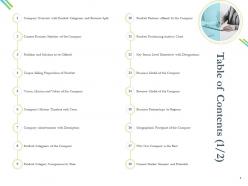
Slide 3: This slide contains the Table of Contents (1/2). It includes - Product Positioning Analysis Chart, Product Features offered by the Company, Current Market Scenario, and Potential, etc.
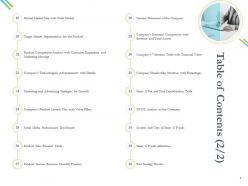
Slide 4: This slide contains the Table of Contents (2/2). It includes - Company’s Financial Comparison with Revenue and Total Assets, Income Statement of the Company, Exit Strategy Routes, etc.
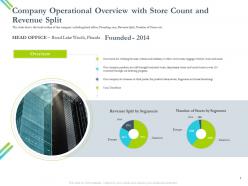
Slide 5: This slide presents the Company Operational Overview with Store Count and Revenue Split. It shows the brief outline of the company including head office, Founding year, Revenue Split, Number of Stores, etc.
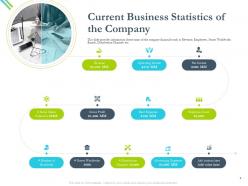
Slide 6: This slide presents the Current Business Statistics of the Company. It provides information about some of the company's financials such as Revenue, Employees, Stores Worldwide, Brands, Distribution Channels, etc.
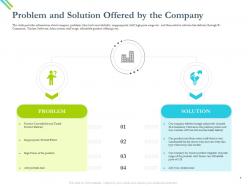
Slide 7: This slide presents the Problem and Solution Offered by the Company. It provides information about company problems and their relative solution.
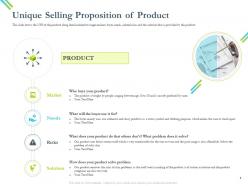
Slide 8: This slide presents the Unique Selling Proposition of the Product. It shows the USP of the product along with details related to the target market, buyer needs, related risks, and the solution that is provided by the product.
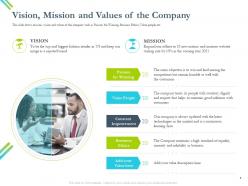
Slide 9: This slide presents mission, vision, and values of the company such as Passion for Winning, Business Ethics, Value people, etc.
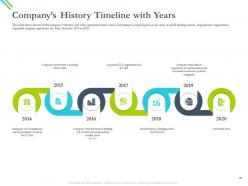
Slide 10: This slide presents the Company’s History Timeline with Years. It shows the history of the company with years and some important events.
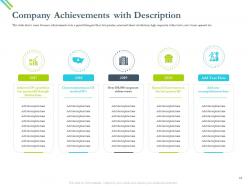
Slide 11: This slide presents the Company Achievements with a Description. It shows some business achievements over a period like growth in the last quarter, increased client satisfaction, high corporate video views, new stores opened, etc.
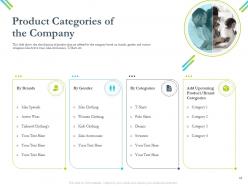
Slide 12: This slide presents the Product Categories of the Company. It shows the classification of product that is offered by the company based on brands, gender and various categories like Activewear, Men Accessories, T-Shirts, etc.
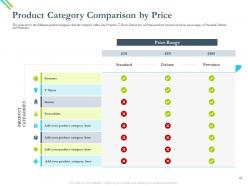
Slide 13: This slide presents the Product Category Comparison by Price. It shows the different product categories that the company offers and their product versions based on price ranges of Standard, Deluxe, and Premium.
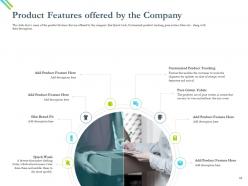
Slide 14: This slide presents the Product Features offered by the Company. It shows some of the product features that are offered by the company along with their description.
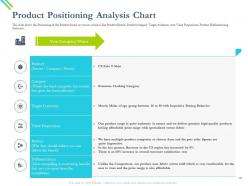
Slide 15: This slide presents the Product Positioning Analysis Chart. It shows the Positioning of the Product based on various criteria.
Slide 16: This slide presents the Key Senior Level Executives with Designations. It shows the various members of the company and a structural team along with their job responsibility details and image.
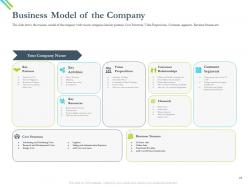
Slide 17: This slide presents the Business Model of the Company. It shows the business model of the company with various categories.
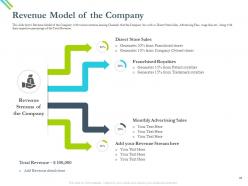
Slide 18: This slide presents the Revenue Model of the Company. It shows the Revenue Model of the Company with various revenue-earning Channels that the Company has along with their respective percentage of the Total Revenue.
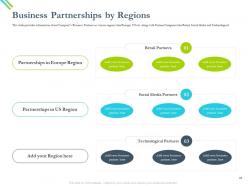
Slide 19: This slide presents the Business Partnerships by Regions. It provides information about the Company’s Business Partners in various regions along with Partner Categories like Retail, Social Media, and Technological.
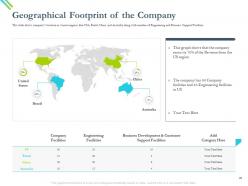
Slide 20: This slide presents the Geographical Footprint of the Company. It shows the company’s location in various regions like the USA, Brazil, China, and Australia along with a number of Engineering and Business Support Facilities.
Slide 21: This slide presents Why Our Company is the Best. It shows positives of our company products and services based on certain aspects.
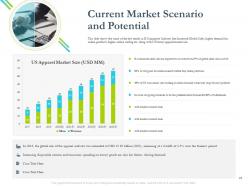
Slide 22: This slide presents the Current Market Scenario and Potential. It shows some of the key trends in the E-Commerce Industry along with the US luxury apparel market size.
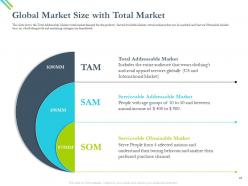
Slide 23: This slide presents the Global Market Size with the Total Market. It shows the Total Addressable Market, Served Available Market, and Service Obtainable Market basis on which the growth and marketing strategies are formulated.
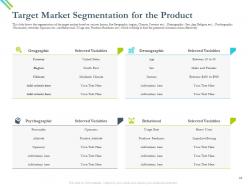
Slide 24: This slide presents the Target Market Segmentation for the Product. It shows the segmentation of the target market based on various factors which will help to find the potential customers more effectively.
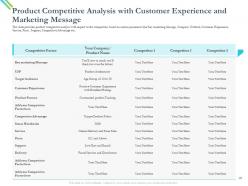
Slide 25: This slide presents the Product Competitive Analysis with Customer Experience and Marketing Message.
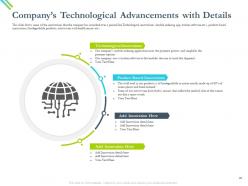
Slide 26: This slide presents the Company’s Technological Advancements with Details. It shows some of the innovations that the company has launched over a period.
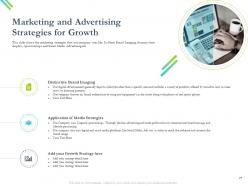
Slide 27: This slide presents the Marketing and Advertising Strategies for Growth. It shows the marketing strategies that our company uses.
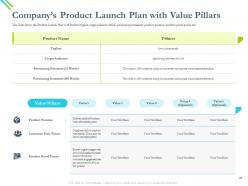
Slide 28: This slide presents the Company’s Product Launch Plan with Value Pillars. It shows the Product Launch Plan with Product tagline, target audience details, positioning statement, product promise, product proof points, etc.
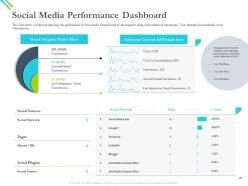
Slide 29: This slide presents the Social Media Performance Dashboard. It shows a dashboard depicting the performance of the Social Media Channel used by the company along with the number of conversions, Visits through Social referrals, social networks, etc.
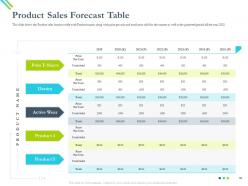
Slide 30: This slide presents the Product Sales Forecast Table. It shows the Product sales forecast table with Product names along with price per unit and total units sold for the current as well as the projected period till the year 2025.
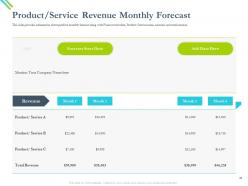
Slide 31: This slide presents the Product/Service Revenue Monthly Forecast. It provides information about product monthly forecast along with Forecast start date, Product/Service name, amounts, and total revenue.
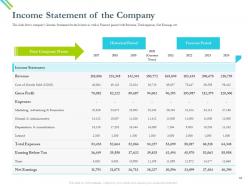
Slide 32: This slide presents the Income Statement of the Company. It shows the company’s Income Statement for the historic as well as the Forecast period with Revenue, Total expenses, Net Earnings, etc.
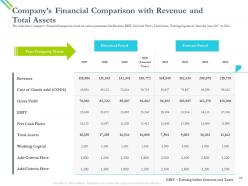
Slide 33: This slide presents the Company’s Financial Comparison with Revenue and Total Assets. It shows the company’s Financial Comparison based on certain parameters.
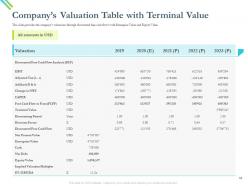
Slide 34: This slide presents the Company’s Valuation Table with Terminal Value. It provides the company’s valuations through discounted free cash flows with Enterprise Value and Equity Value.
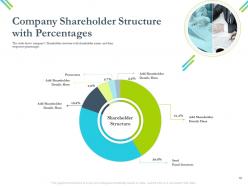
Slide 35: This slide presents the Company Shareholder Structure with Percentages. It shows the company’s Shareholder structure with shareholder names and their respective percentages.
Slide 36: This slide presents the Series C Pre and Post Capitalization Table. It shows the company’s pre and a post-capitalization comparison table with the total valuation of shares and their ownership percentage.
Slide 37: This slide presents the SWOT Analysis of the Company. It shows the company’s strategic planning techniques (strengths, weaknesses, opportunities, and threats) related to the business.
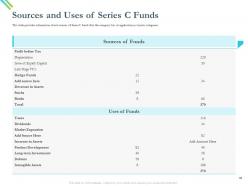
Slide 38: This slide presents the Sources and Uses of Series C Funds. It provides information about sources of Series C funds that the company has its application in various categories.
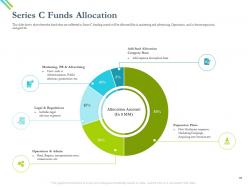
Slide 39: This slide presents the Series C Funds Allocation. It shows that where the funds that are collected in the Series C funding round will be allocated like in marketing and advertising, Operations, and in future expansion and growth.
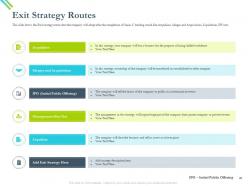
Slide 40: This slide presents the Exit Strategy Routes. It shows the Exit strategy routes that the company will adopt after the completion of the Series C funding round like Acquihires, Mergers and Acquisitions, Liquidation, IPO, etc.
Slide 41: This is the Investor Presentation to Raise Capital from Series C Funding – Icons Slide.
Slide 42: This slide introduces the Additional Slides.
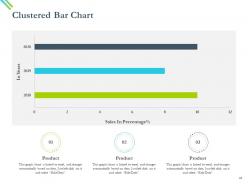
Slide 43: Clustered Bar Chart This slide shows a bar graph that compares 3 products’ sales over a timeline of years.
Slide 44: This slide provides the Mission for the entire company. This includes the vision, the mission, and the goal.
Slide 45: This slide contains the information about the company aka the ‘About Us’ section. This includes the Value Clients, the Target Audience, and Preferred by Many.
Slide 46: This slide shows the members of the company team with their name, designation, and photo.
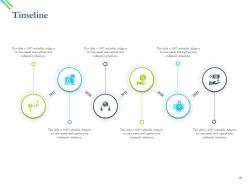
Slide 47: This slide is a Timeline template to showcase the progress of the steps of a project with time.
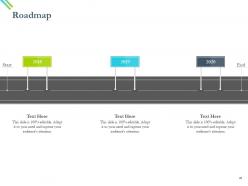
Slide 48: This slide is a Roadmap template to showcase the stages of a project, for example.
Slide 49: This is a Thank You slide where details such as the address, contact number, email address are added.
Investor presentation to raise capital from series c funding powerpoint presentation slides with all 49 slides:
Use our Investor Presentation To Raise Capital From Series C Funding Powerpoint Presentation Slides to effectively help you save your valuable time. They are readymade to fit into any presentation structure.











FAQs for Investor presentation to raise capital from series c funding
Your Series C deck needs to show you've figured out the business model - solid unit economics and a real path to profitability. Investors aren't wondering "will this work" anymore, they want to see scale potential. Include your competitive advantages, experienced team, and how you're actually capturing that big market opportunity you're talking about. Honestly, the financials section is make-or-break here - show 3+ years of growth projections. Don't just throw out a funding number either. Connect your ask directly to specific growth milestones. At this stage it's all about proving you can dominate your space.
Pick 3-5 metrics that actually matter - MRR, customer acquisition cost, lifetime value. That stuff. Make the story super clear with visuals so trends jump out immediately. They're gonna drill down into details anyway, so have your cohort analyses ready. Context is huge too - show them market size and your path to profitability. Honestly, the hardest part is not overwhelming them with every data point you've collected. Practice explaining what drives each metric because they'll definitely ask. Oh, and unit economics breakdowns are non-negotiable.
Don't just rattle off features - show them why competitors can't touch you. Network effects, proprietary data, switching costs that actually matter. Back it up with real numbers too, like retention rates or cost savings. Honestly, most founders just say "we're the best" without proving anything. Walk through actual deals where your advantages won won you business. How has your position gotten stronger since Series B? Then map out exactly how this funding widens the gap even more. VCs want to see the moat getting deeper, not just existing.
Dude, by Series C you absolutely need bulletproof market validation - no more hand-waving allowed. Investors want to see customers actually sticking around and spending more, not just kicking the tires. Show them solid retention numbers, growing user base, and honestly your unit economics better make sense by now. Cohort analysis is your friend here. NDR above 110% if you can swing it. Enterprise customers are clutch too if that's your market. Gone are the days where a cool product idea was enough - they need proof people are hooked on what you're selling long-term.
Dude, your financial forecasting has to be rock solid for Series C. These investors aren't gambling on dreams anymore - they want hard proof you know your unit economics inside and out. Show them a realistic path to profitability over 3-5 years, backed by actual data from what you're doing now. Don't go crazy optimistic, but don't be boring either. Honestly, the investors I know get annoyed when founders clearly just pulled numbers out of thin air. Run different scenarios before you pitch. What happens if growth slows? They'll probably ask anyway.
Be straight up about the risks - competition, scaling headaches, regulatory stuff, whatever's actually stressing you out. But don't just dump problems on them. Right after you mention each risk, explain how you're dealing with it and what your backup plan is. Series C investors aren't looking for rainbows and unicorns anymore. They want to see you've hit some walls and figured out how to get around them with real data, not just wishful thinking. Honestly? Make a whole slide for this instead of crossing your fingers it won't come up. Shows you're not trying to hide anything.
Honestly, just focus on clean visuals that don't make investors squint. Waterfall charts work great for showing revenue growth, and cohort tables are perfect for retention data. PowerPoint's default templates are totally fine - I see too many people waste time on fancy designs when the numbers matter more. One insight per slide, max. Bar charts and line graphs are your friends here. Oh, and definitely test everything on someone first because what makes sense to you might be confusing as hell to others. Use callout boxes to highlight the big wins. The goal is making your data look impressive but not overwhelming.
Series C investors want to see every dollar mapped out with real specifics. Break your fund allocation into clear buckets - product dev, market expansion, hiring, operations - with actual amounts and timelines. Instead of saying "we'll hire engineers," show them exactly how many, which roles, expected salaries. Honestly, the buffer category saved my butt more times than I can count because unexpected stuff always comes up. Each allocation should connect directly to your growth metrics and revenue projections. Create a simple visual breakdown and be ready to justify every single line item when they grill you.
Focus on unit economics first - show them your customer acquisition costs vs lifetime value with real numbers. Investors at Series C want to see you've cracked repeatable growth, so highlight successful expansion into new markets or customer segments. The financial projections part is honestly a bit of a guessing game, but ground them in your actual performance data. Talk about key hires you've made and operational systems that prove you can scale the team. Most crucial thing? Come with specific examples of scaling problems you've already solved. They don't want to hear about potential issues - they want proof you've handled growth challenges before and lived to tell about it.
Show them your numbers have seriously jumped since Series B - like 3-5x revenue growth if possible. Customer acquisition, retention rates, market expansion, all that good stuff. But don't just dump spreadsheets on them. Walk them through the story - how you crushed product milestones, landed key partnerships, hired the right people. Geographic expansion is huge too if you've done it. Honestly, they're mostly trying to figure out if you can handle massive scale without imploding. Focus on whatever proves you're ready for that next level of growth and won't just burn through their cash.
Dude, biggest thing is having your unit economics super clear - like, crystal clear numbers on how you make money per customer. Market size stuff? Don't go crazy with those inflated TAM numbers, investors roll their eyes at that amateur move. Focus way less on early traction stories and more on showing scalable growth metrics since you're at Series C now. Be brutally honest about competition too - they'll sniff out any BS immediately. Oh and definitely have rock-solid answers ready for the gnarly financial questions because they will grill you on those. Keep everything tight on business fundamentals.
Dude, storytelling is everything for Series C. Investors see so many pitches that are just spreadsheets with legs - total snoozefest. You need that narrative thread: problem → your journey → where you're crushing it now → the massive opportunity ahead. Customer stories hit different than charts ever will. Include those founder moments where everything clicked. Show them the "why" behind your numbers, not just the what. Make it feel like missing this round means they're sitting out the next unicorn. Honestly, the best pitches I've seen feel less like presentations and more like inevitable success stories they'd be crazy not to join.
Focus on CAC and LTV first - you want that 3:1 ratio minimum. Monthly churn rates are crucial, plus net revenue retention over 110%. Cohort analysis gets tedious but honestly it's your best friend for proving retention is improving. Growth efficiency stuff like payback period matters too. Sales velocity by channel, conversion rates, all that. The magic number is another good one to throw in there. Series C investors obsess over efficient growth way more than raw growth - they need to see you're not just burning cash to scale. Those cohort charts look messy but tell the real story.
Different investors care about totally different stuff, so you gotta switch up your pitch accordingly. VCs are obsessed with massive scale - they want to see how you'll hit those 10x returns and expand like crazy. Corporate investors? They're basically asking "what's in it for us" - focus on how you'd work with their existing business. PE folks are way more conservative at this point, so hit them hard with your profit margins and how efficiently you run things. Oh, and here's the thing - don't make entirely new decks. Just spend more time on the slides that matter to whoever you're talking to. Same presentation, different emphasis.
Your team slide is make-or-break at Series C. Investors want proof you can hit $100M+ revenue, so skip the generic job titles - nobody cares. Show real numbers instead. Like "VP Sales grew ARR from $10M to $50M at Company X" or "CTO handled 10x user growth without breaking anything." Focus on 2-3 bullet points per person that scream "we've scaled before." I've watched too many founders bomb this by listing where people went to school or whatever. Put your biggest wins front and center - previous exits, domain expertise, anything that shows you're not first-timers.
-
Attractive design and informative presentation.
-
Excellent Designs.
-
Great quality slides in rapid time.
-
Out of the box and creative design.
-
Informative design.
-
Attractive design and informative presentation.
-
Best Representation of topics, really appreciable.
-
Awesomely designed templates, Easy to understand.
-
Unique and attractive product design.
-
Awesomely designed templates, Easy to understand.
-
Page:
- You're currently reading page 1
- Page 2
-
