


IoT Predictive Maintenance Dashboard For Mining Vehicle




Try Before you Buy Download Free Sample Product
 Impress Your
 Audience
 100%
100% Editable
 Save Hours
 of Time


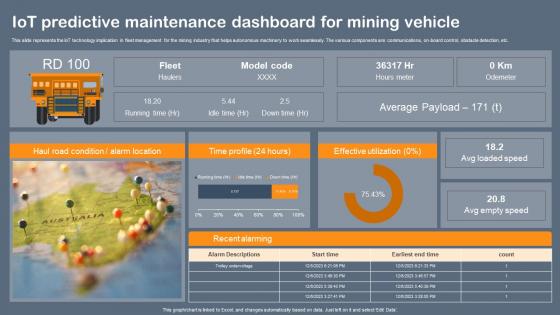
This slide represents the IoT technology implication in fleet management for the mining industry that helps autonomous machinery to work seamlessly. The various components are communications, on board control, obstacle detection, etc.
People who downloaded this PowerPoint presentation also viewed the following :
IoT Predictive Maintenance Dashboard For Mining Vehicle with all 10 slides:
Use our IoT Predictive Maintenance Dashboard For Mining Vehicle to effectively help you save your valuable time. They are readymade to fit into any presentation structure.









FAQs for IoT Predictive Maintenance Dashboard
Start with equipment health scores and failure predictions - that's your bread and butter. Temperature, vibration, and pressure data will save your butt by catching problems early. Track asset utilization rates too because honestly, why spend money fixing stuff that sits idle half the time? Don't forget maintenance costs per asset and downtime duration so you can actually prove ROI to the higher-ups. Work order completion rates matter too. I'd say pick maybe 5-7 metrics to start - any more and your team's gonna get overwhelmed trying to make sense of it all.
Dude, real-time viz is a total game changer for catching issues before they blow up. You'll actually see temperature spikes or weird vibration patterns happening live on your dashboard instead of waiting weeks for some report. Honestly beats the hell out of finding out your bearing died on a random Tuesday. I've watched temperatures slowly climb over hours - way better than those surprise 3am panic calls. You can finally schedule maintenance when it works for you, not when everything's on fire. My advice? Pick your 3 biggest failure points first and get those hooked up.
Honestly, vibration sensors are where you want to start - they'll catch bearing issues and misalignment way before things go sideways. Temperature monitoring is solid too for spotting overheating in motors. Current monitors are clutch for electrical problems that show motor wear. I'd throw acoustic sensors in there if you've got rotating equipment making weird noises. But really, just focus on vibration and temp for your most critical stuff first. Don't overthink it. Once you prevent one major breakdown, the ROI basically pays for itself. Trust me on this one.
So basically these algorithms dig through all your equipment data - sensor readings, maintenance records, failure logs, the whole mess. They catch patterns we'd totally miss. Pretty wild how they get better as you dump more data into them. Your typical "replace every 1000 hours" approach? Forget that. ML looks at real conditions - how hard you're running things, vibration weirdness, temp swings, all of it. The predictions get scary accurate once you've got enough history. Oh, and definitely focus on getting clean sensor data first. That's honestly where most people screw up.
Historical data is basically what makes your predictive maintenance model actually work - it teaches algorithms to spot failure patterns. Feed it sensor readings, maintenance logs, and failure records so it learns normal vs warning signs. Like showing someone thousands of driving examples before they get behind the wheel. Without good data, predictions are pretty much useless guesswork. Honestly, I'd start hoarding everything now, even stuff that seems random. You'll be grateful later when you're building models and have tons of examples to work with.
Alright, so there's basically three things you gotta tackle. Start with validation rules right at the sensor level - just filter out the crazy readings before they mess up your dashboard. That's gonna give you the biggest bang for your buck right away. Then set up some automated checks for missing timestamps, duplicate stuff, or when sensors randomly die (which honestly happens way more than it should). Oh, and don't forget to audit your dashboard metrics against actual equipment performance every so often. Sensors drift over time and you'll catch calibration issues that way. Pretty straightforward once you get the flow down.
So you're gonna need a few things to pull this off. Start with MQTT or CoAP protocols - they're solid for getting your IoT devices to actually talk to each other. Edge computing is where it gets interesting though, since you can process stuff locally instead of sending everything to the cloud (way faster for real-time monitoring). AWS IoT or Azure work great for the heavy data storage and analytics side. Oh, and you definitely need machine learning frameworks - that's literally how the predictive stuff works. Integration APIs are honestly a pain to set up right. My advice? Test with just one device type first before you go crazy scaling everything up.
Look, your maintenance crew needs to catch problems quickly, so don't make them dig through a messy dashboard. I've worked with teams who missed critical alerts because their interface looked like something from a sci-fi movie - way too complicated. Put your most important stuff right up front. Color coding helps, but make it obvious what each color means. Short sentences work better than long explanations when someone's trying to fix equipment. Oh, and definitely test it with the actual technicians first. They'll tell you real fast if something doesn't make sense. Simple beats fancy every time.
Honestly, the data stuff will drive you crazy - your old equipment doesn't play nice with new IoT sensors, so integration is a total pain. Getting your ops team on board is tough too since they don't trust the predictions yet. Clean data is everything though, otherwise you're just making decisions off junk. Your maintenance crew will need training to think ahead instead of just fixing broken stuff. Oh, and definitely start with just one important machine to show it actually works before going all-in. That's what saved us from a huge mess.
So basically, those IoT sensors track stuff like vibration and temperature constantly - the amount of data is honestly insane. When algorithms spot patterns that usually mean something's about to fail, you get a heads up with enough time to actually plan repairs. No more 2 AM emergency shutdowns when everything goes to hell. You're fixing things on your timeline instead of scrambling. I'd definitely start with whatever equipment would screw you over most if it died. Way better than reactive maintenance where you're just waiting for things to break.
Start with the big picture KPIs, then let people dig deeper into details. Group related stuff together instead of spreading it all over - makes way more sense. Red/yellow/green color coding works great for equipment health status. Heat maps are perfect for spotting patterns across multiple assets. You'll want to include context like historical data or benchmarks, otherwise the numbers are pretty meaningless. Honestly, avoid those fancy 3D charts - they just make everything harder to read. Most important thing though? Test it with the actual techs who'll use it daily. They'll catch issues you never thought of.
Track your savings from fewer breakdowns and emergency repairs against what you spent on the dashboard setup. The math works once data starts coming in. Before/after maintenance costs are key - unplanned downtime, emergency calls, replacement parts. Productivity gains from reliable equipment matter too, though they're harder to pin down exactly. Most places hit ROI around 12-18 months, sometimes faster if their equipment was really unreliable before. Get your baseline numbers now so you can actually prove it worked later.
First off, get multi-factor authentication set up - seriously, don't skip this part. Role-based access is huge too, so people only see their own stuff. Everything needs encryption (transit and storage), because hackers go crazy for IoT data. Network segmentation helps keep your devices separate from important systems. Keep your dashboard and devices updated regularly - I know it's annoying but patches matter. Oh, and monitoring/logging will save your butt when weird stuff starts happening. Quarterly security checks aren't glamorous but they'll catch problems early. Trust me on this one.
Honestly, just give each role what they actually need. Maintenance guys want the nitty-gritty - alerts, work orders, sensor readings they can fix right away. Operations managers? They're looking at bigger trends like downtime patterns and equipment effectiveness. Don't bog them down with individual bearing temps or whatever. Executives only care about the money stuff - ROI, cost savings, risk summaries for their meetings. Role-based permissions are clutch here so people aren't drowning in irrelevant data. I'd start by just asking each group what decisions they make daily. Saves you tons of guesswork.
Edge computing's pushing analytics right to your equipment now. AI pattern recognition is getting scary good, plus digital twins are creating virtual copies for better predictions. 5G finally makes real-time monitoring actually real-time (about time). AR lets techs see maintenance data right on the equipment - pretty cool stuff. Oh, and integration with enterprise systems isn't a nightmare anymore. My advice? Start with one critical asset, don't go crazy with data collection. Quality beats quantity every time. Just make sure your team can actually understand what they're looking at.
-
Placing an order on SlideTeam is very simple and convenient, saves you a lot of your time.
-
What an exhaustive collection of templates you guys have there in slideteam. Impressive!!!