IoT Platform HVAC Management Dashboard For Smart Analyzing IoTs Smart Building IoT SS

Rating:
100%
IoT Platform HVAC Management Dashboard For Smart Analyzing IoTs Smart Building IoT SS IoT Platform HVAC Management Dashboard For Smart Analyzing IoTs Smart Building IoT SS
Slide 1 of 9

or

Favourites Favourites

Try Before you Buy Download Free Sample Product

Audience Impress Your
Audience
Editable 100%
Editable
Time Save Hours
of Time
The Biggest Sale is ending soon in
0
0
:
0
0
:
0
0
Rating:
100%
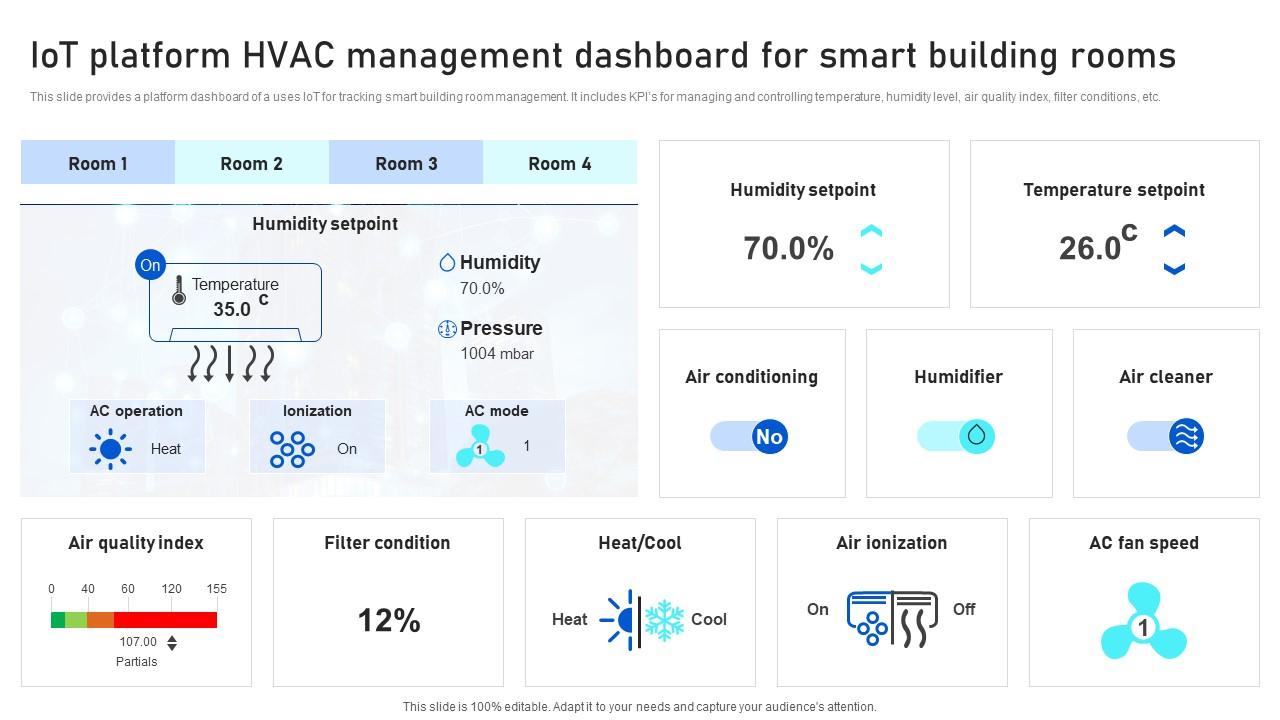
This slide provides a platform dashboard of a uses IoT for tracking smart building room management. It includes KPIs for managing and controlling temperature, humidity level, air quality index, filter conditions, etc. Deliver an outstanding presentation on the topic using this IoT Platform HVAC Management Dashboard For Smart Analyzing IoTs Smart Building IoT SS. Dispense information and present a thorough explanation of Management, Temperature, Conditioning using the slides given. This template can be altered and personalized to fit your needs. It is also available for immediate download. So grab it now.

FAQs for IoT Platform HVAC Management Dashboard For Smart Analyzing IoTs Smart

Key features include real-time temperature monitoring, energy consumption analytics, predictive maintenance alerts, remote system control, and automated scheduling capabilities. These technologies streamline facility management by reducing operational costs, preventing equipment failures, and optimizing energy efficiency, with many commercial buildings finding that integrated dashboards deliver up to 30% energy savings while enhancing tenant comfort.

IoT sensors enhance HVAC efficiency by continuously monitoring temperature, humidity, occupancy, and energy consumption, enabling systems to automatically adjust settings based on real-time conditions. Through predictive analytics and automated controls, facilities like hospitals and office buildings reduce energy costs by up to 30%, while maintaining optimal comfort levels and extending equipment lifespan.

Predictive analytics enables IoT HVAC dashboards to forecast equipment failures, optimize energy consumption patterns, and anticipate maintenance needs by analyzing historical data, sensor readings, and environmental trends. Through machine learning algorithms, facilities managers can prevent costly breakdowns, reduce energy costs by up to 30%, and maintain optimal comfort levels, with many commercial buildings finding that proactive insights deliver significant operational efficiency and extended equipment lifespan.

User interface design enhances IoT HVAC management dashboard experiences by providing intuitive navigation, real-time data visualization, customizable alerts, mobile responsiveness, and streamlined control workflows. Through clean layouts and interactive elements, facility managers can monitor temperature zones, adjust settings remotely, and identify maintenance needs efficiently, ultimately delivering faster response times and improved operational control.

Essential security measures for IoT HVAC management systems include end-to-end encryption, multi-factor authentication, network segmentation, regular firmware updates, and access control protocols. These technologies safeguard building operations by preventing unauthorized access, protecting sensitive environmental data, and ensuring system integrity, with many facilities management companies finding that comprehensive security frameworks ultimately deliver operational confidence and regulatory compliance.

Integration enhances HVAC dashboard functionality by consolidating lighting, security, fire safety, and energy management data into unified control interfaces, enabling cross-system automation and comprehensive building optimization. Through integrated platforms, facility managers can coordinate HVAC operations with occupancy sensors, lighting schedules, and security protocols, ultimately delivering enhanced energy efficiency, improved occupant comfort, and streamlined operational oversight.

Effective HVAC performance data visualization techniques include real-time gauge displays for temperature and pressure readings, heat maps for spatial temperature distribution, trend line graphs for energy consumption patterns, and color-coded status indicators for system health monitoring. These visual approaches enable facility managers to quickly identify inefficiencies, predict maintenance needs, and optimize energy usage across multiple zones, ultimately delivering improved operational control and significant cost reductions in large commercial buildings.

Remote access capabilities enable facility managers to monitor, control, and optimize HVAC systems from anywhere, reducing response times, minimizing on-site visits, and streamlining maintenance scheduling. Through cloud-based dashboards, managers can adjust temperatures, diagnose issues, and track energy consumption across multiple buildings or floors, ultimately delivering operational efficiency and cost savings while ensuring optimal comfort levels.

Machine learning significantly enhances HVAC diagnostic accuracy by analyzing vast sensor datasets, identifying subtle pattern anomalies, and predicting equipment failures weeks before they occur. Through advanced algorithms, facilities managers achieve 85-90% prediction accuracy for maintenance needs, dramatically reducing unexpected breakdowns, minimizing energy waste, and ultimately delivering substantial cost savings while ensuring optimal building comfort across commercial and industrial environments.

IoT dashboards help achieve compliance by providing real-time monitoring of energy consumption, emissions tracking, automated reporting capabilities, and alert systems for regulatory thresholds. These platforms enable organizations to maintain continuous oversight of HVAC performance against standards like ASHRAE and EPA requirements, while automatically generating compliance reports and identifying potential violations before they occur, ultimately delivering reduced regulatory risk and streamlined audit processes.

Common challenges include legacy system integration complexities, network connectivity limitations, sensor installation disruptions, data standardization issues, and staff training requirements across diverse building infrastructures. These implementation hurdles often involve retrofitting older HVAC systems with smart sensors, ensuring reliable wireless coverage throughout multi-story facilities, and managing operational continuity during upgrades, with many building managers finding that phased rollouts and strategic vendor partnerships ultimately streamline adoption while minimizing business disruptions.

Cloud computing enhances HVAC management dashboards by providing scalable storage infrastructure, real-time data processing capabilities, and seamless integration across multiple building locations. Through cloud platforms, facility managers can access comprehensive analytics, automated maintenance scheduling, and predictive insights from anywhere, while reducing on-premises hardware costs and enabling faster system responses, ultimately delivering improved energy efficiency and operational control.

IoT-based HVAC management dashboards deliver significant cost savings through automated energy optimization, predictive maintenance scheduling, real-time performance monitoring, and reduced manual oversight requirements. These systems enable organizations to achieve 15-30% energy cost reductions, minimize equipment downtime through early fault detection, and streamline facility management operations, with many commercial buildings and manufacturing facilities finding that intelligent automation ultimately delivers faster ROI and enhanced operational efficiency.

User feedback drives IoT HVAC dashboard improvements through analyzing usage patterns, identifying feature gaps, and prioritizing enhancement requests from facility managers and technicians. Many organizations leverage feedback analytics to streamline interface design, add predictive maintenance alerts, and integrate energy optimization tools, ultimately delivering more intuitive controls and reduced operational costs.

Current trends shaping IoT HVAC management include AI-driven predictive maintenance, cloud-based monitoring platforms, integration with smart building ecosystems, real-time energy optimization, and mobile-responsive dashboards. These technologies streamline facility operations by reducing unexpected breakdowns, enhancing energy efficiency, and enabling remote system control, with many organizations finding that strategic IoT implementation delivers significant cost savings and improved occupant comfort.

Ratings and Reviews

100% of 100
Review Form
Write a review
Most Relevant Reviews
  1. 100%

    by James Lewis

    Thank you SlideTeam for such an excellent service.
  2. 100%

    by Clayton Sanders

    I've been looking for a good template source for some time. I'm happy that I discovered SlideTeam. Excellent presentations must try!

2 Item(s)

per page: