


Operational performance metrics examples presentation ideas




Try Before you Buy Download Free Sample Product
 Impress Your
 Audience
 100%
100% Editable
 Save Hours
 of Time


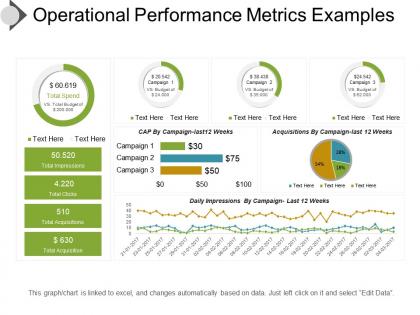
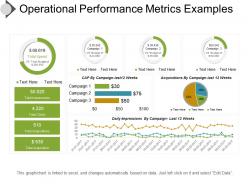
Evaluate your company performance with our ready to use PPT design tool on operational performance metrics PPT image layout. It will help in defining your business value by measuring your company growth prospects. Use this performance metrics PowerPoint layout diagram to define the metrics and their impact on your business structure. Thus the metric which can be analyzed or evaluate to measure your company performance are customer satisfaction level, employee satisfaction level, productivity level, profitability and more. Where measuring the levels as discussed above with this efficiency metrics PowerPoint layout template will also help in improving your employee’s efficiency also. It also helps in enhancing your business productivity and capability too. Define its importance with this business performance metrics PowerPoint slide design. It helps in improving your management efficiency by taking effective decisions. It also helps in taking competitive edge over others in the market. Click on the download link to simply start working over this PPT diagram on the concept of operational KPI PPT layout. Curb communal conflicts with our Operational Performance Metrics Examples Presentation Ideas. Convince folks about the Doctrine of Humanity.
People who downloaded this PowerPoint presentation also viewed the following :
Operational performance metrics examples presentation ideas with all 5 slides:
Our Operational Performance Metrics Examples Presentation Ideas will give you a leg up. Climb the rungs of sucess with your brilliant ideas.


FAQs for Operational performance metrics
You definitely want to track OEE first - it's basically your equipment's report card. Shows you the real efficiency picture. Cycle time matters too since it affects how much you can actually produce and what delivery dates you can promise customers. Defect rates are huge because they catch quality problems early, way before angry customers start calling. If you can swing it, also watch inventory turnover and on-time delivery. Those five will cover most of your bases. Just get daily dashboards running so your team can actually see what's happening. Makes spotting problems so much easier.
Honestly, start with the basics - track your order fulfillment times, inventory turnover, and how often deliveries actually show up on time. Real-time dashboards are a game changer for catching problems early. Don't sleep on supplier performance either, because unreliable vendors will mess up everything downstream. Transportation costs can get out of hand fast too. Here's what I'd do: map out your whole process step by step first. You'll probably find inefficiencies you didn't even know existed. Then benchmark against what others in your industry are doing and focus on your worst bottlenecks first.
Look, you can hit all your efficiency targets and have crazy fast processing times, but if customers hate the experience? Those numbers are basically worthless. Think of it like this - nobody cares how fast your car goes if it's uncomfortable to sit in. What you really want is connecting your operational changes to actual customer feedback scores. I mean, that's the only way to know if you're improving stuff that customers actually notice. Track how tweaking your KPIs affects what customers are saying. Otherwise you're just optimizing random metrics that don't really matter to anyone.
Think of operational metrics like a health check for your business processes. Track things like cycle times, error rates, and how you're using resources - patterns will pop up pretty quickly. You might spot bottlenecks in certain workflow stages or notice defect rates going crazy during night shifts (which honestly happens more than you'd think). Look for anything that consistently deviates from your benchmarks. My advice? Pick your three biggest headaches first and find metrics that actually measure those specific problems. Don't overcomplicate it.
Honestly, start simple with just 2-3 metrics that actually matter for your business. Output per hour and quality scores are solid basics. Task completion rates tell you a lot too. I'd also look at revenue per employee if that applies to your situation. Time-to-complete is weirdly addictive to track - teams get obsessed because the data's so clear. Project deadlines met, customer satisfaction tied to specific people, billable hour utilization... there's tons you could measure. Oh, and don't sleep on goal achievement rates. Training completion matters too, depending on your industry. But seriously, don't try tracking everything at once - you'll go crazy and nothing will actually improve.
Think of cost per unit like a health check for your operations. When it goes down, you're getting more efficient. Spikes usually mean something's broken - could be waste, bad resource use, or workflow issues. I track mine weekly because honestly, it catches problems faster than anything else. The real magic happens when you dig into why it changed after making operational tweaks. That's how you figure out what actually works. It's basically your early warning system, but way more useful than most metrics because it tells you exactly where to look next.
Honestly, start by nailing down exactly what you're measuring and how - write it all out so there's no confusion later. Automate the data collection wherever you can because people always mess up the manual stuff (learned this the hard way). Give each metric an owner so someone's actually responsible. Train everyone on the process upfront. Oh, and do regular check-ins to catch when things start getting sloppy - they always do eventually. The trick is making it part of people's normal routine instead of some extra thing they'll definitely forget about.
Different industries care about completely different things when measuring success. Retail tracks inventory turnover and conversion rates. Healthcare? They're all about patient satisfaction and readmission rates - makes sense since people's lives are literally on the line. Meanwhile logistics companies obsess over delivery times and shipping costs. It really comes down to what actually drives revenue in each sector. Like, a hospital doesn't care about same-store sales growth, you know? When you're looking at any company's performance, just figure out what "winning" looks like for their specific industry first.
Dude, there are tons of ways to squeeze more juice out of your operational data. Predictive analytics lets you spot issues before they blow up - super useful. Machine learning finds patterns you'd never see otherwise. Statistical process control helps separate real problems from normal ups and downs, which honestly most people totally overlook. Root cause analysis is where the magic happens though. That's how you figure out WHY things are happening instead of just what's happening. I'd start with predictive modeling on whatever metrics matter most to your business. Quick wins there, then branch out to the other stuff once you've got momentum.
Hey! So here's the thing - small businesses can totally beat bigger companies at their own game because you're not stuck in endless committee meetings. Pick like 3-5 metrics that actually matter to your customers (response time, how much it costs to get new customers, inventory stuff). Check them weekly, not monthly like the corporate giants do. When something looks weird, you can actually DO something about it right away. Honestly, most big companies are jealous of that flexibility. Start with whatever's your biggest headache operationally and find one number to track it.
Honestly, the toughest part is finding decent comparison data. Especially if you're in some weird niche industry - good luck with that! Most people mess up by comparing themselves to companies that are way too different, or they use ancient industry averages that mean nothing now. Quality benchmark data costs a fortune too. Company size matters, location matters, your whole business model affects everything. Here's what I'd do though - start tracking your own stuff first. See how you improve over time, then slowly add outside comparisons when you find better sources.
Dude, IoT sensors basically do all the monitoring for you - no more waiting around for manual reports. They track everything from how your equipment's running to room temperature and stuff. Then AI jumps in and spots patterns you'd totally miss. Real-time dashboards that actually update themselves? Game changer. Plus you get heads up before things break, which honestly saves so much headache. The whole setup means you're making decisions on current data instead of week-old info. I'd say pick one process to test it on first, then go from there once you see how well it works.
For tracking ops performance, dashboards are clutch - set up KPI scorecards with those red/yellow/green indicators so you can spot issues fast. Heat maps are perfect when you need to see patterns across different teams or time periods. Honestly, waterfall charts don't get enough love but they're amazing for showing how various factors mess with your main numbers. Trend lines are obvious but necessary for tracking changes over time. Control charts will flag when stuff goes off the rails. Oh, and whatever you pick - make sure people can understand it immediately. Nobody's got time to decipher confusing visuals during a Monday morning meeting.
Dude, predictive analytics basically flips the script on how you handle operations. You stop putting out fires and start preventing them. Like, you can actually see demand spikes coming, catch equipment before it breaks down, and get your resources where they need to be ahead of time. Your efficiency numbers get way better, downtime becomes rare, and you're not constantly scrambling to meet targets. Honestly, it's kind of wild how much smoother things run. Just figure out your biggest operational headaches first - that's where you'll see the most impact when you start forecasting around those specific problems.
Map your operational metrics straight back to strategic goals first. No clear connection? Ditch it. I've honestly seen way too many dashboards full of complete fluff metrics that look impressive but mean nothing. Leading indicators are where it's at - they actually predict success instead of just telling you what already went down. Your teams need to get the "why" behind what they're tracking too, otherwise they're just hitting random numbers. Oh and don't forget to review these regularly since strategies shift. The whole point is making sure everyone sees how their daily grind connects to the bigger picture.
-
Out of the box and creative design.
-
Great quality slides in rapid time.