


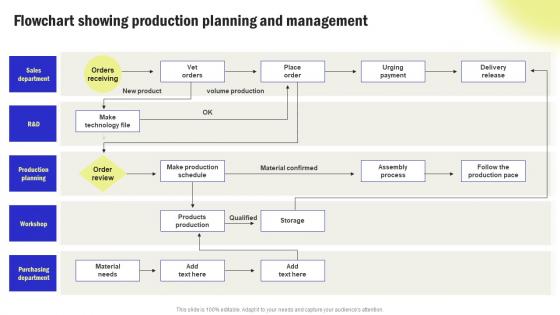
Flowchart Showing Production Planning Streamline Processes And Workflow With Operations Strategy SS V




Try Before you Buy Download Free Sample Product
 Impress Your
 Audience
 100%
100% Editable
 Save Hours
 of Time


Our Flowchart Showing Production Planning Streamline Processes And Workflow With Operations Strategy SS V are topically designed to provide an attractive backdrop to any subject. Use them to look like a presentation pro.
People who downloaded this PowerPoint presentation also viewed the following :
Flowchart Showing Production Planning Streamline Processes And Workflow With Operations Strategy SS V with all 6 slides:
Use our Flowchart Showing Production Planning Streamline Processes And Workflow With Operations Strategy SS V to effectively help you save your valuable time. They are readymade to fit into any presentation structure.





FAQs for Flowchart Showing Production Planning Streamline Processes And Workflow With Operations
Key components of an effective production planning process include demand forecasting, capacity planning, inventory management, resource allocation, and scheduling optimization. These elements work together by aligning production capabilities with market demands, minimizing waste through strategic resource deployment, and enhancing operational efficiency, with many manufacturing organizations finding that integrated planning systems ultimately deliver faster turnaround times and reduced costs.
Demand forecasting significantly influences production planning by enabling manufacturers to anticipate customer needs, optimize inventory levels, and allocate resources efficiently across multiple production cycles. Through predictive analytics and historical data analysis, companies in automotive, electronics, and consumer goods industries can minimize waste, reduce storage costs, and ensure timely delivery, ultimately delivering enhanced customer satisfaction and competitive advantage.
Inventory management serves as the foundation of production planning by balancing raw material availability, work-in-process levels, and finished goods stock to optimize manufacturing schedules. It enables manufacturers to minimize carrying costs while preventing stockouts, with companies in automotive and electronics finding that strategic inventory control reduces production delays by 30-40% while improving cash flow.
Technology streamlines production planning through AI-driven demand forecasting, IoT sensors for real-time equipment monitoring, automated scheduling systems, and integrated ERP platforms. These solutions enable manufacturers to optimize resource allocation, reduce inventory costs, and minimize production delays, with automotive and electronics companies finding that predictive analytics ultimately delivers 20-30% efficiency improvements.
Production planning in JIT environments faces challenges including demand variability, supplier reliability issues, inventory buffer elimination, quality control pressures, and coordination complexity across the supply chain. These obstacles require streamlined communication systems, strategic supplier partnerships, and real-time monitoring capabilities, with many manufacturers finding that successful JIT implementation ultimately delivers reduced waste and enhanced operational efficiency.
Organizations optimize resource allocation through production planning by analyzing demand forecasts, balancing workforce capacity, coordinating material procurement, and scheduling equipment usage efficiently. Manufacturing companies and logistics providers streamline operations by minimizing waste, reducing idle time, and maximizing throughput, ultimately delivering lower operational costs and improved delivery performance while maintaining quality standards.
Key production planning metrics include on-time delivery rates, inventory turnover, capacity utilization, production cycle times, and cost per unit manufactured. These indicators enable manufacturers to track operational efficiency, resource optimization, and customer satisfaction simultaneously, with many organizations finding that monitoring these metrics together delivers improved forecasting accuracy, reduced waste, and enhanced competitive positioning in increasingly demanding markets.
Production planning aligns with business strategy by synchronizing manufacturing capacity with market demand, resource allocation with financial objectives, and operational timelines with strategic goals. Through integrated forecasting and capacity management, organizations streamline costs, enhance customer satisfaction, and accelerate time-to-market, with many manufacturing companies finding that strategic production alignment ultimately delivers competitive advantage and sustainable growth.
Techniques include cross-functional planning meetings, shared forecasting platforms, integrated CRM-ERP systems, joint performance metrics, and regular communication protocols. These approaches streamline coordination by aligning sales projections with production capacity, enabling real-time demand visibility, and creating unified accountability, with many manufacturing organizations finding that such integration reduces inventory costs while improving customer delivery times.
Production planning adapts to market changes and supply chain disruptions through flexible scheduling systems, real-time demand forecasting, supplier diversification, and agile manufacturing processes. These strategies enable manufacturers to pivot quickly during disruptions, maintain optimal inventory levels, and adjust production volumes seamlessly, with many organizations finding that integrated planning platforms ultimately deliver enhanced resilience and competitive responsiveness.
Lead time significantly impacts production planning by determining inventory levels, scheduling parameters, and supplier coordination requirements. Longer lead times necessitate earlier order placements and higher safety stock levels, while shorter lead times enable more responsive production schedules, with many manufacturing organizations finding that optimizing lead times ultimately delivers reduced carrying costs and enhanced customer satisfaction.
Production planning supports sustainability initiatives by optimizing resource allocation, minimizing waste generation, and strategically scheduling energy-efficient processes throughout manufacturing cycles. Through advanced planning systems, manufacturers streamline material usage, reduce overproduction, and coordinate renewable energy consumption during peak availability periods, ultimately delivering significant cost reductions and environmental benefits while enhancing operational efficiency.
Production planning software solutions include Enterprise Resource Planning (ERP) systems, Manufacturing Execution Systems (MES), Advanced Planning and Scheduling (APS) tools, demand forecasting platforms, and inventory management systems. These technologies streamline operations by automating scheduling, optimizing resource allocation, and enhancing visibility across manufacturing processes, with many organizations finding that integrated solutions deliver faster decision-making and improved operational efficiency.
Seasonal fluctuations significantly impact production planning through demand variability, requiring strategic inventory management, workforce adjustments, and capacity scaling across different timelines. Industries like retail, agriculture, and tourism must balance production capacity with seasonal peaks, while manufacturing sectors leverage forecasting models and flexible scheduling to minimize costs, optimize resource allocation, and maintain competitive advantage throughout cyclical demand patterns.
Essential skills for production planning professionals include demand forecasting, inventory management, supply chain coordination, data analysis, and ERP system proficiency. These competencies enable planners to optimize resource allocation, minimize costs, and ensure timely delivery across manufacturing environments, with many organizations finding that strong analytical and communication skills ultimately deliver improved operational efficiency and competitive advantage.
-
The best and engaging collection of PPTs I’ve seen so far. Great work!
-
I am glad to have come across Slideteam. I was searching for some unique presentations and templates for my business. There are a lot of alternatives available here.