


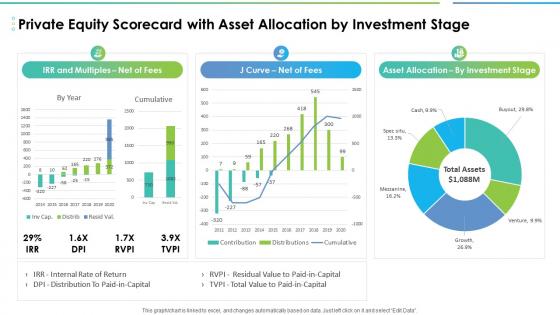
Private equity scorecard with asset allocation by investment stage




Try Before you Buy Download Free Sample Product
 Impress Your
 Audience
 100%
100% Editable
 Save Hours
 of Time


Our Private Equity Scorecard With Asset Allocation By Investment Stage are topically designed to provide an attractive backdrop to any subject. Use them to look like a presentation pro.
People who downloaded this PowerPoint presentation also viewed the following :
Private equity scorecard with asset allocation by investment stage with all 7 slides:
Use our Private Equity Scorecard With Asset Allocation By Investment Stage to effectively help you save your valuable time. They are readymade to fit into any presentation structure.





FAQs for Private equity scorecard with asset allocation
Okay so for PE tracking you definitely need IRR and MOIC - honestly MOIC is way cleaner to understand since it just shows what multiple you're getting back. IRR's your annualized return but can get wonky with timing. Cash flow timing is huge for planning when you'll actually see money. I also track how each deal performs individually and sector breakdown - helps spot what's actually working vs what looks good on paper. Oh and always compare against benchmarks so you know if you're just riding a good market or actually picking well. Just stay consistent with how you measure everything.
So basically, a PE scorecard is just your way of tracking all your portfolio companies without losing your mind. You'll monitor the usual stuff - revenue growth, EBITDA margins, plus whatever operational metrics actually matter for each business. Customer acquisition costs, employee turnover, that kind of thing. The whole point is staying consistent across companies so you're not doing some weird mental gymnastics when comparing performance. I'd say set up monthly or quarterly check-ins with management teams. Catch problems early before they blow up on you - trust me, it's way easier than playing catch-up later.
You'll want to track IRR for annualized returns, TVPI for your total multiple, and DPI for actual cash back in your pocket. RVPI shows unrealized gains still in the portfolio - though honestly that one's pretty squishy depending on how they value stuff. Compare everything against Cambridge Associates or Preqin benchmarks for your vintage year. Don't just look at raw numbers though. Quartile rankings matter way more since they give you real context. Otherwise you're basically flying blind on whether your performance actually means anything relative to peers.
Track MOIC and IRR obviously, but those just show you the final score. What really matters is watching revenue growth, EBITDA margins, and how efficiently they're managing working capital. Some PE shops use these elaborate scoring systems - honestly feels like overkill most of the time. Just pick 3-5 metrics that actually tie to your investment thesis and watch them like a hawk. Set up quarterly reporting from day one so you can pivot if stuff starts going south. Working capital improvements can be huge value drivers that people sleep on.
Dude, ESG stuff is everywhere in PE now - LPs actually care about carbon footprints, diversity numbers, all that. Not just lip service anymore. Funds track governance changes across their whole portfolio and present it alongside financials during fundraising. Honestly caught me off guard how fast this happened. Your investment committees want to see this data now, not later. Oh and start collecting ESG metrics from day one of any deal - trust me on this. Trying to piece together that stuff after the fact? Total headache you don't want.
So basically you want a scorecard to avoid making dumb decisions based on feelings alone. Pick like 5-7 things that actually matter for your deals - financial health, management team, growth potential, whatever fits your strategy. Then score every opportunity the same way. Honestly it's just a fancy checklist but it works. You'll be able to compare deals properly instead of getting caught up in the excitement of one that "feels right." Your whole team stays on the same page too, which is huge when you're evaluating multiple targets. Way better than those "what were we thinking" moments later.
Look, EBITDA margins and revenue growth are your bread and butter here. Debt-to-equity shows if they're drowning in debt. Cash conversion cycle is massive - PE guys go crazy over working capital stuff. ROE and ROIC are fine but honestly? Free cash flow is where the magic happens. That's what actually creates value in these deals. Oh, and you gotta benchmark against competitors quarterly or you're flying blind. Build your models around these and you'll catch most of what matters. The rest is just noise.
Just stick to KPIs that actually move the needle - revenue per employee, EBITDA margin growth, customer acquisition costs, working capital efficiency. That stuff directly shows value creation. Honestly, I've watched so many deals get lost in tracking like 20+ random metrics that mean nothing. Pick maybe 5-7 that tie to your investment thesis and track them quarterly against your entry baseline. The tricky part? You gotta separate what's from your operational work versus just riding a good market. Your LPs need to see the real value-add, not just lucky timing.
Yeah so the big issue is that every industry cares about totally different stuff. SaaS companies obsess over ARR and churn, but your manufacturing deals? They're all about EBITDA margins and working capital. It's honestly like comparing apples to... idk, steel factories lol. Data's a nightmare too - some sectors have clean reporting while others are still drowning in spreadsheets. What works is building scorecards for each industry but keeping universal stuff like cash flow for comparing across your whole portfolio. Pain in the ass but necessary.
Monthly updates are your best bet, honestly. Quarterly is the absolute minimum - any less frequent and you'll be scrambling when fundraising season hits. Trust me, I've watched firms panic with stale data when LPs start asking questions. Weekly is way too much unless something's on fire. What works well is monthly scorecards with deeper quarterly reviews that actually dig into trends and add some context. Oh, and definitely set up automated data feeds wherever you can - manually updating these things is a nightmare. Just make sure everything's timestamped so people aren't second-guessing which version they're looking at.
So for PE scorecards, most firms still just use Excel tbh - everyone gets it and it's super flexible. Version control becomes a nightmare though. If you want something fancier, Anaplan or Tableau are solid for better visuals and automated data feeds. Some people love eFront or Kronos for full portfolio management with built-in scorecard stuff. Really depends on your data setup and how tech-savvy everyone is. My advice? Start with whatever you've got now, see what actually bugs you about it, then upgrade based on real problems instead of shiny features that look cool but you'll never use.
Honestly, start with the management team - what's their track record like? Are they actually good at what they do? Team chemistry matters way more than people think. Market position is critical too - do they have real competitive advantages or just fancy marketing? ESG stuff isn't just trendy anymore, it actually affects valuations now. Also check what operational changes the PE firm wants to make - some of their "improvement plans" are total pipe dreams. Oh, and don't ignore regulatory headaches that could mess things up later. I'd make a quick scoring system so you're not just going off gut feeling with the numbers.
Start with quarterly investor pulse checks - super simple surveys asking about satisfaction and communication quality. Track stuff like how fast you're raising funds and LP commitment rates for follow-ups. Response times matter too; engaged investors actually get back to you quicker. Here's the weird part though - you'll need to score subjective feedback somehow. Maybe use 1-10 scales or analyze the tone from calls (honestly a pain but worth it). Weight sentiment around 20-30% of your scorecard. Don't overthink it initially, just build momentum first.
Look, PE scorecards change based on what the market's doing right now. Bull markets? Everyone's obsessing over growth - revenue jumps, grabbing market share, that stuff. Bear markets flip the script to defensive plays like steady cash flow and debt management. Super annoying how they keep shifting priorities, but I get it. When money's expensive, your EBITDA margins matter way more than hitting some crazy growth number. Oh, and working capital efficiency becomes huge too. Best move is tweaking your scorecard weights every quarter so you're actually measuring what drives value today, not six months ago.
Honestly, having a scorecard saves you so much headache when investors or board members start asking questions. You'll have all your key metrics in one spot instead of frantically digging through different reports. Everyone's looking at the same numbers the same way, which cuts down on confusion. It makes you look way more organized too – like you actually know what you're doing. I'd start with maybe 5-7 metrics that people ask about most. The whole thing just makes those quarterly updates less stressful, and trust me, anything that makes dealing with investors easier is worth it.
-
Out of the box and creative design.
-
Unique design & color.
-
Unique and attractive product design.