

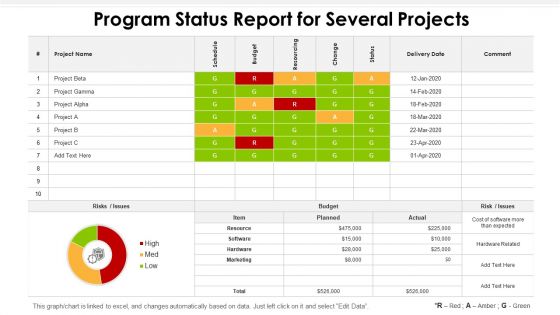
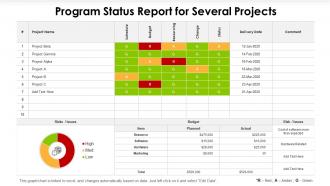
Program status report for several projects




Try Before you Buy Download Free Sample Product
 Impress Your
 Audience
 100%
100% Editable
 Save Hours
 of Time


Our Program Status Report For Several Projects are topically designed to provide an attractive backdrop to any subject. Use them to look like a presentation pro.
People who downloaded this PowerPoint presentation also viewed the following :
Program status report for several projects with all 2 slides:
Use our Program Status Report For Several Projects to effectively help you save your valuable time. They are readymade to fit into any presentation structure.
FAQs for Program status report
Key metrics for assessing project progress include schedule adherence, budget variance, milestone completion rates, resource utilization, and quality indicators. These measurements enable project managers to identify potential delays, cost overruns, and performance gaps early, with many organizations finding that combining quantitative tracking with regular stakeholder feedback ultimately delivers better project outcomes and strategic alignment.
Gantt charts enhance timeline visualization by displaying project tasks, dependencies, durations, milestones, and resource allocation in a comprehensive visual format. Through color-coded bars and timeline mapping, project managers can quickly identify bottlenecks, track progress against deadlines, and communicate status updates to stakeholders, ultimately delivering improved project transparency and enabling more strategic resource management across complex initiatives.
Team communication serves as the backbone for milestone tracking, enabling real-time updates, identifying potential delays, coordinating resource allocation, and ensuring stakeholder alignment throughout project lifecycles. Through regular check-ins and collaborative platforms, organizations streamline progress monitoring, enhance transparency, and accelerate decision-making processes, with many project teams finding that structured communication ultimately delivers improved deadline adherence and competitive project outcomes.
Project management software streamlines progress monitoring by providing real-time dashboards, automated status updates, centralized task tracking, milestone alerts, and integrated reporting capabilities. These tools enable teams to identify bottlenecks quickly, allocate resources efficiently, and maintain transparency across departments, with many organizations finding that automated progress tracking reduces reporting time while enhancing project visibility and accountability.
Bottleneck identification strategies include workflow mapping, resource utilization analysis, milestone tracking, stakeholder feedback loops, and performance metrics monitoring. These approaches streamline project execution by revealing capacity constraints, resource allocation inefficiencies, and timeline disruptions, with many organizations finding that proactive bottleneck detection ultimately delivers faster project completion and enhanced operational efficiency.
Project progress reviews should be conducted weekly for short-term projects, bi-weekly for medium-term initiatives, and monthly for long-term strategic projects, with critical milestones requiring immediate assessment. This cadence enables project managers to identify bottlenecks early, reallocate resources efficiently, and maintain stakeholder alignment, ultimately delivering projects on time and within budget.
Stakeholder feedback provides critical insights into project performance, resource allocation, risk identification, timeline accuracy, and deliverable quality that internal teams might overlook. This external perspective enables project managers to address concerns proactively, adjust strategies based on user requirements, and ensure alignment with business objectives, ultimately delivering better outcomes and stronger stakeholder satisfaction.
Risk assessment tools aid in evaluating project progress by identifying potential bottlenecks, analyzing resource constraints, and tracking milestone dependencies that could derail timelines. These tools enable project managers to proactively address emerging issues, reallocate resources strategically, and maintain stakeholder confidence, with many organizations finding that integrated risk monitoring ultimately delivers improved project outcomes and competitive delivery advantages.
Agile methodologies enable iterative tracking through sprints, daily standups, and burndown charts, while Waterfall uses milestone-based progress measurement with Gantt charts and phase gates. These approaches fundamentally shape reporting frequency and stakeholder visibility, with many organizations finding that Agile delivers more responsive tracking and faster course corrections, ultimately enhancing project outcomes.
Anecdotal evidence from team members provides valuable qualitative insights into project dynamics, workflow bottlenecks, team morale, resource allocation challenges, and client feedback patterns that quantitative metrics might miss. These firsthand observations enable project managers to identify early warning signs, adjust strategies proactively, and enhance team collaboration, ultimately delivering more responsive project management and improved outcomes.
Dashboards for real-time project updates offer immediate visibility into milestones, resource allocation, budget tracking, timeline adherence, and team performance metrics. These visualization tools streamline decision-making by consolidating critical data, enabling faster issue resolution and proactive risk management, with many organizations finding that enhanced transparency ultimately delivers improved stakeholder communication and competitive project delivery timelines.
Historical data from previous projects informs progress expectations by revealing patterns in task durations, resource requirements, risk factors, and team performance across similar initiatives. Through predictive analytics and benchmarking, organizations can establish realistic timelines, allocate resources more effectively, and anticipate potential bottlenecks, ultimately delivering more accurate project forecasts and improved stakeholder confidence.
Team morale significantly impacts project advancement by influencing productivity levels, collaboration quality, communication effectiveness, and overall delivery timelines. High morale drives faster problem-solving, reduces turnover costs, and enhances creative solutions, while low morale can delay milestones and increase project risks, with many organizations finding that investing in team satisfaction ultimately delivers measurable improvements in project success rates.
Scope adjustments significantly impact progress assessments by altering baseline measurements, timeline calculations, and resource allocation metrics. When project boundaries expand or contract, teams must recalibrate their tracking systems, update milestone definitions, and revise completion percentages, with many organizations finding that proactive scope management enhances overall project transparency and stakeholder alignment.
Training resources include project management certifications, software-specific tutorials, data visualization workshops, stakeholder communication courses, and agile methodology programs. These learning approaches enhance tracking capabilities by developing technical proficiency, analytical thinking, and collaborative skills, with many organizations finding that comprehensive training ultimately delivers improved project outcomes and team efficiency.
-
The Designed Graphic are very professional and classic.
-
Understandable and informative presentation.
-
Illustrative design with editable content. Exceptional value for money. Highly pleased with the product.
-
Presentation Design is very nice, good work with the content as well.
-
Best Representation of topics, really appreciable.