


Project portfolio with roadmap and health card dashboards






Try Before you Buy Download Free Sample Product
 Impress Your
 Audience
 100%
100% Editable
 Save Hours
 of Time


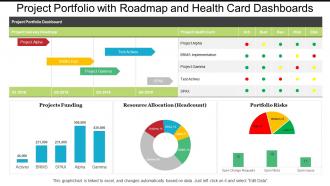
Set a great example for your business and finance analysis related presentations in the assistance of our, project portfolio with roadmap and health card dashboards PPT design. The slideshow includes ready-made PowerPoint templates on project portfolio and project management. Practice data-driven charts, graphs, diagrams, and professional slide layouts to prepare your report in minutes. We have shown the graphics of performance indicators, project finding, resource allocation, and portfolio risks. Moreover, the project delivery roadmap graph shown here can help you portray your information and plans over time. Take a leap off the opening blocks they will put you foremost in the competition in quick time. Use our, project portfolio with roadmap and health card dashboards PPT design and adequately satisfy the purposes of your audience. It is greatly important to for the sake of the company’s future growth and prosperity. Convince them that your choice is the best with our Project Portfolio With Roadmap And Health Card Dashboards. They enable you to canvas for your candidate.
People who downloaded this PowerPoint presentation also viewed the following :
Project portfolio with roadmap and health card dashboards with all 6 slides:
Discord fades away with our Project Portfolio With Roadmap And Health Card Dashboards. They ensure folks become agreeable.

FAQs for Project portfolio with roadmap and
Honestly, most people think it's just about juggling projects, but there's way more to it. First thing - map your current projects against what your company actually wants to achieve. I guarantee you'll find at least two that make zero sense. Resource balancing is huge too because teams always get stretched too thin. Regular portfolio reviews are where the magic happens - that's when you cut the dead weight and move money around. Oh, and portfolio-wide risk management beats worrying about individual project risks every time. Strategic alignment sounds fancy but it's really just "does this help us win?"
First thing - map every project back to your actual business goals. If something doesn't clearly support revenue, cost savings, or market growth, why are you doing it? Build a scoring system to rank projects against these priorities. Honestly, most portfolios I've seen are just random wish lists that eat up resources. Set up quarterly reviews (works for most companies) and get stakeholders who aren't afraid to kill projects. The hard part is saying no to stuff that sounds cool but doesn't actually move things forward. Being ruthless here will save you so much headache later.
Portfolio size matters a ton here. For mid-sized stuff, I'd go with Microsoft Project Online or Smartsheet - both give you solid visibility without the headache. Bigger enterprises usually need Clarity PPM or Planview, though honestly they're massive overkill if you're just starting out. Monday.com and Asana are decent for smaller portfolios, especially if your team likes visual collaboration (which most people do). Here's the thing though - pick whatever your team will actually stick with. The fanciest tool is useless if nobody opens it. Try 2-3 options with real project data first.
Track your budget vs actual spend, timeline stuff, and milestone hits - that's the basics. But honestly? The real story is in strategic value and how your resources are spread across everything. I throw together a simple dashboard showing ROI, schedule variance, and alignment scores. Comparing projects against each other matters way more than just hitting individual targets. Monthly reviews are clutch for spotting the duds early. You can reallocate fast when something's clearly not working out.
Honestly, you can't do portfolio management without getting stakeholders involved - learned this the hard way on my last project. They're the ones who know which projects actually matter for the business strategy and where the money's coming from. Regular check-ins are a must because priorities shift constantly (and trust me, they will). Map out who your key stakeholders are right away, then keep them in the loop throughout everything, not just kickoff meetings. Otherwise you'll end up with a portfolio that looks great on paper but doesn't deliver what anyone wanted.
Honestly, you've gotta bake risk assessment into your portfolio process right from the start. I score each project on risk level plus ROI and strategic fit - just use high/medium/low because fancy scales are a waste of time. Don't dump everything into high-risk projects even when they look amazing financially. Mix it up. Build some cushion into your timelines and budgets too. The trick is making risk visible in every portfolio review, not scrambling when stuff goes sideways later. Works way better than playing catch-up.
Focus on ROI and NPV first - those are what your bosses actually care about. Portfolio value and resource utilization show if you're being smart with what you've got. Strategic alignment matters too, like how well projects fit your company's direction. Oh, and track time-to-market plus success rates because honestly, most teams suck at delivery and don't realize it. Stakeholder satisfaction surveys are worth doing if you can stomach another survey. Start with maybe 3-4 metrics that'll get leadership's attention, then add more once you've got the reporting down. Don't try to measure everything at once or you'll go crazy.
So many things outside your control can mess with your project priorities. Market changes hit hard - I've watched teams panic when competitors dropped similar products out of nowhere. Economic downturns flip everything upside down fast. Then you've got regulatory stuff, tech shifts, resource constraints. Honestly, stakeholder demands from outside your org are the worst sometimes. Your perfectly planned portfolio becomes chaos overnight when any of these hit. The trick is building flexibility into how you prioritize so you can pivot without losing your mind. Otherwise you'll just be constantly scrambling to catch up.
Ugh, resource conflicts are the absolute worst - everyone wants the same people at once. Shifting priorities mess with your head too, plus you never really know what's happening across all your projects. Here's what actually works: get a visual map of everything first (sounds obvious but most people skip this). Set up some kind of centralized system so you can see who's doing what. Regular portfolio check-ins help catch problems early. Oh, and create scoring criteria for projects - saves you when executives randomly decide something else is suddenly "urgent." It's still chaos but at least manageable chaos.
Honestly, most companies have no clue where their people actually are or what they're working on. Start there - figure out who's got bandwidth and what skills you're working with. Then rank your projects by what actually matters strategically, not just whoever's making the most noise (we've all been there). Get some kind of tool to track this stuff so you can see conflicts coming. The real trick though? Don't treat this like a one-and-done thing. Check in monthly, shuffle things around when needed, and yeah - sometimes you gotta hit pause on the less important projects when resources get tight.
Your company culture totally drives how portfolio decisions happen. Risk-averse places? Expect conservative projects and approval hell. Collaborative teams usually nail cross-project coordination better. Hierarchical structures can mess up information flow - though honestly, sometimes that rigid structure actually helps with resource decisions, weirdly enough. Innovation-focused cultures will pick breakthrough projects over safe incremental ones every time. The real trick is spotting your culture's blind spots and designing processes that either play to those strengths or fix what's broken.
Think of PPM as your project overview dashboard - you'll finally see which ones actually matter for your big picture goals. No more managing stuff in isolation and wondering why nothing connects. You can catch resource conflicts before they blow up, plus it's way easier to axe projects that aren't pulling their weight (honestly, there are always a few dead ones hanging around). The trick is getting consistent data from everything so when you're making those brutal priority calls, you're not comparing random metrics. Short version: less guessing, smarter choices about where your time goes.
Honestly, going centralized is a game-changer for visibility - you'll actually know what's happening across projects and catch resource conflicts early. Everyone follows the same processes, which sounds boring but trust me, it saves so much headache later. Leadership can focus on projects that matter instead of random department wishlist items (we've all seen those). You stop duplicating work too, which is huge. Oh and resource sharing becomes way smoother. First step? Map out everything you're currently running, then figure out what's actually moving your business forward versus just keeping people busy.
Honestly, stick to what execs actually care about - ROI, how projects align with strategy, and whether you're burning through resources or hitting risks. Those red/yellow/green dashboards? Perfect for them since they just want to scan stuff quickly. I made the mistake once of showing a CEO detailed Gantt charts and basically watched his soul leave his body lol. Monthly 15-minute check-ins work way better than long meetings. Oh, and always bring solutions, not just a list of problems - they hate when you dump issues on them without recommendations. Executive summaries covering portfolio health and budget stuff are your friend here.
So there's a bunch of stuff happening in PPM right now. AI analytics are getting really good for decision-making - way better than the old gut-feel approach. Teams are mixing agile with traditional methods, which honestly makes more sense than being super rigid about one way. Sustainability isn't just fluff anymore either, it's actual KPIs now. Remote tools have been a game changer too. Some of my colleagues swear their distributed teams work better than when everyone was crammed in one office. There's also this big push around preventing burnout through better resource planning. Bottom line - portfolios need to be flexible and data-heavy now. I'd start by figuring out which projects could use real-time tracking.
No Reviews