


Project Report For Bank Loan Five Years Cash Flow Projections Ppt Slides Designs Download




Try Before you Buy Download Free Sample Product
 Impress Your
 Audience
 100%
100% Editable
 Save Hours
 of Time


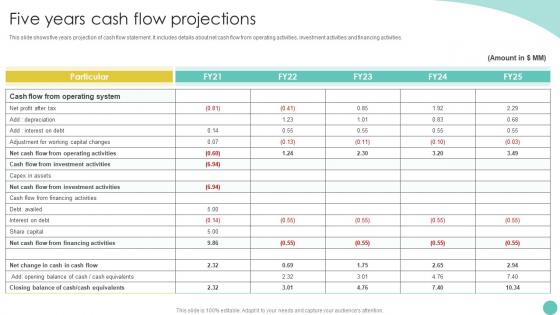
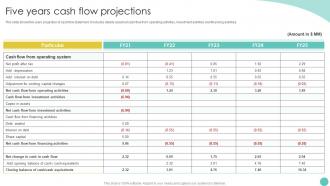
This slide shows five years projection of cash flow statement. It includes details about net cash flow from operating activities, investment activities and financing activities.
People who downloaded this PowerPoint presentation also viewed the following :
Project Report For Bank Loan Five Years Cash Flow Projections Ppt Slides Designs Download with all 6 slides:
Use our Project Report For Bank Loan Five Years Cash Flow Projections Ppt Slides Designs Download to effectively help you save your valuable time. They are readymade to fit into any presentation structure.





FAQs for Project Report For Bank Loan Five Years Cash Flow Projections Ppt
Bank loan cash flow projections should include revenue forecasts, operating expenses, debt service payments, capital expenditures, and working capital requirements. These components enable banks to assess repayment capacity by analyzing seasonal variations, industry-specific risks, and growth trajectories, with many financial institutions finding that comprehensive projections significantly enhance loan approval rates and terms.
Businesses can accurately forecast cash inflows and outflows by analyzing historical financial data, creating detailed monthly projections, incorporating seasonal variations, and accounting for planned investments or expansions. Through comprehensive financial modeling, companies streamline loan applications by demonstrating predictable revenue patterns, expense management, and debt service capacity, ultimately enhancing their creditworthiness and securing more favorable lending terms.
Bank loan cash flow projections typically span three to five years, with monthly breakdowns for the first year and quarterly or annual projections thereafter, depending on loan size and business type. Banks require this extended timeline to assess repayment capacity, seasonal variations, and growth sustainability, with established businesses often providing shorter projections while startups need comprehensive five-year forecasts to demonstrate long-term viability.
Unexpected expenses should be accounted for through contingency reserves, typically 5-10% of projected operating costs, stress testing scenarios, and maintaining flexible credit facilities. Banks increasingly require borrowers to demonstrate multiple contingency layers, with many financial institutions finding that businesses incorporating buffer zones, seasonal variability adjustments, and emergency fund allocations ultimately deliver more reliable repayment performance and stronger loan approval rates.
Common pitfalls include overly optimistic revenue assumptions, underestimating seasonal fluctuations, ignoring one-time expenses, inadequate contingency planning, and failing to account for market volatility. Banks scrutinize these projections carefully, with many loan applications being rejected due to unrealistic forecasting, insufficient documentation of assumptions, and lack of scenario planning, ultimately requiring borrowers to demonstrate conservative estimates and comprehensive risk assessment for approval.
Secured loans typically offer lower interest rates and longer repayment terms, resulting in reduced monthly payments and improved cash flow projections, while unsecured loans present higher costs but faster access to capital. Banks increasingly favor secured lending for predictable cash flows, with many financial institutions finding that collateral-backed loans enable better risk management and enhanced operational efficiency.
Historical financial data serves as the foundation for accurate cash flow projections, providing insights into revenue patterns, seasonal fluctuations, expense trends, and customer payment behaviors. Banks leverage this data to identify cyclical patterns, assess business stability, and validate projected assumptions, with many financial institutions finding that borrowers with consistent historical performance demonstrate more reliable repayment capacity.
Businesses can improve cash flow projection accuracy by implementing rolling forecasts, integrating real-time financial data, conducting scenario planning, and regularly updating assumptions based on market conditions. Through advanced analytics and automated tracking systems, organizations streamline forecasting processes while minimizing human error, ultimately delivering more reliable projections that enhance loan approval chances and strategic financial planning.
Banks evaluate debt service coverage ratios, operating cash flow margins, current ratios, working capital trends, and cash conversion cycles in projections. These metrics enable lenders to assess repayment capacity, operational efficiency, and financial stability, with many financial institutions finding that consistent positive operating cash flows and strong liquidity ratios significantly enhance loan approval prospects.
Businesses should update cash flow projections monthly during the first year post-loan approval, then quarterly once operations stabilize. Regular updates help track loan covenant compliance, identify potential repayment challenges early, and demonstrate financial responsibility to lenders, with many banks requiring updated projections during annual reviews, ultimately maintaining strong banking relationships and ensuring strategic financial planning.
**INPUT**: What tools or software are recommended for developing cash flow projections? **OUTPUT**: Recommended tools include Excel with advanced modeling templates, QuickBooks for integrated accounting data, Prophix for enterprise planning, Adaptive Insights for cloud-based forecasting, and specialized platforms like Float or Pulse. These solutions streamline projection accuracy by automating data integration, scenario modeling, and real-time updates, with many financial institutions finding that dedicated cash flow software delivers enhanced precision and faster loan decision processes.
Scenario analysis enhances cash flow projections by modeling multiple economic conditions, stress-testing assumptions, and identifying potential vulnerabilities across different market environments. Through Monte Carlo simulations and sensitivity analysis, banks can evaluate best-case, worst-case, and baseline scenarios simultaneously, ultimately strengthening risk assessment capabilities and enabling more informed lending decisions in an increasingly volatile financial landscape.
The break-even point in cash flow projections identifies when loan-funded operations generate enough revenue to cover all expenses, including debt service payments, marking the transition from cash outflow to positive cash flow. This critical milestone helps banks assess loan viability and repayment capacity, while borrowers use it for strategic planning and risk management, ultimately enabling more accurate lending decisions and sustainable business growth.
Cash flow projections should present monthly forecasts for 12-24 months, highlighting revenue streams, operating expenses, debt service coverage ratios, and break-even analysis with clear assumptions documented. These projections demonstrate repayment capacity through conservative estimates, sensitivity analysis showing various scenarios, and detailed explanations of seasonal variations, ultimately delivering transparency and credibility that loan officers require for approval decisions.
Cash flow projections track actual money movement in and out of accounts, focusing on liquidity timing, while profit and loss statements show overall profitability including non-cash items like depreciation and accrued expenses. Banks prioritize cash flow projections because they reveal repayment capacity through actual available funds, with lenders finding that profitable companies can still default due to timing mismatches between earnings and cash availability.
-
The PPTs are extremely simple to modify. Thank you for providing the slides that are ready to be used. They assist me in saving a lot of time.
-
Understandable and informative presentation.