


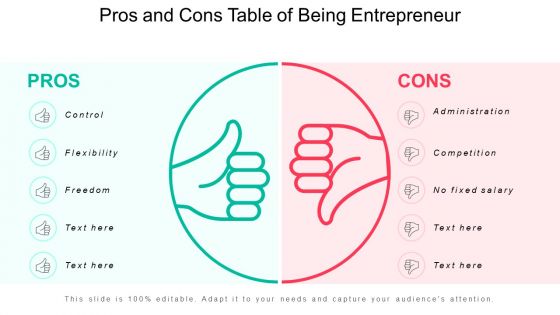
Tableau des avantages et des inconvénients d'être entrepreneur





Try Before you Buy Download Free Sample Product
 Impress Your
 Audience
 100%
100% Editable
 Save Hours
 of Time


Un rire chaleureux est bon pour la santé. Notre tableau des avantages et des inconvénients d'être un entrepreneur est fermement convaincu du fait.
People who downloaded this PowerPoint presentation also viewed the following :
Tableau des avantages et inconvénients d'être entrepreneur avec les 5 diapositives :
Faites partie des personnes performantes avec notre tableau des avantages et inconvénients d'être entrepreneur. Traitez-les sur un pied d'égalité.


FAQs for Pros and cons table
Honestly, resilience is probably the biggest one - you're gonna fail a lot and need to bounce back fast. Being adaptable matters too since you'll constantly pivot when stuff doesn't work. Vision's huge though - spotting opportunities everyone else misses while staying focused on long-term goals (even when everything's falling apart, which it will). You also need decent risk tolerance because you're always making decisions without having all the info. Oh, and passion for whatever you're building is non-negotiable - that's literally what gets you through the awful days. I'd start small with side projects first to build these skills up.
Talk to real people first - seriously, don't skip this step. I learned the hard way on my first startup because I was way too in love with my own brilliant idea (spoiler: it wasn't that brilliant). Hit up potential customers with interviews or surveys. Reddit's great for finding your target crowd too. The whole point? You need to know their actual problems, not what you're assuming they are. Then throw together a basic MVP or even just a landing page. If nobody's signing up or pre-ordering, well... that's pretty telling.
Look, innovation is what separates real entrepreneurs from people just opening another coffee shop (not that there's anything wrong with coffee shops). It's how you spot problems everyone else ignores and come up with solutions that actually matter. You don't have to reinvent the wheel - could be improving existing stuff, serving overlooked markets, or just doing things better than the competition. Without it, you're basically copying what already works, which is way harder to scale. Focus on solving actual problems in ways nobody's tried yet. The innovation part happens naturally when you're genuinely trying to fix something broken.
Honestly, trends drive pretty much every big call you'll make - what to build, when to pivot, all that stuff. You've gotta watch for shifts in how people behave, what tech they're adopting, industry changes. Remote work blew up and suddenly every SaaS company had to completely rethink their game plan. But here's the thing - don't chase every trend like it's the next Bitcoin or whatever. Balance staying aware with sticking to your vision. I'd start with Google Alerts for your industry, maybe some reports to see what's actually happening vs just hype.
Honestly, consistency is everything - keep your voice and visuals the same everywhere. Pick what makes you different and go all-in on it. Generic brands? Nobody remembers them. Don't spread yourself thin on social media either, just dominate 2-3 platforms and actually talk to people instead of shouting at walls. I'm a big fan of content marketing too - blogs, videos, whatever works for you. Shows you know your stuff without being pushy. The whole thing only works if you're genuine though. Focus on fixing real problems for people instead of constantly selling. That's when things click.
Dude, networking is everything for entrepreneurs. Most of your best opportunities - co-founders, customers, funding, mentors - they all come through people you know, not random cold emails. People buy from people they trust, period. The trick is starting before you actually need anything (learned this the hard way). Join some entrepreneur groups, hit up industry events, help people out first without expecting anything back. I know it sounds cheesy but those relationships seriously pay off down the road. Way faster than trying to figure everything out solo.
Honestly? Most founders I know mix different funding sources instead of putting all their eggs in one basket. Your own savings gives you complete control but yeah, you'll burn through cash faster than you think. Angel investors and VCs are solid if you've got a scalable business - just know they'll want a piece of the pie. Bank loans or SBA stuff works too, assuming your credit doesn't suck. Crowdfunding's pretty cool for physical products. My buddy raised like $50K on Kickstarter for his gadget thing. Bottom line: figure out your actual number first, then decide what you're comfortable giving up.
Dude, start with the repetitive stuff that's driving you crazy - customer service bots, automatic invoicing, inventory tracking. Cloud software is clutch because you don't need massive upfront cash. Honestly, I used to spend hours on invoicing alone before I automated it. Project management tools are game changers too. Pick one or two things first though - don't go overboard. Get those working smoothly, then you can add more. The ROI hits fast when you're not doing mindless tasks all day. Trust me, you'll wonder why you waited so long.
Dude, funding's gonna kick your ass first - even when you're making money, waiting for payments is torture. Finding customers is way harder than anyone tells you too. I swear, some days you'll wonder why you didn't just get a normal job. You're doing literally everything - accounting, marketing, probably fixing the printer. The mental stuff though? That's what breaks most people. Build yourself a crew early on, like other founders or mentors. Don't try to hero it alone because you'll burn out fast.
Look, a business plan forces you to work through all the messy stuff before jumping in. Financial projections, potential problems, who your customers actually are - all that unglamorous homework. Banks and investors expect it anyway, so might as well do it right. Honestly, the real benefit is just going through the process. Makes you question your assumptions and catch things you'd totally miss otherwise. Sure, your plan will change (mine did like five times), but having that foundation helps when everything inevitably goes sideways. It's basically your sanity check.
Culture is everything, honestly. Bad culture kills good startups - I've watched it happen so many times. People burn out, quit, and suddenly your great product doesn't matter. But when you nail it? Your team actually wants to grind through the messy parts. They make smarter calls without you micromanaging everything. Hire for culture fit early on, not just skills. Someone mediocre who believes in your mission beats a rockstar who'll poison the vibe. Oh, and define your values before you're desperate to fill seats - way easier than fixing toxic dynamics later.
Honestly, think of it like spreading your money across different stocks - don't blow everything on one idea. I made that mistake with my first startup and wow, did that hurt. Start small with risks you can actually handle, then build up once you've got proof things work. Here's what saved me later: set hard deadlines and failure points before you even start. Hit those benchmarks or cut your losses fast. None of this "just one more month" BS that drains your bank account. Keep enough cash for several tries because let's be real - most ideas flop initially. Test cheap, learn quick, then go big on whatever actually shows promise.
Dude, you HAVE to get customer feedback - like, constantly. Start super early, even with crappy mockups. I've watched so many founders get obsessed with their "brilliant" idea and completely ignore what users actually need. Big mistake. Try surveys, interviews, beta tests, whatever fits your crowd. The thing is, great products change based on real problems people face. Don't just collect feedback though - you've gotta actually use it. I know it sounds obvious but you'd be surprised how many people ask for input then do nothing with it. Your customers will literally tell you what to build if you listen.
So most social entrepreneurs do this "double bottom line" thing - basically tracking money stuff alongside your actual impact. Figure out your main impact metrics first, like how many lives you're helping or whatever environmental benefits you're creating. There's this framework called SROI that puts dollar values on social impact, but honestly it gets messy fast. Just pick 2-3 things you can actually measure consistently and be real about your failures too, not just the wins. You can always add more metrics later once you've got the basics down.
Look, I know it sounds preachy but figure out your core values now before things get crazy. Don't oversell your product - that always backfires. Pay your people fairly even when money's tight (I learned this one the hard way). Customer data needs to stay private, obviously. Also, resist the urge to trash competitors just because you're frustrated. Environmental stuff matters too if it applies to you. Honestly? The temptation to cut ethical corners hits hard when you're bootstrapping. But that reputation damage isn't worth it. Write this stuff down early - you'll thank yourself later when you're making split-second decisions under pressure.
No Reviews