

Presentación de diapositivas de PowerPoint sobre control de calidad





Try Before you Buy Download Free Sample Product
 Impress Your
Audience
 100%
Editable
 Save Hours
of Time


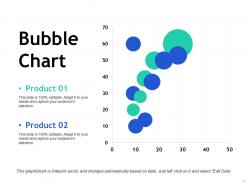
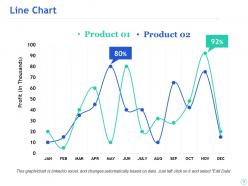
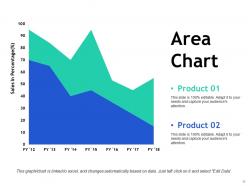
Los siguientes diseños de PowerPoint son para presentaciones de PPT relacionadas con el aseguramiento de la calidad. Garantizar la calidad y la mejora del producto es un paso significativo para entregar bien en el mercado. Hemos incluido temas apropiados después de una investigación exhaustiva para una solución completa. Los gráficos de control de calidad, la hoja de control diario, la hoja de recuento de defectos, el panel de control de gestión de calidad son algunos temas de preocupación en las diapositivas. Se incluyen gráficos de área, gráficos de burbujas y gráficos de líneas en las diapositivas de PowerPoint para un estudio en profundidad. Puede llegar a su público objetivo y a clientes valiosos al plasmar sus ideas investigadas. El área de texto que se comunica con cada etapa se puede utilizar para representar el esquema de su negocio, las opiniones sobre el mercado actual y las acciones emprendidas para lograr los objetivos deseados. Enciéndase con todos los nuevos acontecimientos con nuestra plantilla de PPT más atractiva, las diapositivas de presentación de PowerPoint de control de calidad y olvídese de las decepciones. Haga clic en el botón de descarga y proceda. Abogue por un paseo saludable con nuestras Diapositivas de Presentación de PowerPoint de Control de Calidad. Elabore sobre los innumerables beneficios.
People who downloaded this PowerPoint presentation also viewed the following :
Contenido de esta presentación de Powerpoint
"La calidad es el resultado de la intención, el esfuerzo, la dirección y la ejecución hábil". Esta cita de John Ruskin ejemplifica la importancia del monitoreo de calidad para una empresa. Este esfuerzo colectivo con toma de decisiones consciente asegura que los problemas y defectos en los productos no pasen desapercibidos, evitando la insatisfacción de los clientes.
Por lo tanto, es necesario realizar controles regulares de calidad para todos sus proyectos a fin de regular los procesos, verificar defectos, monitorear su frecuencia y anotar qué defectos ocurren con más frecuencia. Esto le dará un plan de acción para gestionar estos defectos y siempre entregar productos de calidad. El aseguramiento regular de la calidad ayudará a generar confianza con sus clientes y partes interesadas y garantizará que su marca se mantenga exitosa a largo plazo.
La importancia de las plantillas de control de calidad
Para hacer este proceso más manejable y fácil, hemos diseñado una gama de plantillas de diapositivas de control de calidad estructuradas y 100% personalizables. Utilice estas plantillas para organizar sus datos sobre defectos, efectividad general del equipo, problemas en proyectos, resolución de defectos y el alcance de sus proyectos. De manera creativa y gráfica, puede verificar qué tan bien están resultando sus programas de control de calidad y qué tan rápido puede resolver cualquier defecto.
PS: Para más plantillas de control de calidad, consulte nuestras Diapositivas de Control de Calidad Operacional y Plantillas de Fabricación de Precisión Farmacéutica y Control de Calidad.
¿Listo para ver estas plantillas de control de calidad? Entonces comencemos.
Plantilla 1: Gráfico de Control de Calidad
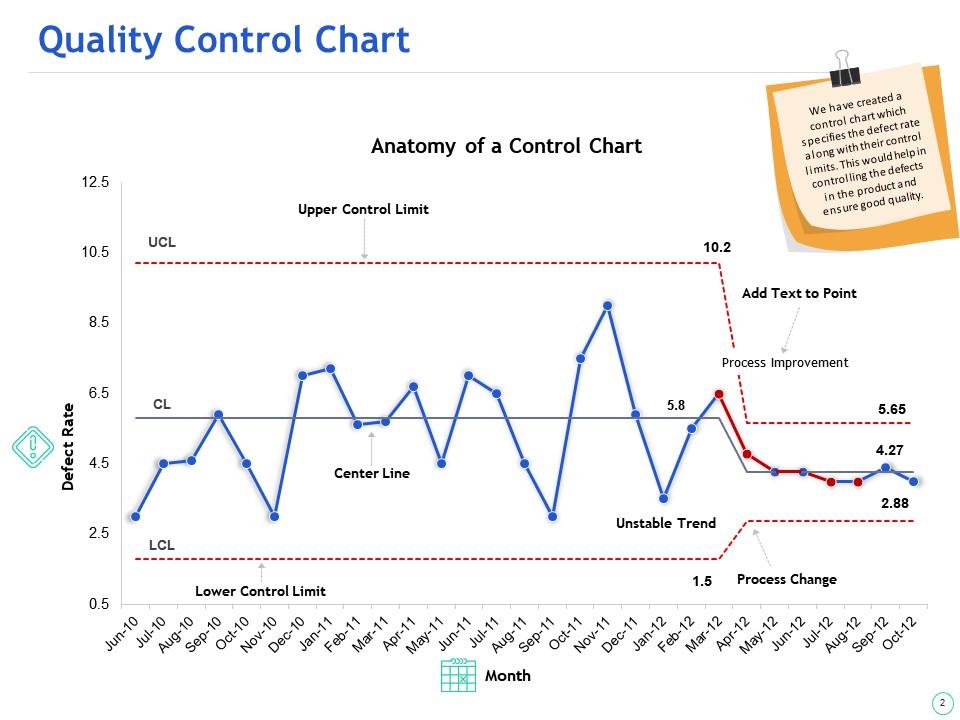
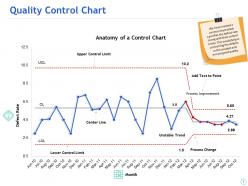
Monitorear el proceso y encontrar obstáculos es crucial para producir un producto de alta calidad. Utilice nuestra Plantilla de Gráfico de Control de Calidad para especificar y rastrear la tasa de defectos junto con los límites de control. Puede monitorear el límite de control superior, el límite de control inferior, la mejora del proceso y la tasa de defectos de mes a mes. Esto lo ayudará a entregar productos de alta calidad a sus clientes y partes interesadas y asegurar el éxito de su negocio.
Plantilla 2: Hoja de verificación de control de calidad
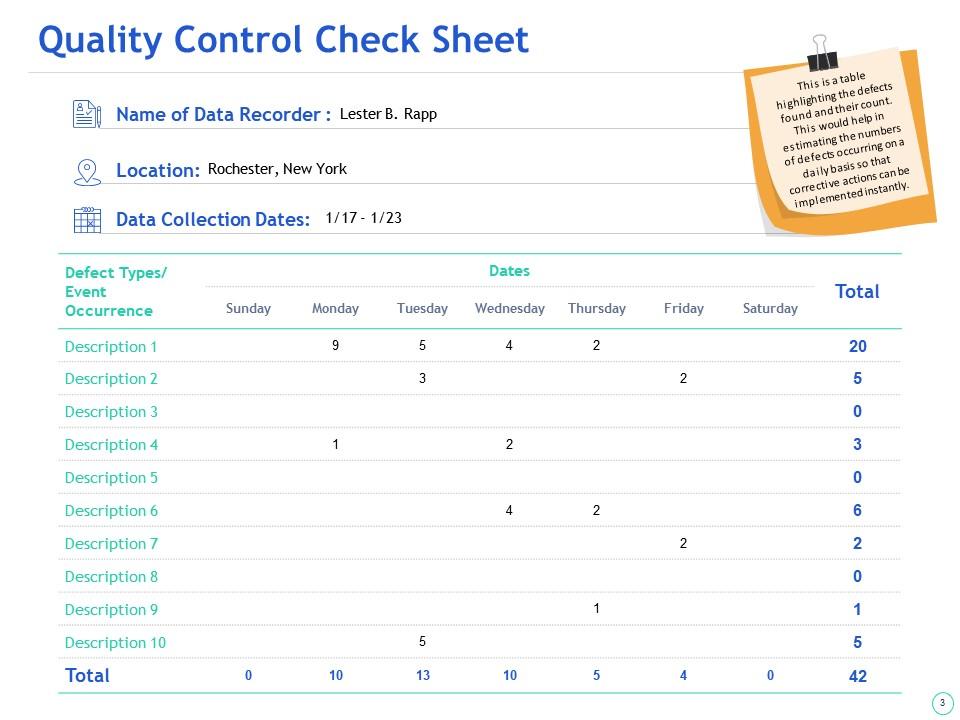
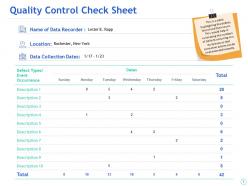
¿Necesita monitorear los productos entregados a los clientes diariamente? Esta Hoja de verificación de control de calidad proporciona un formato listo para rastrear la cantidad de defectos que ocurren diariamente. Esto lo ayudará a notar las áreas que necesitan trabajo e implementar acciones correctivas efectivas de inmediato para rectificar estos defectos. Puede listar el nombre del registrador de datos, la ubicación, las fechas y los tipos/ocurrencias de defectos diariamente.
Plantilla 3: Hoja de verificación de control de calidad
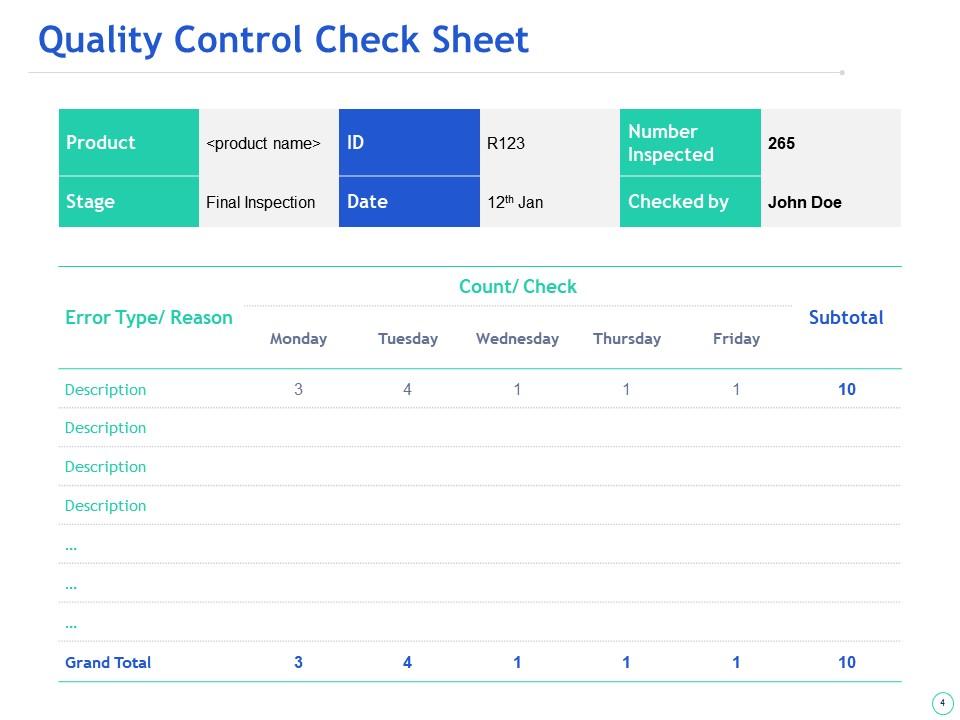
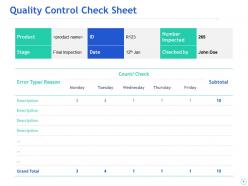
Utilice esta diapositiva de PPT para enumerar todos los defectos de productos y errores de proceso en su negocio. Esta hoja de verificación proporciona un formato prediseñado para tomar decisiones rápidas para detectar con qué frecuencia ocurren estos defectos y errores y recopilar datos sobre ellos. Esto mantendrá un control sobre la cantidad y frecuencia de los defectos y asegurará que sus productos sean revisados por control de calidad con frecuencia.
Plantilla 4: Hoja de recuento de defectos
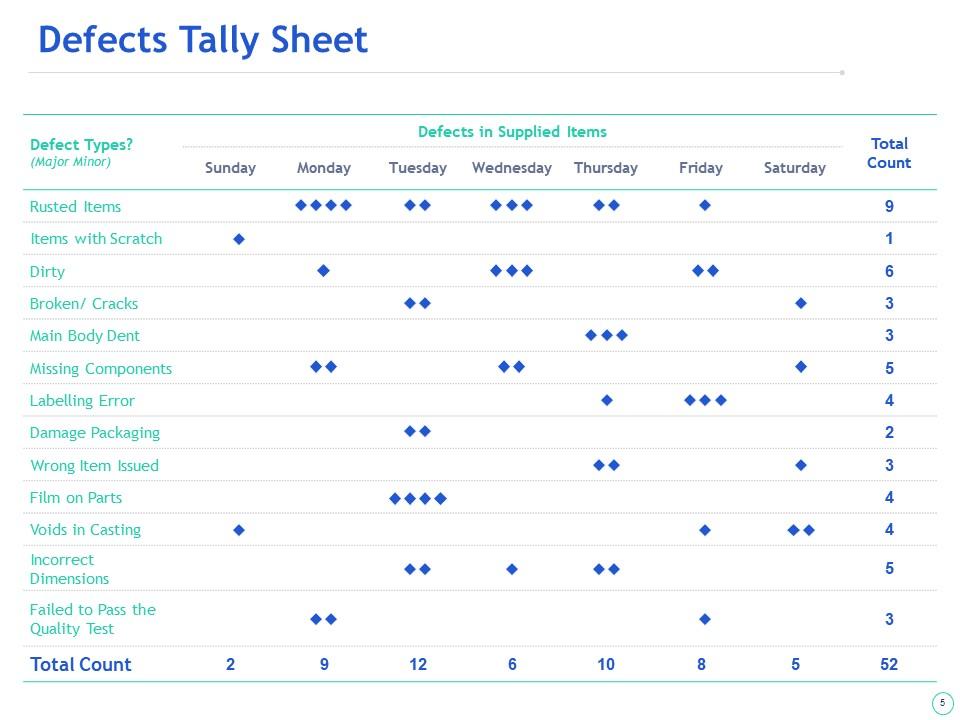
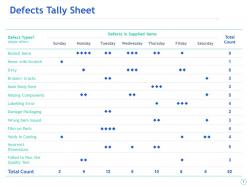
Esta plantilla de PPT proporciona una lista lista de todos los posibles defectos que pueden ocurrir, como artículos oxidados, artículos con rayones, artículos sucios, productos con grietas, abolladuras en el cuerpo principal, componentes faltantes, dimensiones incorrectas y más. Puede contar estos defectos con sus productos suministrados diariamente para ver cuántos de estos defectos ocurren con frecuencia y cuál es el margen de estos defectos. Esto ayudará a diseñar las acciones para asegurar que estos defectos se eliminen y que entregue productos de calidad.
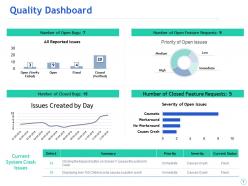
Plantilla 5: Tablero de control de calidad
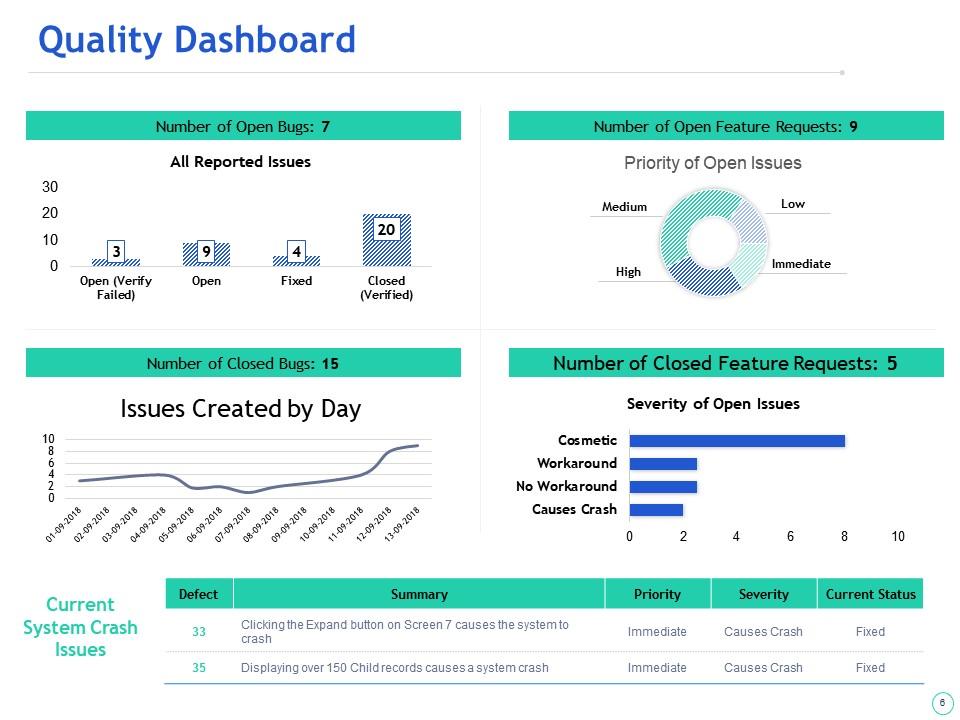
Esta plantilla de Tablero de control de calidad es perfecta para las organizaciones, ya que le ayuda a comprender los errores, las operaciones de los sistemas y los problemas abiertos y cómo resolverlos. Utilícelo para saber cuántos errores abiertos, cerrados y verificados se han reportado junto con las solicitudes de funciones abiertas en su empresa. También puede mostrar la gravedad de los problemas abiertos, como soluciones alternativas y bloqueos. Esto asegurará que pueda priorizar los defectos que necesitan trabajo y que estos errores se ordenen y corrijan de inmediato para un mejor aseguramiento de la calidad.
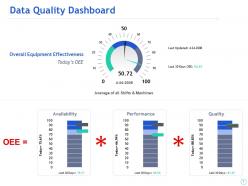
Plantilla 6: Tablero de control de calidad de datos
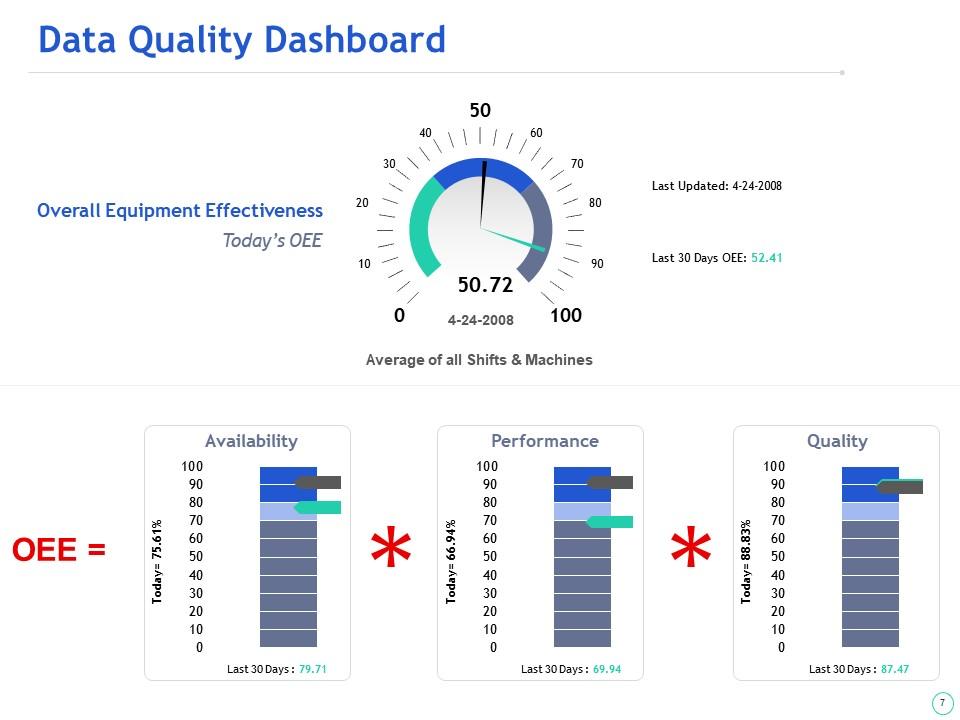
Para medir la efectividad de su equipo, utilice este Tablero de control de calidad de datos, donde puede usar gráficos circulares y gráficos creativos para mostrar su desempeño de calidad. Esto puede ayudarlo a ver qué tan productivos son sus turnos y máquinas durante un mes. También puede comparar la disponibilidad, el rendimiento y la calidad durante los últimos 30 días para ver el porcentaje de Efectividad General del Equipo (OEE) mensual. Utilice estos datos para ver qué máquinas necesitan mejoras y mantenimiento para eliminar defectos y cuáles funcionan bien para estabilizar la producción.
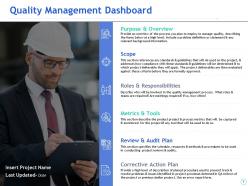
Plantilla 7: Tablero de control de gestión de calidad
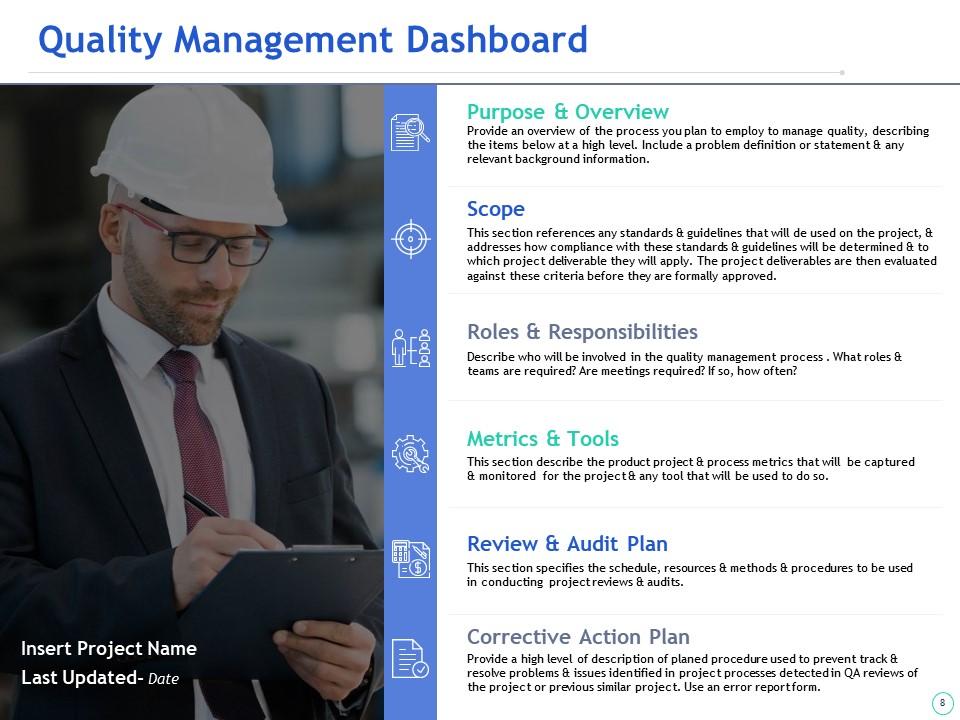
Para optimizar su contenido de calidad y asegurar que está lanzando buenos productos con un mínimo de defectos, necesita este Tablero de control de gestión de calidad. Utilice esta presentación para describir el propósito del proyecto, como qué método planea usar su empresa para asegurar que no haya defectos, e incluso puede incluir su declaración de problema en este. Luego, puede simplificar las pautas del proyecto establecidas y el cumplimiento en la sección de alcance. También puede establecer los roles y responsabilidades de los involucrados en estas verificaciones de calidad y con qué frecuencia deben hacerlo. Finalmente, puede revisar las métricas, especificar los recursos para las auditorías de proyectos y aprender a prevenir y rastrear problemas para asegurar que no haya defectos.
Asegurando el control de calidad
Las listas de verificación de control de calidad identifican efectivamente los posibles defectos en sus productos y su frecuencia. Utilice estas plantillas de PPT para crear una estrategia efectiva para mejorar sus productos mediante controles periódicos de calidad y eliminando estos defectos. Esto lo ayudará a simplificar toda la información disponible y representarla claramente para una toma de decisiones efectiva e informada.
PS: Si tiene un negocio de construcción o algún proyecto de construcción, puede utilizar estos Planes de inspección de control de calidad para seguridad en la construcción.
Presentación de diapositivas de PowerPoint de control de calidad con las 25 diapositivas: 1. Introducción al control de calidad 2. Importancia del control de calidad 3. Principios del control de calidad 4. Herramientas de control de calidad 5. Planificación del control de calidad 6. Implementación del control de calidad 7. Monitoreo y mejora continua 8. Roles y responsabilidades 9. Análisis de datos y toma de decisiones 10. Gestión de no conformidades 11. Acciones correctivas y preventivas 12. Auditorías de calidad 13. Satisfacción del cliente 14. Mejora de procesos 15. Gestión de proveedores 16. Capacitación y desarrollo del personal 17. Documentación y registros 18. Tecnología y control de calidad 19. Casos de éxito 20. Desafíos y oportunidades 21. Tendencias en el control de calidad 22. Integración con otros sistemas de gestión 23. Beneficios del control de calidad 24. Resumen y conclusiones 25. Preguntas y respuestas
Haga un gran alboroto con la audiencia con nuestras Diapositivas de Presentación de Control de Calidad. Disfrutarán de la atención adicional.







FAQs for Quality Control
You gotta nail down what "good quality" actually means first - document it so there's no confusion. Set up checkpoints at the spots where things usually go wrong. Regular inspections are obvious, but here's the thing most people mess up: you need someone actually digging into why problems happen, not just catching them after the fact. I'd map out your whole process and figure out the trouble spots first. Then build your monitoring around those areas. The feedback loop is honestly make-or-break though. Without that, you're just playing whack-a-mole with issues instead of preventing them.
Honestly, just focus on the basics - defect rates, customer complaints, and how many products pass quality checks the first time around. Returns are huge too because that's what actually hits your bottom line. I'd also track rework costs since those add up fast. Don't go crazy with like 15 different metrics though - pick maybe 3 or 4 that matter most to your specific business. Set up a simple dashboard to check monthly trends instead of getting bogged down in all the data. Customer satisfaction scores matter more than internal stuff sometimes, even if management doesn't always see it that way.
Honestly, you can't do quality control right anymore without tech backing you up. Automated systems spot defects way faster than we ever could - it's kind of crazy actually. AI helps catch patterns before they blow up into real problems, and IoT sensors give you live data on temps, vibrations, all that stuff. Machine learning even predicts issues by looking at old data trends. Still doing everything manually? You're probably missing things and burning time. I'd start small though - throw some basic automated testing at your most critical stuff first and see how it goes.
Look, continuous improvement stuff like Kaizen and PDCA cycles are game-changers for catching quality problems early. Instead of waiting for things to blow up, you're getting your team to regularly look at processes and make tiny tweaks that actually matter. Way smarter than the old "wait til it breaks" method we all used to do. Plus your whole crew starts caring about quality instead of just dumping it on the QC guys - which honestly makes their job way easier too. Just grab one process that's been driving you nuts and try a quick PDCA cycle this week.
Honestly, the worst part is dealing with people who hate change - they'll fight you on everything. Getting leadership to actually care is rough too since they think QC just costs money. Don't even get me started on trying to collect decent data when half your systems are from like 2010 and don't connect to anything. Budget's always tight for training and proper tools. My take? Pick one small process first, nail some easy wins to prove it works, then slowly branch out. Way less painful than trying to overhaul everything at once.
Honestly, quality control is all over the map depending on your industry. Pharma companies? They're doing crazy extensive testing because the FDA doesn't mess around and people's lives are literally on the line. Manufacturing focuses more on defect rates and keeping things consistent. Food industry is obsessed with contamination and shelf life - which makes sense. Tech is interesting because they're always doing user testing and hunting bugs, though half the time it feels like they just release stuff and let us figure out what's broken. Healthcare obviously prioritizes patient safety protocols. Construction worries about whether buildings will actually stay up. Really comes down to figuring out what quality means for your customers and what disaster you're trying to avoid.
Use real examples from your actual production line - people learn way better when they can touch the stuff they'll be checking. Cover the technical standards but also explain WHY each check matters. Understanding the purpose makes them better at spotting issues. I always share some disaster stories about failed QC (honestly keeps everyone awake during training). Have your experienced workers mentor the new folks for a few weeks. Don't make people feel dumb for asking questions - that's how you kill learning. Oh, and definitely do refresher sessions because skills get rusty surprisingly fast.
So data analytics basically lets you catch quality problems before they blow up into bigger issues. Track your defect rates and keep an eye on how your equipment's performing. Real-time dashboards are clutch here - you'll spot weird patterns right away. I'd also dig into your historical data to see what conditions usually cause problems. Honestly, it's almost like predicting the future sometimes. My advice? Don't go crazy at first. Pick maybe two metrics that matter most, see how it works, then add more once you're convinced it's worth it.
Dude, customer feedback is like having a crystal ball for spotting problems early. People will tell you exactly what's broken way before your internal team catches it. The crazy part? They use your stuff in totally random ways you'd never think to test for. I'd set up some kind of tracking system to catch patterns - like if five people complain about the same button not working or whatever. Then just feed all that info straight into your quality checks. It's honestly better than most metrics because it's real-world usage, not lab conditions.
Honestly, ISO standards are like having a cheat sheet for quality control - they give you this tested framework instead of making it up as you go. Most of your clients probably expect ISO certification anyway, so you're kinda stuck getting it. The cool thing is they force you to document everything properly and set up real testing procedures. Way better than just doing random quality checks when you remember to. Each industry has different ISO standards, so figure out which ones matter for you. Then just follow their roadmap - saves you from reinventing the wheel, you know?
Set clear quality specs upfront so everyone's on the same page. Do regular audits - mix scheduled ones with surprise visits (suppliers absolutely hate those but they're super effective). Check everything when it comes in before it hits production. Track supplier performance with scorecards over time. Honestly though, the biggest thing is building actual relationships with your suppliers. My old boss always said treat them like partners, not just vendors. When they trust you and feel valued, they'll actually call you when problems come up instead of trying to hide them.
Honestly, perfectionism is a productivity killer. Find that sweet spot between "good enough" and overdoing it. I'd focus your heaviest quality controls on stuff that actually matters - like what could hurt customers or your business. Everything else? Streamline those checks. Risk-based thinking really helps here. Map out your current processes and ask "what happens if this screws up?" For routine tasks, try sampling instead of checking every single thing. Automate the repetitive stuff if you can. The whole point is catching problems that actually matter without grinding everything to a halt. Start small and see what works.
Dude, skipping quality control is such a bad move - trust me on this one. You'll get slammed with defects, returns, maybe even recalls if you're unlucky. The rework costs are brutal and will destroy your margins. Your reputation gets trashed too, which honestly? That's the worst part because customers don't forget. Instead of growing your business, you're stuck putting out fires all day. I learned this the hard way at my last job. Build quality checks throughout the whole process, not just at the end. Way cheaper than dealing with pissed off customers later.
Good QC basically prevents customer headaches before they happen. Your products stay consistent, people trust you more, and they actually come back. Plus they'll tell their friends - which honestly is the best marketing you can get. Nobody wants to deal with broken stuff or sketchy service, right? So catching problems early beats scrambling to fix angry customer complaints later. I always think it's smarter to spend money preventing issues upfront. Way less stressful than playing damage control when things go sideways.
Dude, quality control is getting wild with AI and machine learning. Instead of catching defects after they happen, predictive analytics will spot them before. IoT sensors monitor everything in real time, plus automation handles inspections way faster than humans ever could. Digital twins let you test scenarios virtually - honestly that part blows my mind. Blockchain might track quality data too, though I'm still figuring out how useful that'll actually be. The whole field's shifting from reactive to predictive. My advice? Start messing around with AI tools and data analytics now - you'll need those skills to stay competitive.
-
Awesomely designed templates, Easy to understand.
-
Great experience, I would definitely use your services further.