


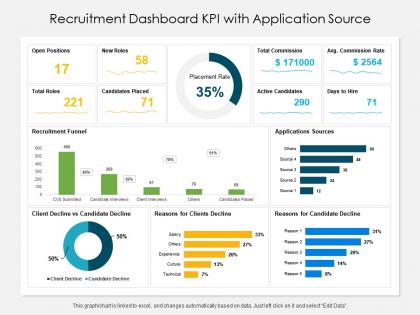
Recruitment dashboard kpi with application source





Try Before you Buy Download Free Sample Product
 Impress Your
 Audience
 100%
100% Editable
 Save Hours
 of Time


Our Recruitment Dashboard KPI With Application Source are topically designed to provide an attractive backdrop to any subject. Use them to look like a presentation pro.
People who downloaded this PowerPoint presentation also viewed the following :
Content of this Powerpoint Presentation
Description:
The image is a PowerPoint slide titled "Recruitment Budget." It outlines the budget allocation for hiring employees with different levels of experience. The slide is divided into three vertical sections, each corresponding to a range of experience: Fresher, 0-4 years, and 5-7 years. Key elements include:
1. Total Number of Employees to be Hired:
Indicates the recruitment target, set at 5.
2. Salary Budget (USD MM):
Lists the budget in millions of dollars for each experience category, with $3 MM for freshers, $5.5 MM for those with 0-4 years of experience, and $8 MM for those with 5-7 years of experience.
3. Number of Employees to be Hired:
Specifies the number of hires planned for each category, with 1 fresher, 2 for the 0-4 years category, and 2 for the 5-7 years category.
4. Total Recruitment Expenses:
This appears to be the cumulative cost per hire, but the units are not clear from the image provided.
Use Cases:
This slide is instrumental for strategic planning in various sectors, facilitating a clear visual representation of recruitment financial planning to ensure that hiring practices align with budgetary constraints and organizational goals.
These slides can be used in the following industries:
1. Technology:
Use: Budgeting for tech talent acquisition
Presenter: HR Director
Audience: Senior Management, HR Team
2. Finance:
Use: Allocation of funds for recruiting financial experts
Presenter: Chief Financial Officer
Audience: HR Department, Finance Team
3. Healthcare:
Use: Planning budget for hiring medical professionals
Presenter: Medical HR Manager
Audience: Hospital Administrators, Department Heads
4. Education:
Use: Structuring the hiring budget for educators
Presenter: Dean or Academic Affairs Director
Audience: University HR, Academic Council
5. Manufacturing:
Use: Outlining budget for skilled/unskilled labor force
Presenter: Plant Manager
Audience: HR Managers, Production Supervisors
6. Retail:
Use: Financial planning for retail staff expansion
Presenter: Retail HR Manager
Audience: Store Managers, Recruitment Team
7. Government:
Use: Government sector recruitment budget planning
Presenter: Public Service HR Coordinator
Audience: Department Heads, Hiring Managers
Recruitment dashboard kpi with application source with all 2 slides:
Use our Recruitment Dashboard KPI With Application Source to effectively help you save your valuable time. They are readymade to fit into any presentation structure.

FAQs for Recruitment dashboard kpi
Start with time-to-fill, cost-per-hire, and quality of hire - those are your bread and butter. Time-to-fill shows if your process is actually working. Cost-per-hire keeps finance happy when budget reviews come around. Quality's harder to nail down, but check performance reviews and who's still around after 90 days. Oh, and candidate experience scores too! People talk, especially in smaller industries where everyone knows everyone. Honestly, bad candidate experiences spread faster than good ones. Get these four down first, then you can always add more later based on what's driving you crazy.
Time-to-fill basically shows you exactly where your hiring gets stuck. Compare yours to industry benchmarks - if you're way off, maybe cut some interview rounds or get hiring managers to decide faster. You know there's always that one manager who takes weeks to give feedback, right? Anyway, track it by department so you can see patterns. Some roles just take longer, which is fine, but you'll spot the real problems. Once you're measuring consistently, dig into why certain positions drag on forever. It helps you figure out where to actually focus your time.
Honestly, candidate quality beats everything else when you're looking at recruitment metrics. Time-to-fill might look great on paper, but who cares if you're just pushing through mediocre people? The numbers that actually matter are offer acceptance rates, how new hires perform, retention after 6-12 months. I've watched teams get obsessed with speed while their quality goes down the drain - such a waste. You want to track both, but always come back to: are we hiring people who stick around and crush it? That's your real win.
Start with industry reports - SHRM, LinkedIn Talent Insights, Glassdoor's analytics. They've got solid benchmarks for time-to-fill, cost-per-hire, offer acceptance rates by sector. But honestly? Join some HR communities or recruitment forums where people actually spill real numbers. Those conversations beat official reports half the time. Just make sure you're not comparing a tech startup to like, a massive healthcare system - totally different beasts. Oh, and set up quarterly check-ins to see how you're tracking against benchmarks. Keeps you from getting too far off course.
Honestly, I'd go with a proper ATS like Greenhouse or Lever - they track all the important stuff automatically (time-to-fill, where your best hires come from, etc). Tableau's great for visualizing data if you're into that, but tbh Excel works fine for smaller teams. Don't overthink it. Zapier's useful for connecting everything together so you're not manually moving data around all day. Oh, and whatever you pick, make sure it plays nice with what you already use. Last thing you want is another system that doesn't talk to anything else.
Here's the thing - tracking the right recruitment metrics actually saves you from retention headaches later. You'll spot which job boards keep sending candidates who bail after three months (ugh, frustrating but super useful data). Time-to-productivity and quality of hire scores? They're goldmines for predicting who'll actually stick around. Plus your candidate experience ratings matter way more than people think - crappy interviews often equal quick exits. I mean, honestly, nobody wants to work somewhere that treated them poorly from day one. Focus on refining where you source people and how you interview them. You're not just trying to fill roles faster, but finding folks who'll actually grow with your company.
Track your diversity ratios at each stage - applications through final offers. See where different demographic groups drop off in your hiring funnel, that's where bias might be creeping in. Also check if you're even sourcing from diverse talent pools to begin with (super overlooked but crucial). Time-to-hire can vary between groups too, which is telling. Survey new hires about their interview experience - inclusion matters as much as the numbers. Honestly, none of this works unless you set actual targets and review them monthly with hiring managers.
Dude, you'll be completely in the dark if you're not checking those metrics regularly. Time-to-hire starts creeping up without you realizing it. Candidate quality tanks. You're probably burning money on job boards that suck. I watched one team lose amazing candidates for months during interviews - they had no clue until way too late. Weekly check-ins would've caught that immediately. Your hiring managers will definitely start breathing down your neck about slow processes, then you're scrambling to catch up instead of staying ahead of it. Honestly, monthly reviews are bare minimum. Weekly is way better though.
So basically you want to connect your recruiting metrics to whatever keeps your executives up at night. Growth mode? Focus on time-to-fill and retention rates for key hires. Tight budget? Cost-per-hire becomes your best friend. Here's what actually works: sit down with leadership regularly and figure out their biggest headaches. Then show how your numbers either fix those problems or make them worse. Honestly, most recruiters skip this step and wonder why nobody cares about their reports. Pick maybe 3-4 KPIs max that tie directly to company goals. More than that and you'll lose people.
First, figure out what's actually broken - is it taking forever to fill roles, are your hires not working out, or are your sourcing channels trash? Long time-to-fill means you need to speed up interviews and maybe start building relationships with people who aren't actively looking. Bad hires? Get pickier upfront and make sure hiring managers actually know what they want (easier said than done, I know). If it's sourcing, ditch the job board obsession - literally everyone uses those. Check your numbers weekly instead of monthly so you can pivot faster. Don't try fixing everything at once though.
Honestly, treating candidates well makes such a huge difference for your hiring metrics. Happy candidates accept offers faster and actually refer their friends to you. Clear communication and quick feedback? Game changer for time-to-hire and acceptance rates. But mess up the experience and people will straight-up ghost you or trash your company online (which is brutal for your employer brand). Even candidates who don't get hired become cheerleaders if you treated them right. I've seen it happen - one bad Glassdoor review can scare away tons of good people.
So offer acceptance rate is basically how many people actually say yes when you make them a job offer. Low rates usually mean your pay sucks, you oversold the role, or they found something better. It's honestly pretty humbling when you realize candidates are passing on you left and right! But here's the thing - tracking this stuff by role and manager helps you figure out where to bump up salaries or fix your pitch. Sometimes it's just one hiring manager who's terrible at selling the company. Worth keeping tabs on for sure.
Yeah, definitely works! Pick a few metrics that match your hiring goals - like how many people engage with your job posts or click through to apply. LinkedIn's the obvious choice, but honestly Instagram and TikTok are gold if you're after younger candidates. I'd track follower growth on company pages too. The real test? See how many solid applications actually come from social vs other channels. My advice would be start small with 2-3 metrics and check them monthly. You'll quickly figure out what's driving interest and what's just... noise.
Your ATS is honestly your best bet - it tracks everything from application to hire. Pull headcount and time-to-fill from your HRIS too. Job boards give you source effectiveness data, though LinkedIn's analytics are kinda all over the place sometimes. Calendar tools help with interview scheduling metrics, and you'll need finance system data for cost-per-hire stuff. Just avoid those manual tracking spreadsheets everyone starts but never actually updates lol. Focus on systems where people consistently enter data. Set up automated reports so you're not scrambling for numbers every month.
Honestly, new hire feedback is such an underused resource. Survey them after their first month about the whole experience - how long everything took, communication quality, whether the job actually matched what you described. Candidates pick up on stuff we totally miss from our side. You might discover your interview process has useless stages, or that you're rushing people through too fast (happens more than you'd think). Even your job descriptions could be way off. Just do a simple 5-question survey and you'll start seeing patterns pretty quickly. It's like getting the inside scoop on what's actually broken in your hiring process.
-
Graphics are very appealing to eyes.
-
Professional and unique presentations.
-
Innovative and attractive designs.
-
Excellent products for quick understanding.
-
Use of different colors is good. It's simple and attractive.