


Role Of AI In Automotive Innovation Training Ppt




Try Before you Buy Download Free Sample Product
 Impress Your
 Audience
 100%
100% Editable
 Save Hours
 of Time


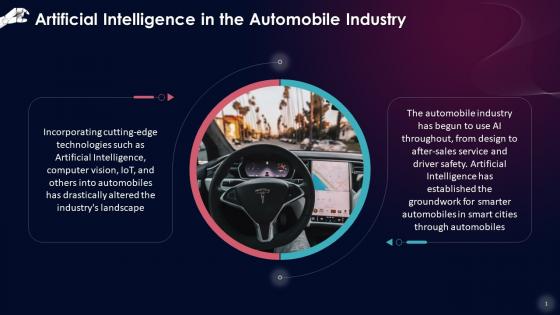
These slides give an overview of how AI is helping to revolutionize the automotive industry. High-tech automotive firms have begun to employ cutting-edge technologies such as AI to compete in the market while providing the highest level of customer satisfaction. AI helps develop engaging and personalized user experiences, provides seamless car trading for customers, and boosts business profits.
People who downloaded this PowerPoint presentation also viewed the following :
Content of this Powerpoint Presentation
Slide 1
This slide gives an overview of how AI is helping to revolutionize the automotive industry. High-tech automotive firms have begun to employ cutting-edge technologies such as AI to compete in the market while providing the highest level of customer satisfaction.
Slide 2
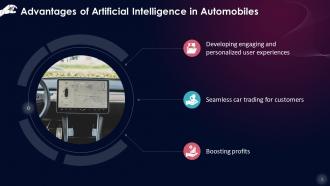
This slide lists the benefits of the impact of Artificial Intelligence on the automobile industry. AI helps in developing engaging and personalized user experiences, provides seamless car trading for customers, and boosts business profits.
Instructor’s Notes:
- Developing engaging and personalized user experiences: Driver assistance technology, commonly used in vehicles today, relies heavily on AI. It successfully monitors a driver's eye, detecting whether or not the motorist is sleepy or sleeping. The AI in the car learns everything about the driver's preferred temperature setting, favorite songs, and navigational preferences to make traveling more fun, intuitive, and stress-free
- Seamless car trading for customers: AI is not restricted to automobile manufacturing and delivering superior user experiences, it also makes consumers' car buying and selling process extremely easy. In the future, AI-enabled interface systems will be able to recommend the best cars to customers based on their driving skills, insurance, health data, penalties, and other factors. In addition, next-generation vehicles will be able to get real-time information on traffic congestion or any other emergency and use AI to build high-resolution 3D representations of actual roadways
- Can help in boosting profits: Artificial Intelligence has the potential to help automakers stop losing money. In the short run, taking advantage of the increasingly advanced levels of data on vehicles, parts usage, and driving behaviors will be critical. Machine Learning and data science are essential technologies enabling flexible demand planning techniques and optimizing cost savings
Slide 3
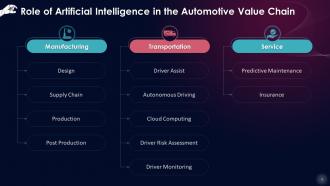
This slide showcases the applications that Artificial Intelligence has in the automotive industry. AI is currently being used in areas such as design, supply chain, production, and post-production. Furthermore, AI is being used in 'driving assistance' and 'driver risk assessment' systems, which is revolutionizing the transportation industry. It is also making waves in the aftermarket services such as predictive maintenance and insurance.
Slide 4
This slide lists types of innovations based on Artificial Intelligence in the automobile industry such as 3D printers, smart helmets, autonomous vehicles, machine vision, and collaborative robots.
Instructor’s Notes:
- 3D Printers: 3D printers are used in the automotive sector to make fitness prototypes, visually pleasing parts, and efficient car models, among other things. Fused Filament Fabrication (FFF), employed in the automobile industry for manufacturing end-use parts, is one of the critical technologies underpinning 3D printers
- Smart Helmets: Driver safety is one of the top priorities and smart helmets are among the most important AI innovations in this industry. Drivers prefer smart helmets because of the modern technology that allows them to summon an ambulance or a family member in an accident. It also includes other features such as operating vibration sensors, alcohol sensors, collision alarms, LED lights, etc
- Autonomous Vehicles: High-tech giants are attempting to mass-produce self-driving cars all around the world. Without a human driver in the driver's seat, AV can perceive the surrounding environment and drive on its own. The ability to wander freely and independently in the city is beneficial to senior citizens
- Machine Vision: A Machine Vision System (MVS) is an AI technology that enables a computer to inspect, evaluate, and recognize static or moving images. It's a branch of computer vision similar to surveillance cameras but allows for automatic image capture, evaluation, and processing. It is critical for optimizing value chain operations such as quality assurance, production, logistics, and others. Machine vision is being used in the automotive sector to recognize specific objects, speed up existing production processes, and eliminate any errors or dangers, among other things
- Collaborative Robots: With their sophisticated features such as machine loading, machine tending, inspection, assembly in factories, and many more, collaborative robots, or cobots, are thriving in this business. Cobots collaborate with human employees to improve outcomes, consistency, flexibility, and assistance while reducing human error
Slide 5
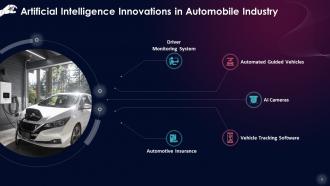
This slide lists types of innovations based on Artificial Intelligence in the automobile industry such as driver monitoring systems, automated guided vehicles, AI cameras, vehicle tracking software, and automotive insurance.
Instructor’s Notes:
- Driver Monitoring System: Driver monitoring systems are quickly becoming one of the most popular AI advancements in preventing catastrophic road accidents by notifying drivers during tiredness, distraction, and other factors. It's also known as driver state sensing, and it uses a dashboard-mounted high-tech camera with infrared LEDs to track drivers' eye movements
- Automated Guided Vehicles: AGVs have begun to provide many benefits to the automotive sector, including lower direct labor costs, elimination of manpower shortages, reducing errors, restricting heavy products handling, scalability, increased productivity, improved safety, etc.
- AI Cameras: Integrating AI cameras in vehicles has enhanced the automobile industry's revenue. Drivers choose cars with AI cameras to ensure the safety of themselves and their loved ones. With a multi-path approach and the use of AI for image or video recognition, these AI cameras provide many services to drivers, making roads significantly safer
- Vehicle Tracking Software: The motor industry has recognized the relevance of vehicle tracking software in locating a car efficiently and effectively. The GPS is configured to offer real-time updates on a vehicle's location and condition
- Automotive Insurance: In the smart automobile sector, automobile insurance is critical. Drivers can estimate their own auto damage for their insurance providers
Slide 6
This slide lists the projected growth of Artificial Intelligence in the Automotive Industry. The AI in Automotive Market was valued at over $1 billion in 2019 and is expected to expand at a 35% Compound Annual Growth Rate (CAGR) between 2020 and 2026.
Instructor’s Notes: Artificial Intelligence in the automobile industry is predicted to cause significant upheaval by improving production capabilities and enhancing company growth. The development and implementation of novel technologies like autonomous mobility, car simulations, rapid prototyping, and AI-enabled automotive manufacturing gives the autonomous technologies sector a bright future. Automakers are rapidly adopting AI platforms into their existing production systems and are focusing on developing autonomous vehicles to improve passenger mobility.
Role Of AI In Automotive Innovation Training Ppt with all 22 slides:
Use our Role Of AI In Automotive Innovation Training Ppt to effectively help you save your valuable time. They are readymade to fit into any presentation structure.












FAQs for Role Of AI In Automotive
So basically, most of the cool safety stuff in cars now runs on AI. Your automatic braking, lane warnings, blind spot alerts - all that tech uses cameras and sensors to watch everything around you. The crazy part is how fast it reacts, like way quicker than we ever could. Some systems can actually see crashes coming by reading traffic patterns and how people drive. Honestly, if you're buying a car soon, definitely get one with those AI safety packages. My cousin's Tesla literally saved him from rear-ending someone last month. Worth every penny.
So your car can basically predict when stuff's gonna break now - pretty wild, right? The AI watches all these sensors tracking engine vibrations, oil condition, brake wear, that kind of thing. No more guessing or sticking to those old maintenance schedules. It learns patterns and spots problems before they actually happen. Honestly, it's like having a mechanic living in your dashboard. You'll catch issues way before you're stuck on some random highway at 2am. Saves you money too since you're not doing repairs you don't actually need yet. Check if your car already does this!
Dude, so AI is basically what makes self-driving cars actually work. It's processing insane amounts of data from all those sensors and cameras - like recognizing pedestrians, reading signs, making split-second decisions. Without machine learning, you'd just have a regular car with expensive equipment doing nothing lol. The crazy part is how it predicts what other drivers might do, even the unpredictable ones. These systems are crunching massive datasets in real-time. Investment-wise? Look at companies building solid AI training data and edge computing. That's where the real money is.
Honestly, AI is a game-changer for car dealerships. You've got chatbots answering questions instantly, plus they can suggest cars that actually match what you need. Virtual test drives are pretty neat too. But the AR stuff is where it gets really cool - you can see different paint colors and options right on your phone instead of going back and forth a million times. Financing gets way faster since AI processes loans quickly and finds better rates. Oh, and the predictive thing is wild - salespeople basically know what you want before you even show up. Don't try to do everything at once though, just pick one thing and start there.
So basically these systems pull data from cameras, sensors, GPS - you name it - to figure out where traffic's gonna suck before it actually does. Pretty cool stuff honestly. They study old patterns to predict rush hour disasters and weather mess-ups, then reroute everyone automatically. Those smart traffic lights that seem to "know" when you're coming? That's the ML doing its thing instead of just running on boring timers. Oh and when your GPS suddenly tells you to take some random side street - that's usually the algorithm trying to save you from sitting in traffic hell.
Ugh, the bias thing is probably your biggest headache - if your training data sucks, you'll end up discriminating against whole groups of people. Then there's all that location data you're hoarding, which honestly feels pretty creepy when you think about it. Don't even get me started on the trolley problem stuff... like who decides if the car should save the driver versus some random pedestrian? Build a diverse team though, lock down your data governance early, and just be upfront about how your AI actually works. These aren't easy problems but at least transparency helps.
So basically AI makes your EV way smarter about using power. It learns how you drive and preps the battery before you even get in. The regenerative braking thing is actually super neat - it can tell when you'll hit traffic and adjusts accordingly. Battery temps get managed better too, which saves a ton of energy. Oh and it figures out your routes to optimize everything. Honestly the whole system just gets more efficient over time. When you're car shopping, definitely go for one with good AI energy management. Makes a real difference in range.
Honestly, there are three big things that freak me out about this stuff. Safety failures are huge - like what happens when the AI glitches while you're doing 70 on the freeway? That's genuinely terrifying. Hackers are another nightmare since these cars are basically computers on wheels now. Someone could potentially mess with your brakes remotely, which is... yeah. Plus there's the whole job thing - millions of truckers and drivers will get screwed over. We really need way more testing and better security before this goes mainstream. It's moving fast though.
Your car's AI basically stalks your habits in a helpful way lol. It learns when you drive, what music you like, where you usually go. Then it starts predicting stuff - like suggesting your morning playlist or cranking the heat before you even think about it. Mine got scary good at knowing I'd want Starbucks locations around 2pm. The system keeps getting smarter as your routine changes too. You'll need to turn on data sharing in settings first though, otherwise it can't learn anything about you.
Dude, AI is completely changing how car companies handle their supply chains. Machine learning can actually predict when parts will fail before it happens - saves them from shutting down entire production lines. The demand forecasting is insanely accurate now, and they're using it to optimize inventory and logistics routes in real time. Companies are also getting better at spotting supplier risks early, like material shortages or political stuff that might mess things up. Honestly, if your company isn't looking into this yet, I'd start with demand forecasting. That's where you'll see results fastest.
So basically cars are becoming like giant smartphones that can chat with traffic lights, other cars, all that stuff. The AI crunches tons of sensor data to make instant decisions about safety and routing. Honestly, it's kinda crazy how fast this tech is moving - reminds me of when everyone suddenly had iPhones, you know? Your car will literally optimize your route in real-time based on what's happening around you. I'd keep an eye on which car companies are going hard on V2X tech since they'll probably dominate the market. Traffic jams might actually become a thing of the past.
So basically it's like giving cars eyes, right? The cameras capture everything and AI turns that into data the car can actually use. Lane warnings, self-driving, spotting pedestrians - all that stuff runs on computer vision now. Honestly the pedestrian detection still freaks me out sometimes, but it works crazy well. Multiple cameras feed into machine learning algorithms that build this 360-degree picture of what's around the car. Oh and they even track if you're actually paying attention while driving. If you're diving into automotive AI, definitely get familiar with how all that visual data gets processed and mixed with other sensors.
So AI basically helps car companies design better vehicles way faster. The crash simulations alone save tons of time - no more endless manual testing. Tesla and BMW are crushing it with machine learning in their factories right now. Manufacturing gets a huge boost too since AI can predict when machines will break before they actually do. Plus the robots are crazy precise now. Quality control is probably where it shines most though - catches defects we'd totally miss. Supply chains run smoother too. Honestly the whole prototyping process is just night and day compared to like five years ago.
So AI in cars is getting pretty wild these days. Your GPS now learns traffic patterns and reroutes you in real-time, which honestly saves me like 20 minutes on my commute. There's predictive maintenance that'll ping you before something breaks - way better than being stranded somewhere. The driver assistance stuff is crazy good at reading road conditions too. Oh, and some cars actually learn how you drive and adjust the suspension and steering to match. Wild, right? They're even working on accident prevention that processes thousands of data points per second. Definitely worth looking for those adaptive features when you're car shopping.
Dude, the data stuff is honestly insane now. Car companies are pulling info from everywhere - social media, what people search for, how they mess around with online car configurators. Tesla and Ford can basically predict what features you'll want before you even know it. Pretty creepy but also impressive? They're getting scary good at figuring out when you're ready to buy your next car just from your digital habits. Short sentences hit different sometimes. If you're working in auto, seriously dive into the AI analytics side - the patterns they're finding will blow your mind.
-
I loved the hassle-free signup process. A few minutes and, I had this giant collection of beautiful designs.
-
I didn’t expect such a good service for the money I am paying. But, they exceed my expectations. Great work SlideTeam.