


Roles And Responsibilities Of Key Finance Team Members How Ecommerce Financial Process Can Be Improved




Try Before you Buy Download Free Sample Product
 Impress Your
 Audience
 100%
100% Editable
 Save Hours
 of Time


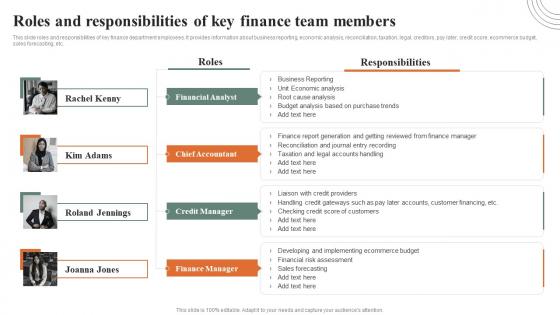
This slide roles and responsibilities of key finance department employees. It provides information about business reporting, economic analysis, reconciliation, taxation, legal, creditors, pay later, credit score, ecommerce budget, sales forecasting, etc.
People who downloaded this PowerPoint presentation also viewed the following :
Roles And Responsibilities Of Key Finance Team Members How Ecommerce Financial Process Can Be Improved with all 6 slides:
Use our Roles And Responsibilities Of Key Finance Team Members How Ecommerce Financial Process Can Be Improved to effectively help you save your valuable time. They are readymade to fit into any presentation structure.





FAQs for Roles And Responsibilities Of Key Finance Team Members How Ecommerce Financial Process
So the ecommerce finance team basically tracks all your revenue and payment stuff for online sales. They're watching cash flow, figuring out if your customer acquisition costs actually make sense, and dealing with all those sneaky marketplace fees. Honestly, the tax compliance thing across different states is such a headache. They also handle chargebacks and refunds - plus they work with ops on pricing strategies and inventory costs. Oh, and definitely loop them in early if you're launching anything new. They need time to set up tracking properly, otherwise you'll be scrambling later trying to figure out your numbers.
Honestly, ecommerce forecasting is way more intense than regular retail. You're watching conversion rates and cart abandonment change by the hour - it's kinda crazy compared to the old quarterly forecasts based on foot traffic. The upside? Instant feedback means you can pivot campaigns super fast. Downside is your forecasts become outdated practically overnight. I'd definitely set up dashboards that refresh automatically because manually pulling data every week gets old real quick. Traditional retail was more seasonal and predictable. This digital stuff keeps you on your toes way more, but the real-time insights are honestly pretty addictive once you get used to them.
Look, data analytics is what separates successful ecommerce businesses from the ones burning through cash. You need to track customer acquisition costs, lifetime value, inventory turnover - all that stuff. Without decent numbers, you're basically throwing darts blindfolded. I've seen too many people make budget decisions based on gut feelings and wonder why they're broke six months later. Analytics help you spot actual trends, forecast what'll sell, and figure out which marketing channels are legit profitable. Set up dashboards for your key metrics now. Trust me, waiting until you're in trouble is way too late.
Honestly, you've gotta automate your cash flow tracking and check it daily - weekly just doesn't cut it anymore. Set up dashboards for stuff like days sales outstanding and inventory turnover. Ecommerce moves way too fast for monthly check-ins, you'll completely miss when things go sideways. Also do scenario planning since demand can literally explode or tank overnight (learned that one the hard way). Here's the thing though - get your credit lines sorted NOW while you're in good shape. Don't wait until you're scrambling. Same with supplier payment terms - negotiate better ones upfront when you have leverage.
Start with CAC, LTV, and your LTV:CAC ratio - those are your bread and butter metrics. Conversion rates, average order value, and cart abandonment are crucial too. If you're doing subscriptions, obviously track MRR. Honestly, inventory turnover and gross margins by product category tell you way more than most people realize. Cash flow's huge, especially if you deal with seasonal stuff (learned that one the hard way). Set up a weekly dashboard with these so you can actually spot what's happening. Don't overthink it though - better to track a few things consistently than everything poorly.
Honestly, you can't really separate fraud prevention from your financial planning - they're tied together. Chargebacks and fraud losses eat into your profits directly. Budget around 0.5-2% of revenue for detection tools, depending how risky your business is. Don't forget about chargeback fees either (like $15-25 each time). Here's the tricky part though - if your filters are too aggressive, you'll block real customers and lose sales. But too loose? You're bleeding money to fraudsters. I'd track your fraud rate every month and tweak your budget from there. It's honestly just trial and error until you find that sweet spot.
Dude, definitely get your finance team involved in pricing decisions. They can run all the margin math to show how different prices impact your bottom line. Plus they're weirdly good at competitive research since they get cost structures. One thing I learned the hard way - they'll catch which products actually make money vs just boost sales volume. Super easy to miss that when you're obsessing over conversion rates. They can also model scenarios like "what if we slash prices 15% for a flash sale?" Just bring them in before you make changes, not after.
Oh man, international sales are such a pain for financial planning. Currency rates never stop moving, so when the dollar gets strong, your overseas revenue looks way smaller once you convert it back. I've seen companies get totally blindsided by this. You'll need hedging strategies and honestly, I'd run multiple forecast scenarios with different exchange rate assumptions - saves you headaches later. Track everything in both local currency and USD too. Focus your hedging on whatever currencies bring in the most cash first.
Honestly, you're gonna want something like A2X or Link My Books - they sync directly with QuickBooks or Xero and handle all the annoying stuff automatically. Fees, refunds, sales tax across different platforms. Manual reconciliation is a nightmare, learned that the hard way. If you're doing serious volume, maybe look at NetSuite or Sage Intacct instead. The main thing is making sure it plays well with whatever platforms you're already selling on. I'd start by writing down all your current channels first, then see which accounting software works best with those. Makes the whole decision way easier.
So for inventory valuation, stick with lower of cost or market - whichever number is smaller and more conservative. FIFO works great for most ecommerce since it's simple and matches how your stock actually moves. The biggest thing? Don't keep switching methods or your year-over-year numbers will be totally useless. Include shipping costs in your calculations too. Write down any damaged or old inventory that's just sitting there. Oh, and do monthly checks - I learned this the hard way when small issues turned into major headaches. Consistency beats perfection here, trust me.
Ugh, data silos are the absolute worst. Marketing counts a conversion the second someone hits "buy" but finance won't call it revenue until the payment actually processes and ships. So you're constantly fighting over numbers that don't match up. Different tools make everything messier since they never sync properly. Everyone has their own definition of basic stuff too - like what even counts as customer acquisition cost? Honestly, just get both teams in a room to agree on definitions first. Then maybe invest in some kind of data warehouse that actually pulls everything together. Way easier than playing referee between departments forever.
Start with one sustainability project and do a basic cost-benefit breakdown for your boss. Track ROI on stuff like green packaging or solar - honestly, leadership eats this up when they see actual numbers. Build carbon costs into your financial models too. Work with procurement on total ownership costs for sustainable suppliers. Yeah, you might pay more upfront, but efficiency gains usually pay off later. Also the brand value boost is real. Oh, and integrate green metrics right into your regular budgeting process - makes it way less of a separate "thing" to manage. Once you get rolling, it's actually pretty straightforward.
Dude, you absolutely can't mess around with financial compliance in ecommerce. Payment processors like Stripe will literally kick you off their platform if you're not following PCI DSS rules - that's game over. Sales tax is a nightmare too, especially if you're selling across state lines or internationally with all those VAT requirements. Consumer protection laws vary everywhere, which honestly makes my head spin sometimes. But seriously, one slip-up means massive fines and customers will never trust you again. Get someone on your team who can stay on top of all the regulatory changes and audit everything regularly.
Ugh, returns are honestly the worst for your bottom line. You lose the original sale, obviously, but then you're also eating return shipping costs and paying someone to restock everything. Half the time you can't even resell returned stuff at full price, so that's more money down the drain. Your cash flow gets all screwed up too since you have to back out that revenue from your books. Here's what I'd do - track return rates by product every month. Anything hitting over 15% probably means you've got quality issues or customers aren't getting what they expected.
You're gonna live in Excel - pivot tables are everything, seriously. Strong analytical skills are a must since you're always digging through sales data and forecasting. Ecommerce metrics like CAC and LTV matter way more than traditional finance stuff online. APIs and data viz tools become second nature because you're constantly pulling from different platforms. Oh, and communication is huge - you'll be explaining complex financial stuff to marketing teams who... well, let's just say they think differently. I'd definitely learn Shopify or Amazon's reporting tools first to see how data actually flows through these systems.
-
Impressive templates. Designing a presentation is fun now!
-
World-class PowerPoint designs that are fully customizable!