


Business Finance Process With Record To Report Approach




Try Before you Buy Download Free Sample Product
 Impress Your
 Audience
 100%
100% Editable
 Save Hours
 of Time


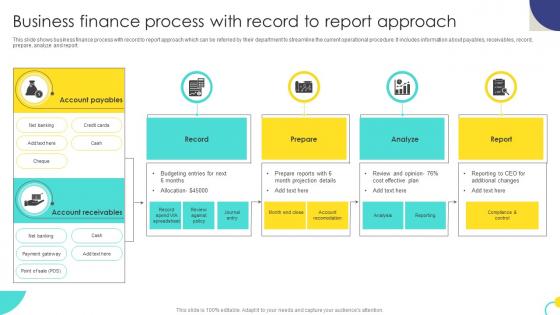
This slide shows business finance process with record to report approach which can be referred by their department to streamline the current operational procedure. It includes information about payables, receivables, record, prepare, analyze and report.
People who downloaded this PowerPoint presentation also viewed the following :
Business Finance Process With Record To Report Approach with all 6 slides:
Use our Business Finance Process With Record To Report Approach to effectively help you save your valuable time. They are readymade to fit into any presentation structure.





FAQs for Business Finance Process With Record
Look, cash flow management is everything - track your receivables like your life depends on it. Build up some emergency cash reserves and forecast out at least a year ahead. Most businesses tank because they ignore this stuff until it's crisis mode (seriously, don't be those people). Balance your debt and equity based on where you're at growth-wise. Monitor working capital ratios monthly - boring but necessary. Oh, and audit where you stand financially right now before doing anything else. Short sentences work. Your risk tolerance should drive these decisions too.
Check your cash flow weekly, not monthly - that's what actually makes a difference. I'd set up a basic spreadsheet tracking money in vs out for the next 2-3 months. Invoice the same day you finish work (I know, sounds obsessive but it works). Then chase up late payments after a week, not a month. Here's the thing most people don't do - ask suppliers for 30-day payment terms instead of paying upfront. Yeah it feels weird asking, but they're used to it. Try to keep 2-3 months expenses saved if possible. Just pick one thing to start with this week though.
So basically, financial forecasting is like your business crystal ball - you're trying to predict future cash flows and expenses using past data and market trends. It's way better than just winging it and hoping for the best, trust me. You can spot cash problems before they hit, plan big investments, or pivot when things get weird. Honestly, most people overthink it at first. Just start with simple monthly forecasts and tweak them as you go. It's like checking weather before a road trip - not perfect, but you'll be way less screwed if storms hit.
Dude, cash flow is everything. Seriously track your runway - know exactly how many months you've got left. We almost went under in month 8 because I wasn't paying attention! Start your budget with must-haves only, then add the fun stuff if there's room. Update projections monthly since things change so fast in startups. Always run three scenarios: best case, realistic, and total disaster. Here's the kicker - pad everything by 20-30% because stuff always costs more and takes forever. Weekly reviews with your team keep everyone grounded in reality instead of fantasy land.
Financial ratios are honestly a game-changer for spotting trends fast. Focus on the big ones first - profitability stuff like gross margin, liquidity ratios (current ratio is clutch), and efficiency metrics that show how well you're using your assets. Raw numbers don't tell the whole story, but ratios give you actual context. I'd track maybe 5-6 core ones quarterly instead of going crazy with like 20 different calculations. That way you can see if things are getting better or worse over time. Plus you can compare yourself to competitors, which is always fun (or terrifying).
Dude, honestly there's a bunch of ways to go about this. Bank loans and SBA stuff are solid if your credit's decent - rates are usually pretty good. Angel investors or VCs are great because they actually know their shit and can help beyond just money, but yeah you're giving up some ownership. Oh and there's this revenue-based thing that's kinda cool - you just pay back a percentage of what you make each month instead of being locked into fixed payments. Way more flexible. Equipment financing might work depending on what you need. I'd figure out your exact number first and when you need it by, then see what makes sense.
So basically, interest rates control how much it costs to borrow money for your business. Low rates? Perfect time to get loans for new equipment or expansion since it's cheap. When they're high though, borrowing gets expensive fast and you'll probably want to hold off on big projects. I learned this the hard way watching my cousin's restaurant plans get derailed in 2022. You might end up looking for investors instead or just using whatever cash you have. The Fed meetings are worth watching since rate changes hit your loan costs pretty quickly - like within a few months usually.
So equity's great because no monthly payments eating into your cash flow, unlike loans that can crush you when sales are slow. You get partners with real expertise too, which honestly can be worth more than the money sometimes. But yeah, you're giving up control. Debt lets you stay boss of everything - just gotta handle those payments. Oh and if things go sideways with equity, you won't be stuck paying it back personally like with most business loans. Really depends if you need cash now or can wait to find the right partner who actually brings value.
Just use the basic ROI formula: (Net Profit / Cost of Investment) × 100. The math's easy - tracking your initial costs against what you actually get back over time. I usually do it quarterly but annually works too. Here's the thing though - figuring out what even counts as "return" is way harder than the actual calculation. Revenue boost? Cost savings? Better productivity? Pick what matters for your specific goal first. Oh and start tracking everything from day one of whatever you're investing in. Trust me, trying to piece together data later is a nightmare. Clean numbers from the start = way less headache down the road.
Dude, finance tech is a total game changer. Automate your invoicing, expense tracking, payroll - all that tedious stuff that eats up hours. Cloud platforms give you real-time data wherever you are. AI can actually predict cash flow issues before they hit, which is honestly pretty wild. My cousin still does everything manually and it's painful to watch - like trying to navigate with a paper map. Pick one thing to start with, maybe expense management? That's usually the easiest win. Then just build from there once you get comfortable.
So first, figure out where you're most vulnerable - customers not paying up, prices going crazy, supply chain issues, that sort of thing. Financial ratios are your friend here. Check your debt-to-equity and current ratio to see how stretched you are. Then do some "what if" scenarios - like what happens if your biggest client bails? I actually think the stress testing part is kind of fun, weird as that sounds. Start simple with a risk matrix - just plot everything by how likely it is vs how much it'd hurt. Cash flow analysis is boring but super telling about your real stability.
First thing I'd do is audit what you're actually spending money on - you'll probably find subscriptions you forgot about or processes that are just burning cash. Automate the boring repetitive stuff if you can. Call up your suppliers and negotiate better rates (honestly, they almost always have room to move on pricing). Energy-efficient upgrades sound super unsexy but they actually save serious money over time. Remote work is another big one for cutting office costs, assuming your team can handle it. I'd start with whatever's easiest to fix first, then work your way up to the bigger changes.
Dude, taxes mess with literally every big money decision you make. Like, when you're picking between a loan or selling equity? The loan interest is deductible, so debt usually wins. I've seen companies buy equipment in December just to cut their tax bill - timing is everything. You might push expenses forward or hold off on invoicing clients. Honestly, sometimes I think businesses make weird choices just because of tax breaks. Your whole setup gets filtered through "but what about taxes" first - whether that's your LLC vs corporation decision, big purchases, even where you set up shop. Just... definitely talk to your accountant before doing anything major.
Look, your business credit score is basically what gets you better loan rates and terms. Lenders think you're less risky when it's good. Suppliers are more willing to give you trade credit too - which honestly saved my ass more than once when cash flow got tight. Some clients even peek at your credit before signing contracts, so it can make or break deals. The whole thing just follows you around like a shadow. My advice? Check it regularly and don't be late on payments. Keeps all those doors open for when you need them.
Honestly, financial analytics can reveal some crazy stuff you'd never catch in basic reports. You'll spot patterns in cash flow and customer behavior that are total game-changers. Sometimes the most profitable products aren't what you'd expect - I've seen businesses shocked by which services actually make money. It shows you exactly where you're hemorrhaging cash and which customers are worth their weight in gold. You can even run "what if" scenarios before making big moves. My advice though? Start with just customer profitability first. Don't try analyzing everything at once or you'll go nuts.
-
I am glad to have come across Slideteam. I was searching for some unique presentations and templates for my business. There are a lot of alternatives available here.
-
“Thanks to SlideTeam. Now I can make smart presentations in a fraction of time without any hassle.”