

Scenario Planning Powerpoint Presentation Slides






Try Before you Buy Download Free Sample Product
 Impress Your
Audience
 100%
Editable
 Save Hours
of Time


Our Scenario Planning Powerpoint Presentation Slides are topically designed to provide an attractive backdrop to any subject. Use them to look like a presentation pro.
People who downloaded this PowerPoint presentation also viewed the following :
Content of this Powerpoint Presentation
Slide 1: This slide introduces Scenario Planning. State your company name and begin.
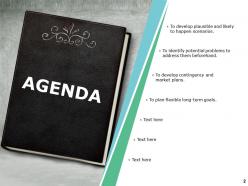
Slide 2: This is an Agenda slide. State your agendas here.
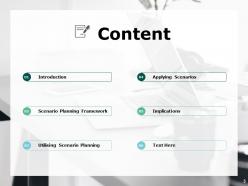
Slide 3: This slide shows Content of the presentation.
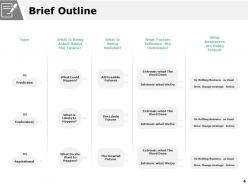
Slide 4: This slide provides Brief Outline of the project with categories as- Predictive, Exploratory, Aspirational.
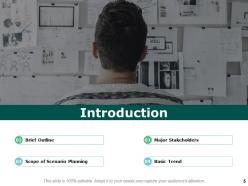
Slide 5: This is an Introduction slide describing topics as- Brief Outline, Scope of Scenario Planning, Major Stakeholders, Basic Trend.
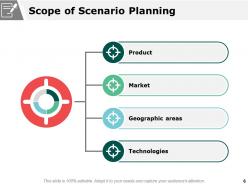
Slide 6: This slide shows Scope of Scenario Planning describing- Market, Geographic areas, Technologies, Product.
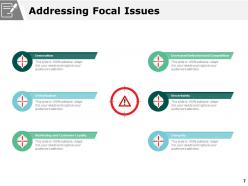
Slide 7: This slide presents Addressing Focal Issues through- Marketing and Customer Loyalty, Globalization, Innovation, Integrity, Uncertainty, Increased Selection and Competition.
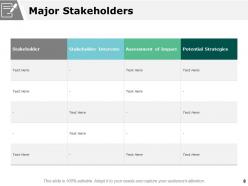
Slide 8: This slide displays Major Stakeholders in tabular form.
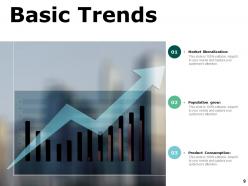
Slide 9: This slide showcases Basic Trends such as- Market liberalization, Product Consumption, Population grow.
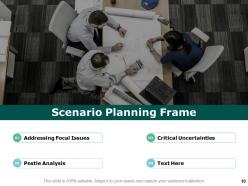
Slide 10: This slide represents Scenario Planning Frame describing- Pestle Analysis, Addressing Focal Issues, Critical Uncertainties etc.
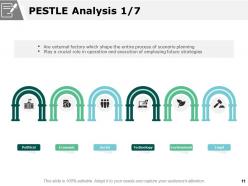
Slide 11: This slide shows PESTLE Analysis with related icons.
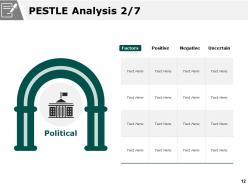
Slide 12: This slide presents PESTLE Analysis describing political factors.
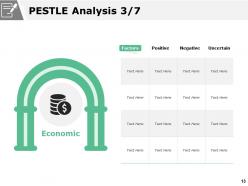
Slide 13: This slide displays PESTLE Analysis describing economic factors.
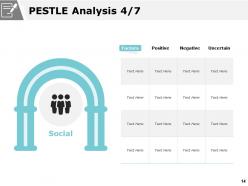
Slide 14: This slide represents PESTLE Analysis with social factors.
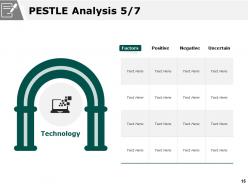
Slide 15: This slide showcases PESTLE Analysis with technology factors.
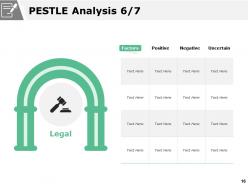
Slide 16: This slide shows PESTLE Analysis with legal factors.
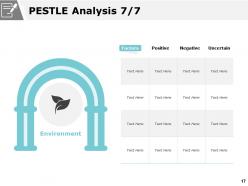
Slide 17: This slide presents PESTLE Analysis with environment factors.
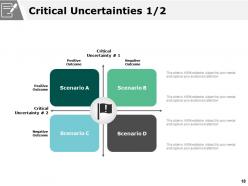
Slide 18: This slide shows Critical Uncertainties in matrix form.
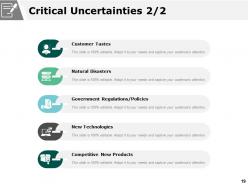
Slide 19: This is another slide on Critical Uncertainties describing- Government Regulations/Policies, Natural Disasters, Customer Tastes, New Technologies, Competitive New Products.
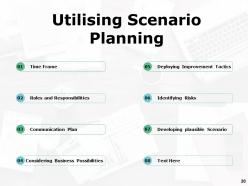
Slide 20: This slide presents Utilising Scenario Planning with categories as- Considering Business Possibilities, Time Frame, Deploying Improvement Tactics, Roles and Responsibilities, Identifying Risks, Communication Plan, Developing plausible Scenario.
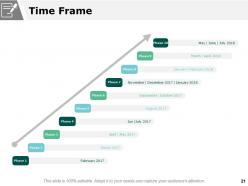
Slide 21: This slide displays Time Frame with 10 phases. Use it as per requirements.
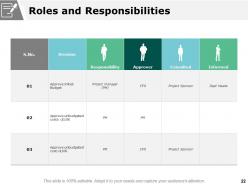
Slide 22: This slide represents Roles and Responsibilities in tabular form.
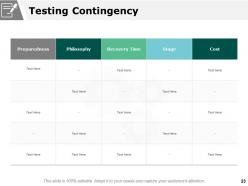
Slide 23: This slide showcases Testing Contingency in tabular form.
Slide 24: This slide shows Monitoring & Maintaining Changes among various factors.
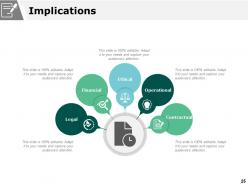
Slide 25: This slide presents Implications describing- Legal, Financial, Ethical, Operational, Contractual.
Slide 26: This is another slide on Implications.
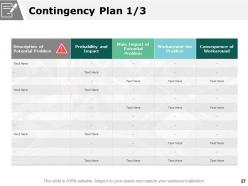
Slide 27: This slide shows Contingency Plan in tabular form.
Slide 28: This is another slide on Contingency Plan describing- Scenario, Response Strategy, Implementation Plan, Operational Support Plan, Preparedness plan, Budget.
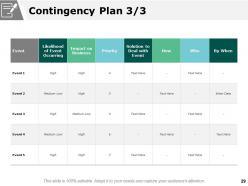
Slide 29: This is another slide Contingency Plan in tabular form.
Slide 30: This slide presents Scanning Business Changes with related flow chart.
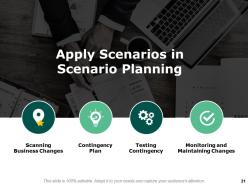
Slide 31: This slide showcases Apply Scenarios in Scenario Planning with categories as- Scanning Business Changes, Contingency Plan, Testing Contingency, Monitoring and Maintaining Changes.
Slide 32: This slide shows Financial Projections in tabular form.
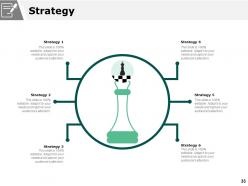
Slide 33: This slide displays Strategy with related text boxes.
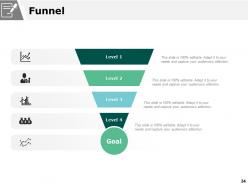
Slide 34: This is a Funnel slide with different levels. Use it as per requirements.
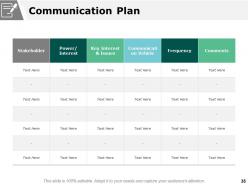
Slide 35: This slide presents Communication Plan in tabular form.
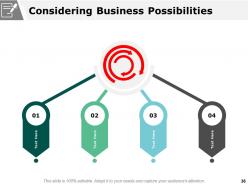
Slide 36: This slide showcases Considering Business Possibilities with related diagram.
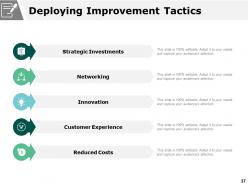
Slide 37: This slide shows Deploying Improvement Tactics describing- Strategic Investments, Networking, Innovation, Customer Experience, Reduced Costs.
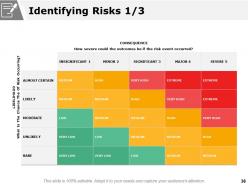
Slide 38: This slide presents Identifying Risks with level of consequences and likelihood.
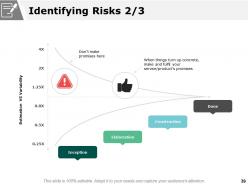
Slide 39: This is another slide on Identifying Risks in graphical form.
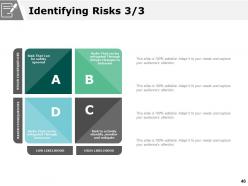
Slide 40: This is another slide on Identifying Risks in matrix form.
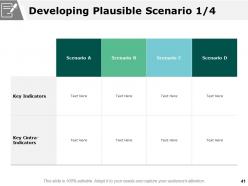
Slide 41: This slide shows Developing Plausible Scenario.
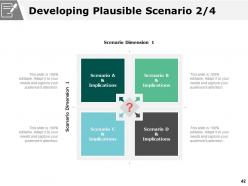
Slide 42: This is another slide on Developing Plausible Scenario.
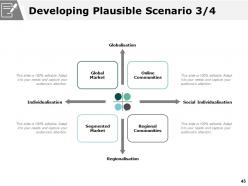
Slide 43: This is another slide on Developing Plausible Scenario.
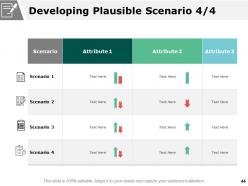
Slide 44: This is another slide on Developing Plausible Scenario.
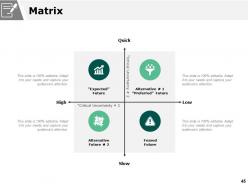
Slide 45: This is a Matrix slide describing- Preferred Future, Expected Future, Feared Future, Alternative Future.
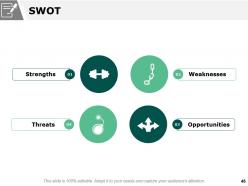
Slide 46: This is a SWOT slide describing- Opportunities, Threats, Weaknesses, Strengths.
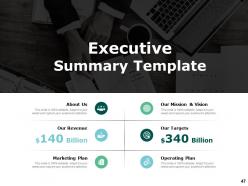
Slide 47: This slide shows Executive Summary Template with related imagery and text.
Slide 48: This slide is titled as Additional Slides for moving forward.
Slide 49: This is a Silhouettes slide to show people specific information etc.
Slide 50: This slide shows Hexagon with Icons.
Slide 51: This slide presents Circular Image with text boxes.
Slide 52: This slide displays Puzzle Pieces with text boxes.
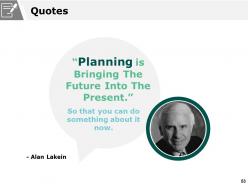
Slide 53: This is a Quotes slide to convey message, beliefs etc.
Slide 54: This is About Our Company slide to show company specifications etc.
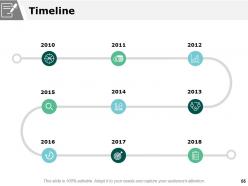
Slide 55: This is a Timeline slide to show information related with time period.
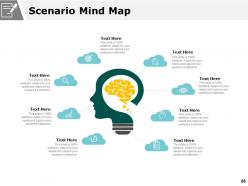
Slide 56: This slide shows Scenario Mind Map for representing entities.
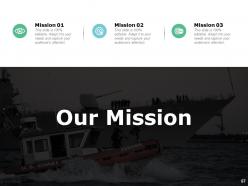
Slide 57: This is Our Mission slide with related imagery and text boxes.
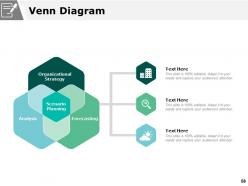
Slide 58: This slide shows Venn Diagram with text boxes.
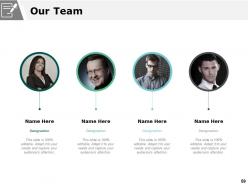
Slide 59: This is Our Team slide with names and designation.
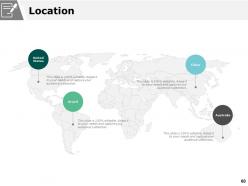
Slide 60: This is a Location slide with maps to show data related with different locations.
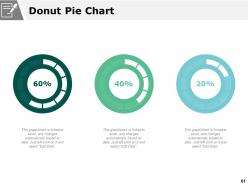
Slide 61: This slide shows Donut Pie Chart with data in percentage.
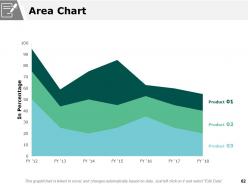
Slide 62: This slide presents Area Chart with three products comparison.
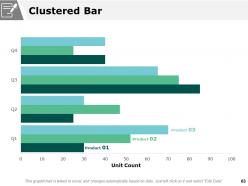
Slide 63: This slide displays Clustered Bar chart with three products comparison.
Slide 64: This is a Contact Us slide with address, contact numbers and email address.
Scenario Planning Powerpoint Presentation Slides with all 64 slides:
Use our Scenario Planning Powerpoint Presentation Slides to effectively help you save your valuable time. They are readymade to fit into any presentation structure.





FAQs for Scenario Planning
Honestly, scenario planning is a game-changer because it gets your team thinking past just one "likely" outcome. You'll catch risks and opportunities way before competitors who are just flying blind. It's like having a crystal ball but actually useful since you're not putting all your eggs in one basket. Your strategy becomes way more flexible too - you've already gamed out the "what ifs." The best part? Your team stops panicking when things get uncertain. I'd say start small - pick 3-4 realistic scenarios for whatever big decision you're facing and test how your plans hold up against each one.
Honestly, you've gotta start with what could actually hurt your business - revenue, supply chains, regulation changes, competitive stuff. Hunt down emerging trends through industry reports and talk to experts. It's like being a detective for weak signals that might blow up later. Focus on scenarios by two things: how likely they are and how badly they'd mess with your operations. Pick the ones that would seriously freak out your CEO, not just small annoying stuff. Build 3-4 different scenarios - don't just make variations of the same disaster. Run them past different teams because they'll catch things you missed.
You can't really do scenario planning without getting stakeholders involved. They'll spot blind spots you'd miss and bring perspectives you wouldn't think of. Plus they're way more likely to actually use the results if they helped build them - which honestly makes sense. Get them in early when you're figuring out the key uncertainties, then again when you're testing if your scenarios are realistic. I'd start by mapping who knows the most about your topic and has real influence. The tricky part is balancing getting their expertise while making sure they feel ownership of the whole thing.
External factors are what actually make your scenarios different from each other. Economic stuff like inflation or recession totally changes the game. Tech advances can flip entire industries - I mean, look at what's happening with AI right now, it's crazy. You'll want to pick 2-3 key external drivers that could realistically shift during your planning period. Then build scenarios around different ways those factors might play out. Honestly, the trick is figuring out which external forces would hit your specific situation the hardest. Start there and work backwards.
Morphological analysis is probably your best starting point - break down the big uncertainties into different pieces, then mix and match them systematically. Cross-impact analysis helps too since you don't want scenarios that completely contradict each other. For expert input, try the Delphi method. It avoids that whole groupthink mess. If your project's pretty straightforward though, just do a 2x2 matrix - grab your two biggest uncertainties and map four scenarios in the quadrants. Way simpler. Oh, and definitely run your scenarios by stakeholders early to test assumptions. Trust me on that one.
So basically you're thinking through different "what if" situations that could mess with your business. Map out a few futures - best case, worst case, whatever's in between. This shows you weak spots you'd probably miss otherwise. It's honestly like stress-testing your plans against all the crazy stuff that might happen. The good part? You can actually prep for each scenario instead of panicking later. Oh, and don't go overboard - just pick 3 or 4 realistic situations for your next project and figure out what could tank in each one. Way better than winging it.
The biggest trap? Making your scenarios way too similar - like just tweaking one variable instead of imagining truly different worlds. Teams always get obsessed with their "most likely" outcome and barely glance at the others, which is honestly pointless. You'll also run into groupthink if everyone thinking about this comes from the same background. Oh, and another thing - don't make them super narrow in scope. Really challenge what you think you know. Otherwise you're just doing this whole exercise to stick it in a drawer somewhere instead of actually using it to make better calls.
Dude, scenario planning is like doing fire drills for your business strategy. Sounds kinda nerdy but it's actually clutch when everything goes sideways. You basically map out 3-4 different "what if" situations and figure out how you'd handle each one. This way you're not scrambling when stuff inevitably changes. Your team gets better at spotting warning signs early and you'll have backup plans ready to go. Plus it makes everyone more flexible mentally - which honestly might be the most valuable part. Just start small with whatever big decision you're facing next.
Don't replace your strategy process - just add scenarios to it. Test your current assumptions by asking "what if we're totally wrong about this?" Build multiple futures into your planning instead of betting everything on one forecast. Most companies get paralyzed trying to make this perfect and never actually do it. Connect each scenario to real decisions you're making right now. Pick early warning signs for each scenario, then make someone track them. Otherwise you'll just have nice presentations that nobody looks at again. The whole point is making scenarios useful, not impressive.
Monte Carlo tools like @RISK or Crystal Ball are perfect for the heavy number-crunching stuff. Tableau and Power BI work great when you need dashboards that actually make sense to people - trust me, executives hate staring at raw data. ScenarioPlanning.io is decent for strategic stuff, though sometimes I think a simple decision tree does the job just as well. Oh, and Lucidchart's influence diagrams are surprisingly useful. Really depends who you're presenting to. Your analysts will want all the simulation details, but leadership just wants clean visuals they can understand quickly. Start basic and add complexity later - learned that one the hard way.
Honestly, scenario planning is such a game-changer for getting your team unstuck. You basically sit around mapping out wild "what if" situations - like what happens if AI takes over your industry or customers completely change how they buy stuff. Forces everyone to think way outside their normal bubble. Short sessions work best (quarterly maybe?). Mix up your team with people from different departments since they'll spot opportunities you'd totally miss. It's strategic daydreaming that actually pays off. You'll catch problems early and find innovation ideas hiding in all that uncertainty. Plus you'll beat competitors to the punch.
Quarterly reviews are the bare minimum, but monthly makes way more sense if your industry moves fast. Track your assumptions against reality with a basic dashboard - nothing fancy, just monitor the key stuff each scenario was built on. Once things start going off track from your baseline, time to refresh everything. Oh and don't just swap out numbers. Actually dig into whether the logic still holds or if there's new variables you missed before. Seriously though, set those calendar reminders right now or you'll definitely forget.
Your scenarios need to match what actually threatens your industry. Healthcare? Build around patient safety crises, regulatory curveballs, supply chain nightmares - pandemic stuff or when key drugs suddenly vanish. Finance is all about market chaos and interest rate swings. Here's the thing though - don't wing it. Get actual sector experts involved because they know which risks will bite you. I'd start with your 3-4 biggest vulnerability spots, then stress-test those hard. Use metrics that make sense for your field and timelines that reflect how fast things go sideways in your world.
Mix hard data with gut feelings - that's your sweet spot. Pull historical trends, market numbers, demographics, economic stuff from your industry. Then dig into the messier bits: expert opinions, customer complaints, tech disruptions, cultural changes. Honestly, the qualitative stuff often matters more than people think. Short sentences work. Longer ones help you explain the nuances of how external forces might screw with your plans. Start with your biggest "what ifs" then find data that either backs up or totally destroys your assumptions. Don't ignore the weird outliers - they're usually telling you something important.
Honestly, scenario planning is a game changer because it forces everyone to stare at the same "what if" situations instead of staying stuck in their own department bubbles. Your marketing team might think losing a big client just means finding new leads, but ops sees it as cutting staff and finance panics about cash flow. Run everyone through "what happens if demand jumps 300%" and watch how differently each group would handle it. I'd try one session where each team walks through their response to the same scenario - you'll catch so many gaps before they actually bite you. Plus it gives everyone a common way to talk about the scary stuff nobody wants to think about.
-
Excellent Designs.