


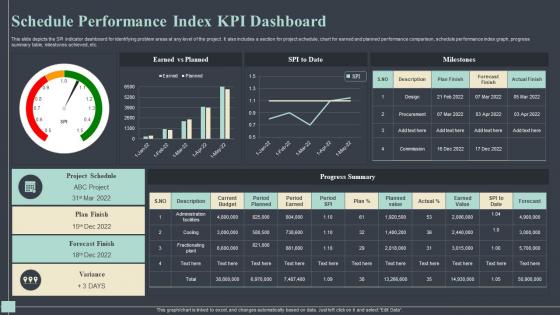
Schedule Performance Index KPI Dashboard




Try Before you Buy Download Free Sample Product
 Impress Your
 Audience
 100%
100% Editable
 Save Hours
 of Time


This slide depicts the SPI indicator dashboard for identifying problem areas at any level of the project. It also includes a section for project schedule, chart for earned and planned performance comparison, schedule performance index graph, progress summary table, milestones achieved, etc.
People who downloaded this PowerPoint presentation also viewed the following :
Schedule Performance Index KPI Dashboard with all 7 slides:
Use our Schedule Performance Index KPI Dashboard to effectively help you save your valuable time. They are readymade to fit into any presentation structure.





FAQs for Schedule Performance
So SPI tracks whether you're hitting your project timeline or not. Take your Earned Value and divide it by Planned Value - that's literally it. Like if EV is $50K and PV is $40K, you get 1.25, which means you're cruising 25% ahead of schedule. Below 1.0? You're behind. Above 1.0? You're ahead. Honestly, I'd check this stuff weekly because waiting too long to spot problems is how projects go off the rails. Oh, and 1.0 is your sweet spot - that means you're right on track with what you planned.
So SPI compares your earned value to planned value - pretty simple math. Above 1.0 means you're ahead of schedule, below means you're behind. I actually like this metric because it's not confusing like some of the others. Check it regularly though, not just at big milestones. That way you'll catch problems early instead of having that awful moment where you realize you're months behind schedule. Honestly, your stakeholders will thank you for the heads up. It's basically your early warning system for timeline issues.
So you're ahead of schedule - nice! That SPI over 1.0 means you're getting more done than planned for the time invested. Honestly though, sometimes being way ahead makes people wonder if you cut corners or missed something. Worth figuring out why you're crushing it. Maybe your original estimates were super conservative? Your team's just clicking really well? Dependencies wrapped up quicker than expected? Whatever it is, definitely write down what's working. You'll want to steal these tactics for your next project when you're doing timeline estimates.
Think of SPI like your project's pulse - when it dips below 1.0, you're falling behind and need to move fast. Maybe shift some people around, speed up critical stuff, or have those fun conversations with stakeholders about cutting scope. Above 1.0? You're golden and can probably lend folks to other disasters. I'm pretty obsessive about checking mine weekly since the pattern tells you way more than just one random number. The whole point is spotting trouble early enough to actually fix it instead of just writing fancy reports about why everything went sideways.
So your SPI tanked below 1.0? Yeah, that just means you're behind schedule - actual progress is lagging what you planned. Could be a bunch of things really. Maybe your initial timeline was way too optimistic (happens ALL the time). Or your team got pulled onto other stuff, scope creep snuck in, technical problems popped up. Weather, supplier drama, teams not talking to each other - honestly the list goes on. Most projects hit this at some point, don't stress too much. Just catch it early with regular check-ins so you can shuffle resources around or manage expectations before everything goes sideways.
So SPI and CPI basically work as a team to show you what's actually happening with your project. If your SPI drops below 1.0 (you're behind) but CPI stays above 1.0 (under budget), you can probably throw more money at it to catch up. I run into this situation all the time, honestly. Both numbers crashing together? That's when you panic. The trick is watching how they move together over weeks or months - don't get hung up on single data points. Way better to use both when you're figuring out where to shift resources around.
Check your SPI weekly when things are moving fast. Daily's even better if the project's complex or risky. During slower phases, maybe every two weeks works, but honestly once you're in the habit, weekly feels natural. The main thing is staying consistent - you want to spot schedule problems before they blow up. Also smart to measure right after big milestones to see how they affected your timeline. Oh, and definitely set a calendar reminder or you'll totally forget to pull those numbers!
So for tracking SPI, most people just use Microsoft Project since it does the math automatically once you plug in your planned vs actual stuff. Primavera P6 works great too, especially for bigger projects. Excel's an option if you're into building formulas, but honestly that gets old real quick - been there, done that. Tools like Monday.com or Smartsheet can handle it too with some tweaking. My take? Just use whatever project software your team's already got. Most of them have SPI built in anyway, you just gotta find where they hid it in the menus.
Yeah totally, just gotta tweak it for how agile actually works. Traditional SPI compares planned vs actual schedule stuff - perfect for waterfall but kinda weird for sprints. What I'd do is compare your planned story points against what you actually finished each sprint. Track it over a few sprints and you'll start seeing patterns in your team's velocity. Honestly, some people get way too into the calculations here, but the real value is catching when you're consistently biting off more than you can chew (or maybe playing it too safe). Super helpful for figuring out capacity issues before they bite you.
When your SPI drops below 1.0, that's your cue to get ahead of the problem. Don't let stakeholders find out through the grapevine - they absolutely hate being blindsided. Hit them with the facts first: here's where we are versus where we planned to be. But honestly, nobody wants to hear just bad news. Come armed with your game plan too. Maybe you're bringing in extra help, cutting some scope, or pushing out deadlines. Whatever it is, show them you've got a handle on fixing this mess. Being upfront about problems while proving you're actively solving them? That's how you keep people's trust intact.
Don't just drop the SPI number without explaining what it actually means for your timeline. Show the trend over several weeks - one bad data point isn't the end of the world, trust me. I've watched people completely freak out over nothing! Charts work way better than boring tables here. If your SPI is under 1.0, you gotta have a recovery plan ready. Pair it with Earned Value data and call out any big variances with real reasons. Your stakeholders want solutions, not just problems dumped on them.
Honestly, looking at old SPI data is like having a mirror for your planning skills. Your team probably has patterns you don't even realize - maybe you always start projects slow then speed up later, or certain work types consistently blow past estimates. Pull up your last 5-10 projects and crunch the average SPI at major checkpoints. I swear, most teams are way more predictable than they think. Build that reality check into your next timeline upfront instead of being surprised when you're behind schedule again. Way better than the whole "this time will be different" approach that never works.
Look, SPI matters a ton in performance contracts because your payment literally depends on it. Above 1.0 means you're ahead of schedule - hello bonus payments. Drop below 1.0 and you might face penalties or reduced pay. Clients love this stuff because it keeps contractors honest about timelines. Both sides get objective math instead of those vague "we're making good progress" updates that nobody trusts anyway. Track your SPI consistently and document everything. Trust me, you'll need that paper trail when payment conversations get heated. Way better than arguing over gut feelings.
Ugh, when your SPI tanks you gotta figure out what's actually broken first. Are you short on people? Did scope creep sneak up on you again? Maybe those original estimates were just wishful thinking - happens to the best of us. Look, once you know what's wrong, you can throw more resources at the critical stuff or move people around to clear bottlenecks. Sometimes you'll need to have those painful conversations about cutting scope or pushing deadlines. Nobody likes doing it, but being upfront with everyone beats pretending everything's fine. Update your timeline with real numbers based on how things are actually going.
Here's the thing - people think SPI measures time delays, but it doesn't. If your SPI is 0.8, you're not 20% behind schedule. You're earning value 20% slower than planned. Completely different! Don't rely on SPI alone either - honestly, that's asking for trouble. Cross-check it with your critical path analysis and actual milestone dates. SPI's awesome for spotting trends and comparing how projects are doing, but treat it like one piece of the puzzle. I've seen too many PMs get burned by trusting just one metric.
-
Illustrative design with editable content. Exceptional value for money. Highly pleased with the product.
-
The best part about SlideTeam is their meticulously prepared presentations (complete-decks and single-slides both), infused with high-quality graphics and easy to edit. All-in-all worthy products.