


Supervised Machine Learning With Types And Techniques





Try Before you Buy Download Free Sample Product
 Impress Your
 Audience
 100%
100% Editable
 Save Hours
 of Time


Our Supervised Machine Learning With Types And Techniques are topically designed to provide an attractive backdrop to any subject. Use them to look like a presentation pro.
People who downloaded this PowerPoint presentation also viewed the following :
Supervised Machine Learning With Types And Techniques with all 9 slides:
Use our Supervised Machine Learning With Types And Techniques to effectively help you save your valuable time. They are readymade to fit into any presentation structure.

FAQs for Supervised Machine Learning With
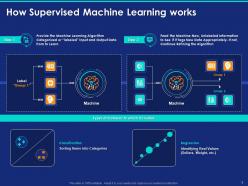
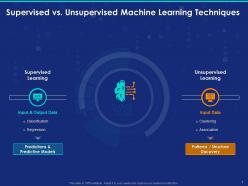
So supervised learning has labeled data - you're literally showing the model examples with the right answers, like "this email is spam, this one isn't." Unsupervised is the opposite. No labels at all. The model just tries to find patterns in whatever data you throw at it. Think of supervised as studying with an answer sheet versus unsupervised being more like... idk, trying to figure out why certain customers buy stuff without knowing anything about them first. Honestly? Start with supervised if you're new to this. Way easier to tell if you're screwing up or not.
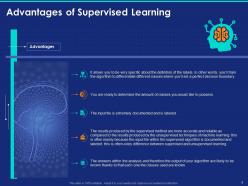
Start with your business goal - what are you actually trying to predict? That shapes everything. Get domain experts involved because they know the nuances you'll miss. Bad labels will wreck your model, trust me. Use multiple people to label the same data and check if they agree. Disagreement usually means your guidelines suck. Begin small with like 100-200 samples to test your approach. Once that's working, scale up. Write down your labeling rules clearly so everyone's on the same page. I've seen teams waste months because their labels were inconsistent from day one. It's way easier to fix this stuff early than debug a broken model later.
Honestly, just start with linear/logistic regression or decision trees - they're simple and you can actually explain what's happening. Random forests give you better accuracy when you need it. For text stuff, SVMs are clutch. Neural networks are obviously amazing for images and speech, but people throw them at everything these days when simpler models would work fine. Oh, and k-nearest neighbors is pretty intuitive for recommendations. It really comes down to your data size and whether you need to explain your results to someone else. Don't overthink it - begin simple, then get fancy later if you have to.
So overfitting is when your model basically cheats by memorizing the training data instead of actually learning patterns. Training accuracy looks amazing but then it bombs on new stuff. Watch for that gap between training and validation scores - dead giveaway. Try regularization (L1/L2), early stopping, or dropout if you're doing neural nets. More data helps too, obviously. Cross-validation catches it early which is clutch. Honestly, I'd start simple and add complexity slowly rather than going nuts from the start. Train/validation/test splits are your friend here.
So cross-validation is basically testing your model on different chunks of data instead of just one split. Think of it like getting multiple opinions before making a decision. You divide your data into k parts and rotate which one's the test set - that's k-fold CV. Way better than crossing your fingers with a single train/test split! It catches overfitting you'd totally miss otherwise. Honestly, I use it every time I'm comparing models or tuning parameters. The performance estimates are just more reliable, and you won't get burned when your model hits real data.
So basically, feature selection helps you ditch the useless stuff in your dataset that's just making noise. Your model trains way faster and usually performs better too since it's not getting distracted by junk features. Less features = less overfitting, which is always good. The interpretability boost is honestly my favorite part - makes explaining things to non-tech people so much easier. I'd start with something simple like checking correlations or trying recursive feature elimination to figure out what's actually useful. Oh, and your accuracy often improves too since the algorithm can focus on what matters.
Ugh, imbalanced datasets are the worst - your model basically gets lazy and just guesses the majority class every time. You'll think you're crushing it with 95% accuracy, but then realize you're missing all the important rare cases. Super frustrating! Try SMOTE to create synthetic examples of your minority class, or just weight the classes differently so wrong predictions hurt more. Oh, and definitely ditch accuracy as your main metric. F1 scores and confusion matrices will actually show you what's happening. Trust me, I learned this the hard way on a project last month.
So you'll wanna test your model on fresh data it's never seen - that's your test set. Accuracy works for classification, but precision, recall, and F1 give you way better insight into false positives/negatives. For regression stuff, go with MAE, MSE, or R-squared to check prediction errors. ROC curves are clutch for binary classification - they show sensitivity vs specificity tradeoffs. Honestly, single metrics can be misleading. Pick 2-3 that actually matter for your specific problem and compare across different models. That's how you'll find what actually works best.
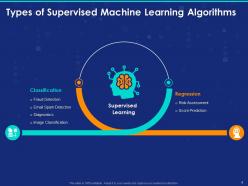
Honestly, just think about what you're trying to predict. Regression is for numbers - like house prices, how hot it'll be tomorrow, or your company's sales next month. Classification? That's more yes/no stuff, spam detection, identifying cats vs dogs. Here's what I always do: if your answer could be something random like 47.3 or 284.6, then regression's your move. But if it's just picking between categories like "A" or "B," you'll want classification instead. Really comes down to whether you're asking "how much?" versus "which one?" Pretty straightforward once you think about it that way.
Dude, preprocessing is HUGE - seriously can't stress this enough. Clean your data first, deal with missing values, normalize features, encode categorical stuff properly. I've watched so many projects crash and burn because people skipped this part. Your model's only gonna be as good as what you put into it, right? When you rush through preprocessing, your algorithm gets confused by messy formats and weird outliers instead of learning actual patterns. Oh and explore your dataset thoroughly before doing anything else - trust me, you'll thank yourself later when everything actually works instead of giving you random garbage results.
So basically you're combining multiple models instead of just trusting one - like getting advice from several friends instead of one person. Random forests do this with bagging, XGBoost uses boosting, or you can just make different algorithms vote. Works because models screw up in different ways, so their mistakes cancel out while they agree on the right stuff. I always throw together like 3-4 different algorithms now since it's such an easy performance boost. Honestly took me way too long to start doing this regularly - wish someone had told me sooner!
Bias is probably the biggest thing - your model could totally screw over certain groups if your training data sucks or reflects old inequalities. Privacy's another headache, especially with personal info. Can you actually explain how your model works? That transparency thing becomes super important in stuff like hiring decisions. Oh, and definitely audit your dataset early on - I learned that the hard way on a project last year. Document everything too because stakeholders will ask. It's a lot to juggle but you'll get the hang of it.
So hyperparameters are like the settings you adjust before your model starts learning - stuff like learning rate, batch size, how many layers to use. Get them wrong and your model will either crawl along super slowly or overfit badly. Honestly the most annoying part when you're new to this stuff. Different algorithms care about different hyperparameters too. I'd say start with whatever defaults scikit-learn gives you, then try grid search or random search to fine-tune the important ones. Makes a huge difference for your specific data.
Dude, AutoML is probably the biggest thing right now - it handles all that annoying hyperparameter stuff automatically. Also seeing tons of explainable AI so you can actually figure out why your model spits out certain results. Multi-modal learning is everywhere too, like models that process text AND images together instead of separately. Federated learning's picking up steam for privacy stuff. Oh and honestly? AutoML alone will save you so much time it's ridiculous. I'd mess around with AutoKeras or H2O.ai to get a feel for it. Definitely worth checking out.
Healthcare uses it tons for diagnosing stuff from X-rays and predicting patient outcomes. Finance is all over fraud detection and credit scores - makes sense since they're obsessed with risk. Marketing teams use it to figure out customer segments and who's about to cancel their subscription. You're basically teaching algorithms by showing them labeled examples first. The tricky part? Getting good quality data with proper labels - honestly that's where most projects get stuck. Pick what you want to predict, then hunt down historical data that actually tells the story you need.
-
Appreciate the research and its presentable format.
-
Unique and attractive product design.
-
Understandable and informative presentation.
-
Excellent design and quick turnaround.