


Startup business idea proposal powerpoint presentation slides




Try Before you Buy Download Free Sample Product
 Impress Your
 Audience
 100%
100% Editable
 Save Hours
 of Time


Frustrations disappear with our Startup Business Idea Proposal Powerpoint Presentation Slides. Your convictions come alive again.
People who downloaded this PowerPoint presentation also viewed the following :
Content of this Powerpoint Presentation
What brings a startup idea to a reality? Is it the showcased or projected benefits of the startup? Is it the people involved in the idea? Is it the willing investors? Or is it the idea itself that brings the startup to a reality?
If you think deeply, you will agree that although different aspects help convert a startup idea to reality, investors play a somewhat more important role. When a startup idea takes hold, the first thing that comes to mind is funding, and for this pursuing investors to back the startup is essential. However, doing this is not an easy task.
This start-up business plan complete deck eases your way from idea of execution.
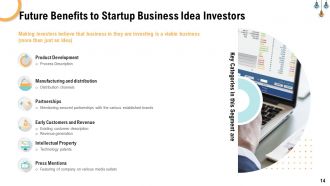
Investors seem to be reluctant to invest in a business based on a startup idea itself. What you need is a well-versed set of documents showcasing details related to the business, its competitors, prevailing market conditions, usual hurdles you must overcome, and the roadmap, etc.
Thankfully, SlideTeam’s 100% editable startup and business idea proposal template can help you do the same. Use this slide to showcase information related to crucial elements related to the business and the market. This information will help you cater to the analysis capabilities of the investors and bring in the required investments quickly.
Get the world’s best business idea proposal with this PPT Template product from SlideTeam.
Let’s learn more about the complete deck, with 100% editable and customizable templates, and its offerings below and ascertain how it can help you grab the attention of your audience.
Let’s explore!
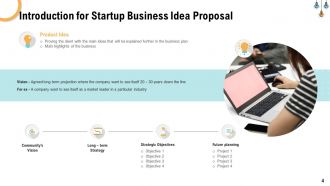
Template 1: Introduction to Startup Business Idea Proposal
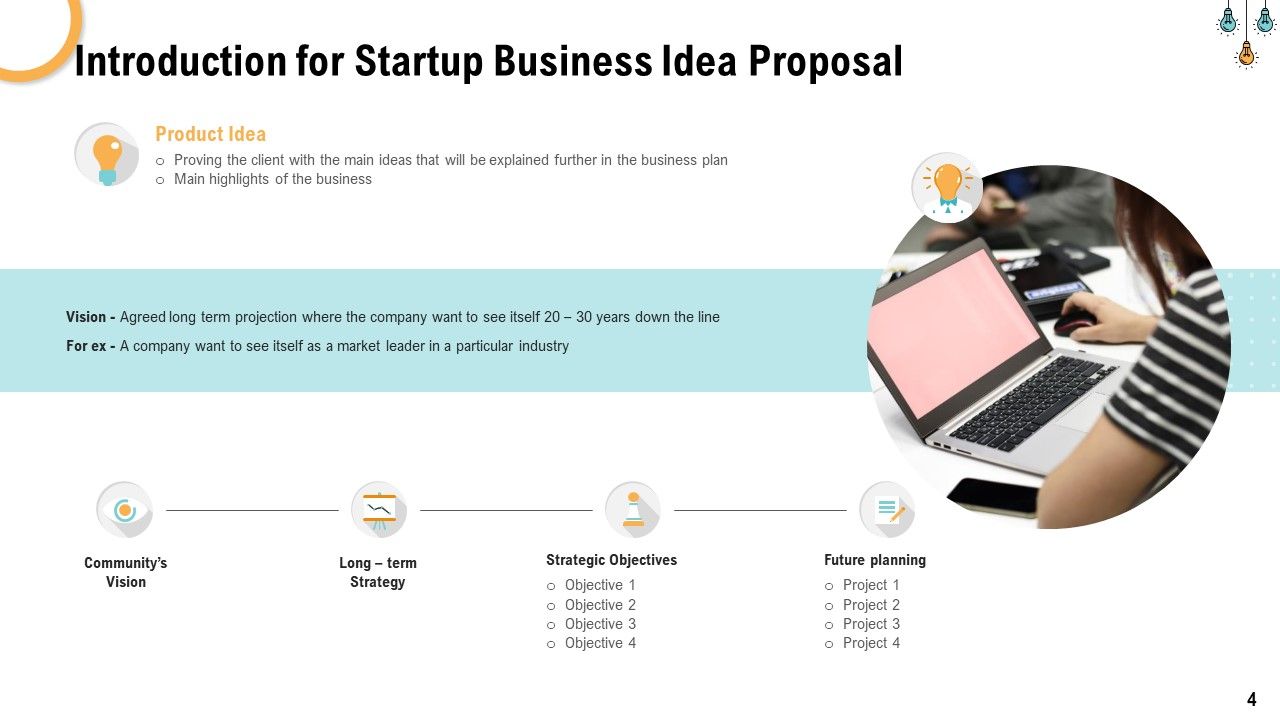
The first thing you need to explain to your audience is the idea itself. You can take the help of this slide to showcase information related to the business idea, its products, services, and more. To do the same, you can start by delineating your Vision statement. You can also state the product or service idea in the slide to explain what you want to offer to customers. Apart from this, you can also list the long-term strategy and strategic objectives.
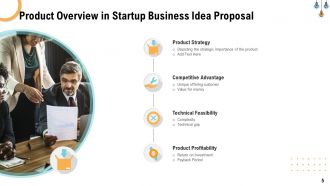
Template 2: Product Overview in Startup Business Idea Proposal
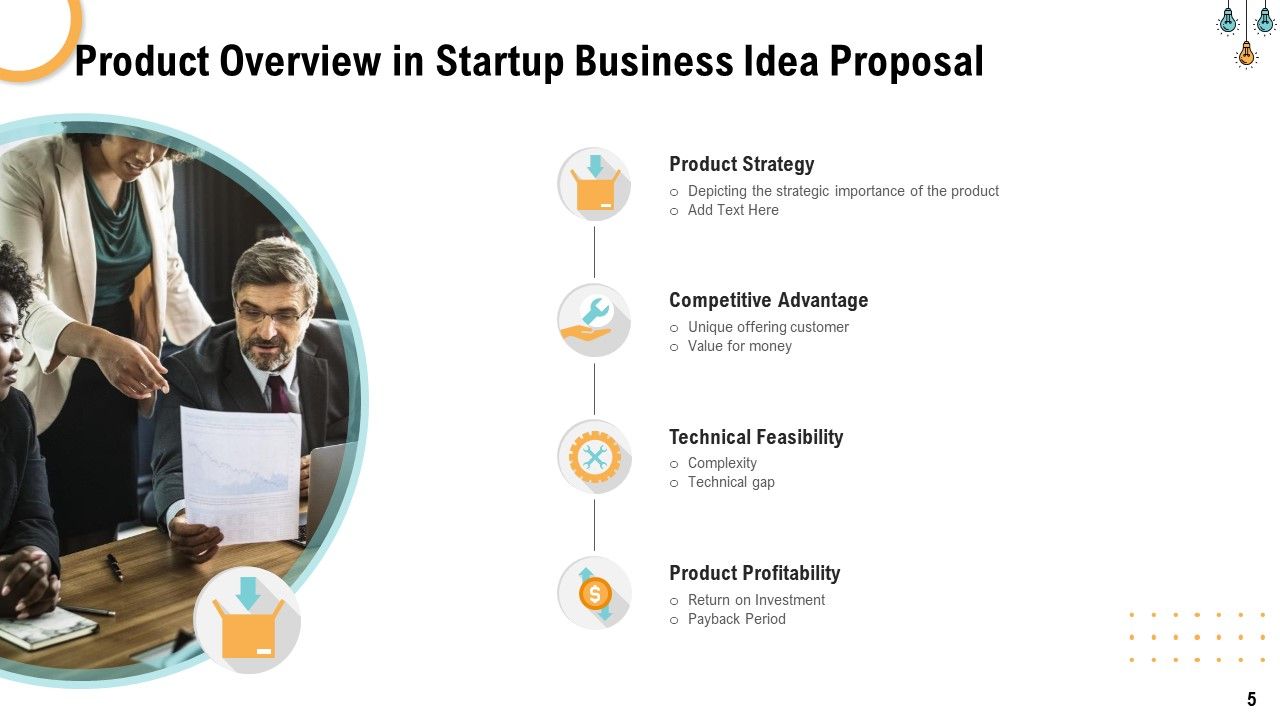
Now that your business’s vision is clear, the audience may want to know more about the product(s) or service(s) you plan to offer. This is where this slide comes in and explains the competitive advantage of entering the business domain, the entire product strategy, the technical feasibility of procuring or manufacturing the product, and the overall profitability that the product can offer in due time. The PowerPoint Layout answers the Whats of the audience with ease.
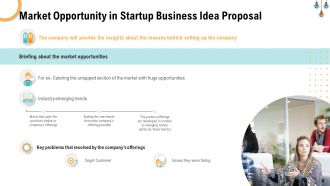
Template 3: Market Opportunity in Startup Business Idea Proposal
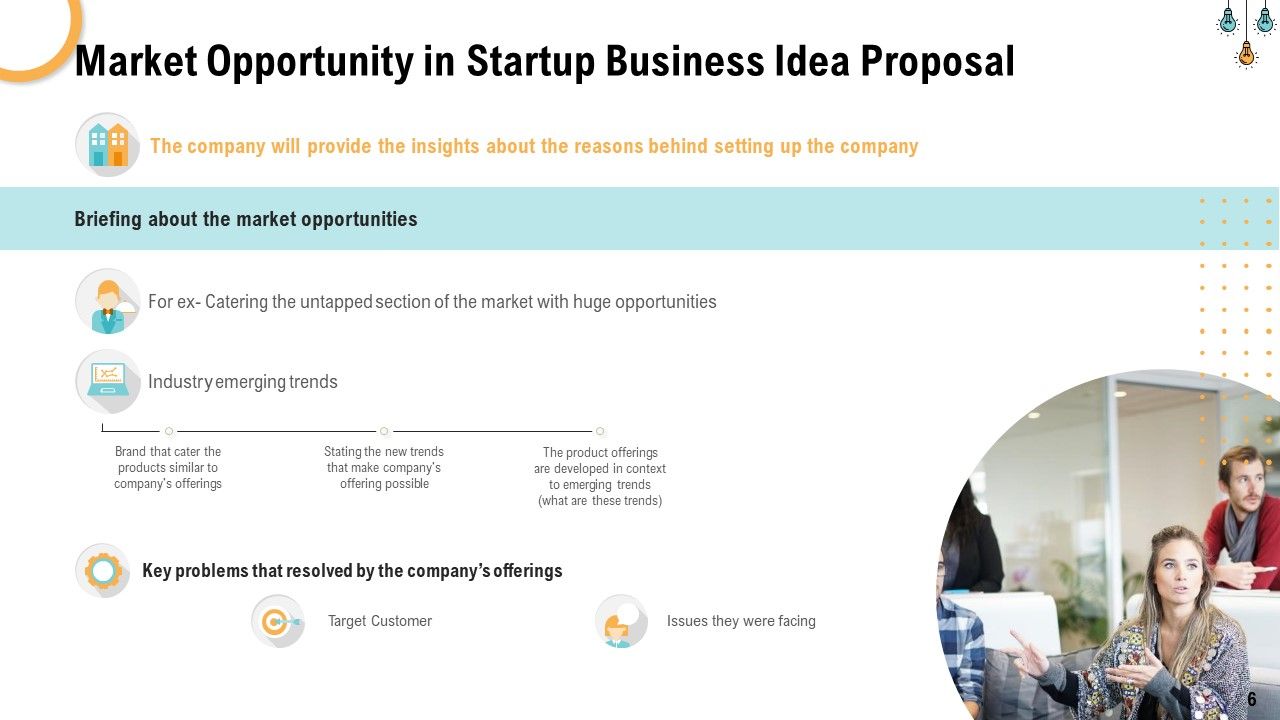
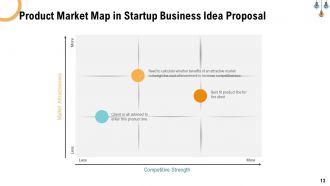
The success of a business relies heavily on the market. Hence, to make your startup idea successful, you should also conduct thorough market research and ascertain the overall market opportunity. This slide allows you to showcase the findings of the research and the scope of market opportunities to the audience. For this purpose, you can list competitors and their products that are similar to yours, then you can showcase the competitive advantage of your products, and show the relationship of the products with ever-changing trends.
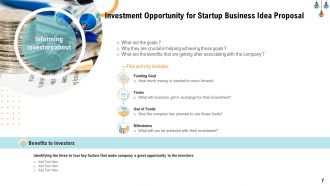
Template 4: Investment Opportunity for Startup Business Idea Proposal
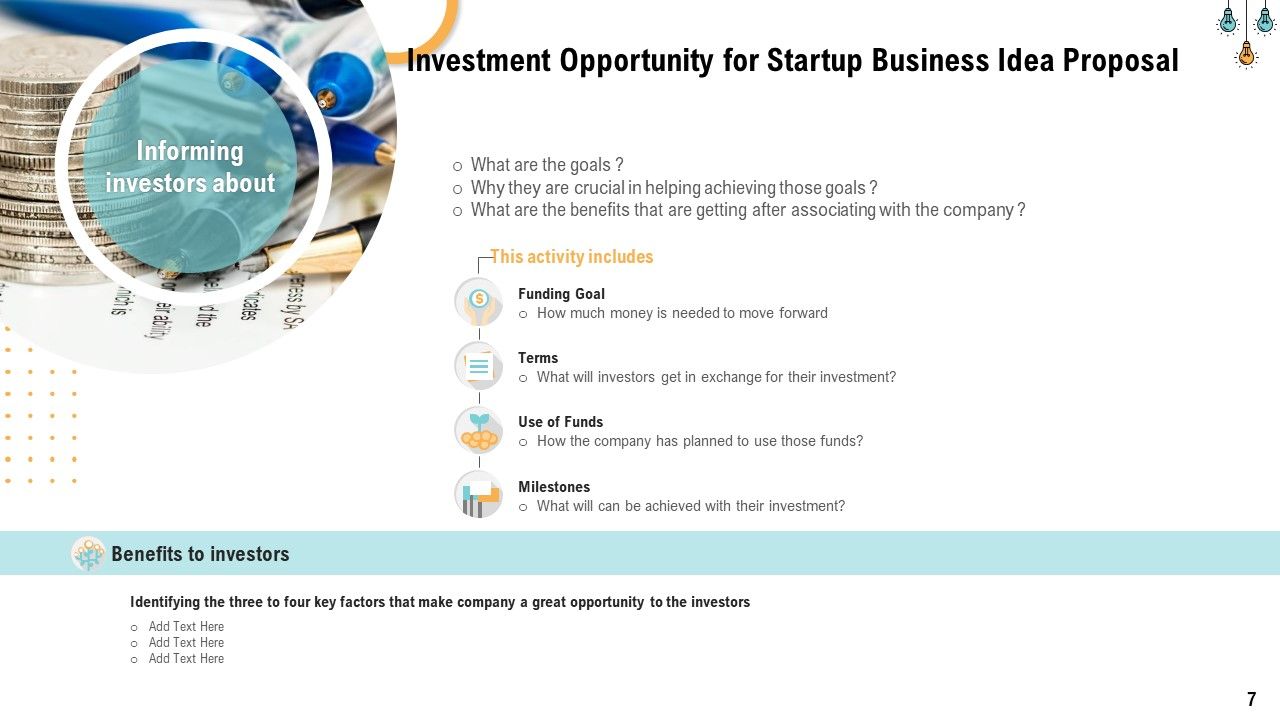
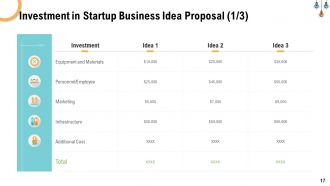
All investors care about is investment and to the extent it will grow. If you can prove to investors that you have reliable and researched data that portrays the potential success of your business idea, then you can easily gain investments. This slide allows you to showcase the scope of investment opportunities to your audience. Here, you can state how much money you need for the business, the terms and conditions your business is comfortable with, and other information that the investors may seek.
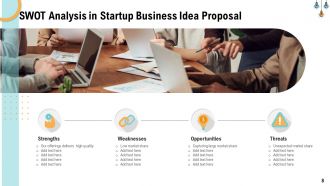
Template 5: SWOT Analysis for Startup Business Idea Proposal
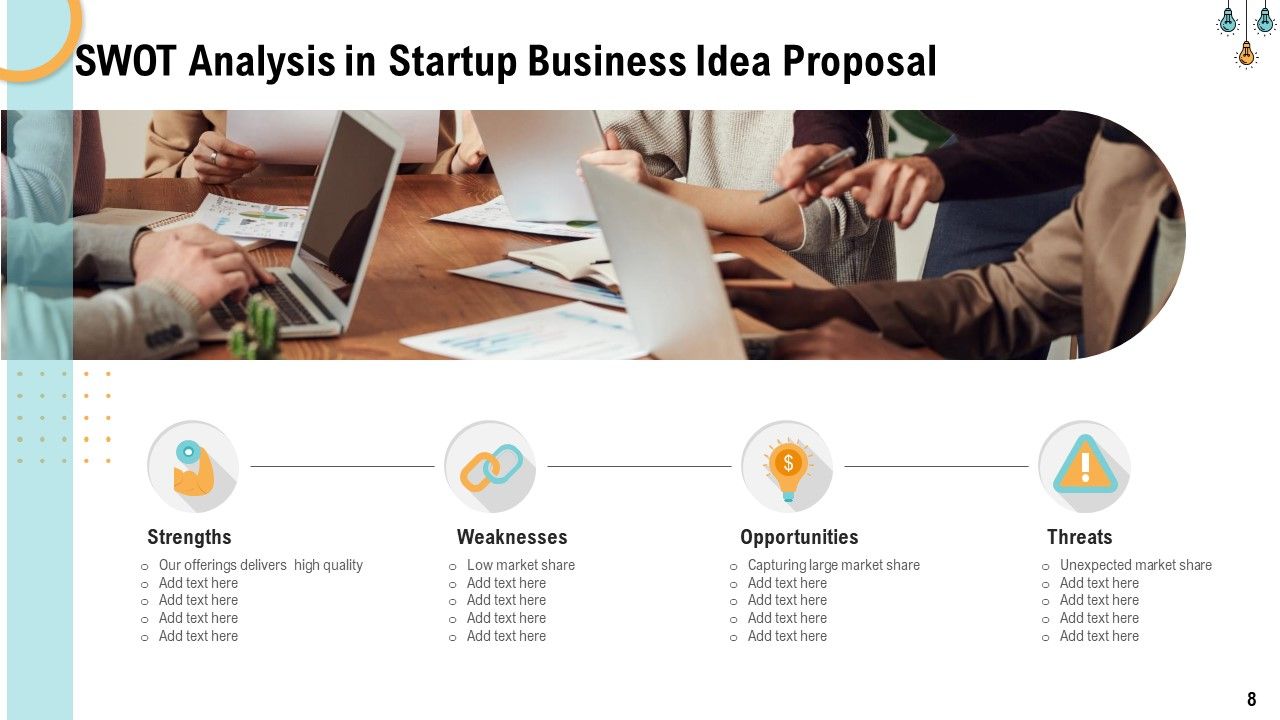
The Strengths, Weaknesses, Opportunities, and Threats or SWOT technique of analysis is quite commonly used to showcase the criticalities of any business. You can also use the same to showcase that your business’s strengths and opportunities overpower the weaknesses and threats posed by the market conditions, competition, and other factors. You can take the help of this slide to showcase this difference using some informative text. You can showcase the main factors of SWOT and help the audience make an informed decision.
Template 6: Product Roadmap in Startup Business Idea Proposal
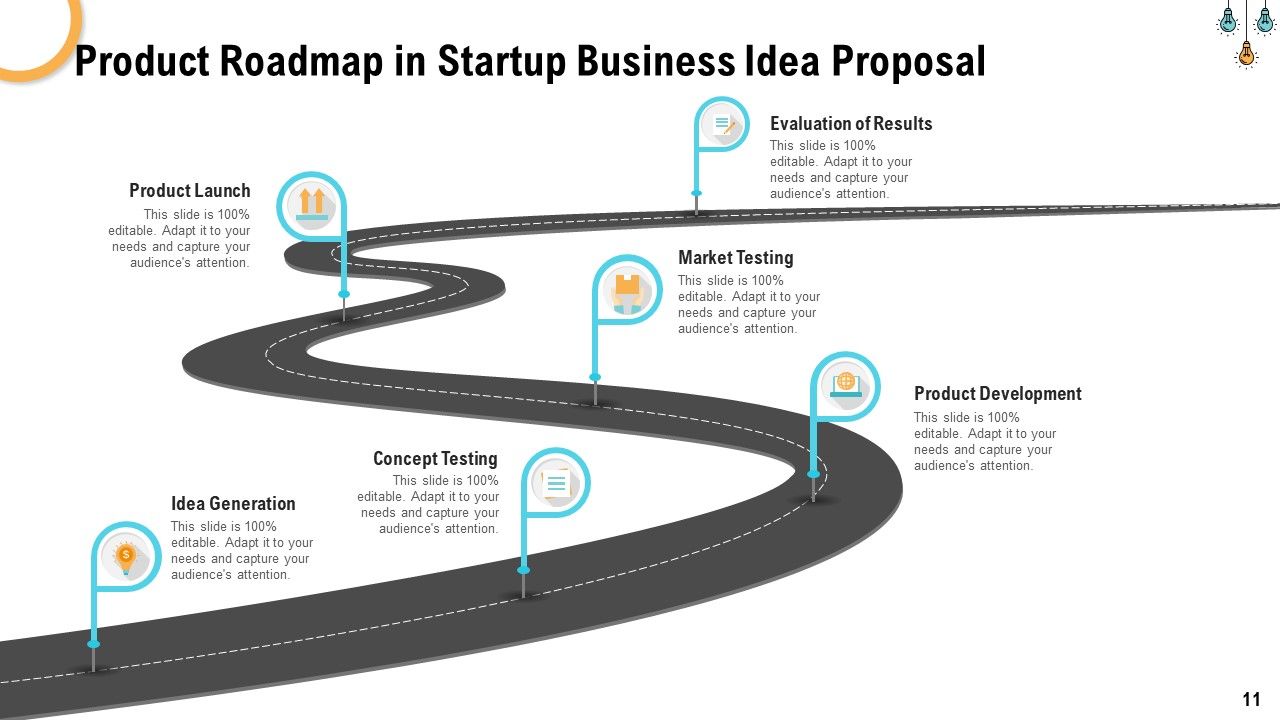
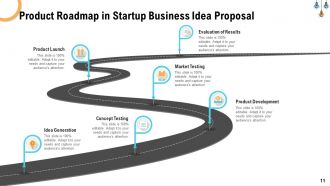
When you start a business, you just can’t decide to proceed willy-nilly. There must be a planned course of action for the business to follow. A lack of a well-planned roadmap means a lack of interest in your business. Hence, to showcase your planning to the audience, you can take the help of this presentation template to state how the business operations will proceed. The milestones of this roadmap can be idea generation, testing, development, and more.
Template 7: Product Lifecycle in Startup Business Idea Proposal
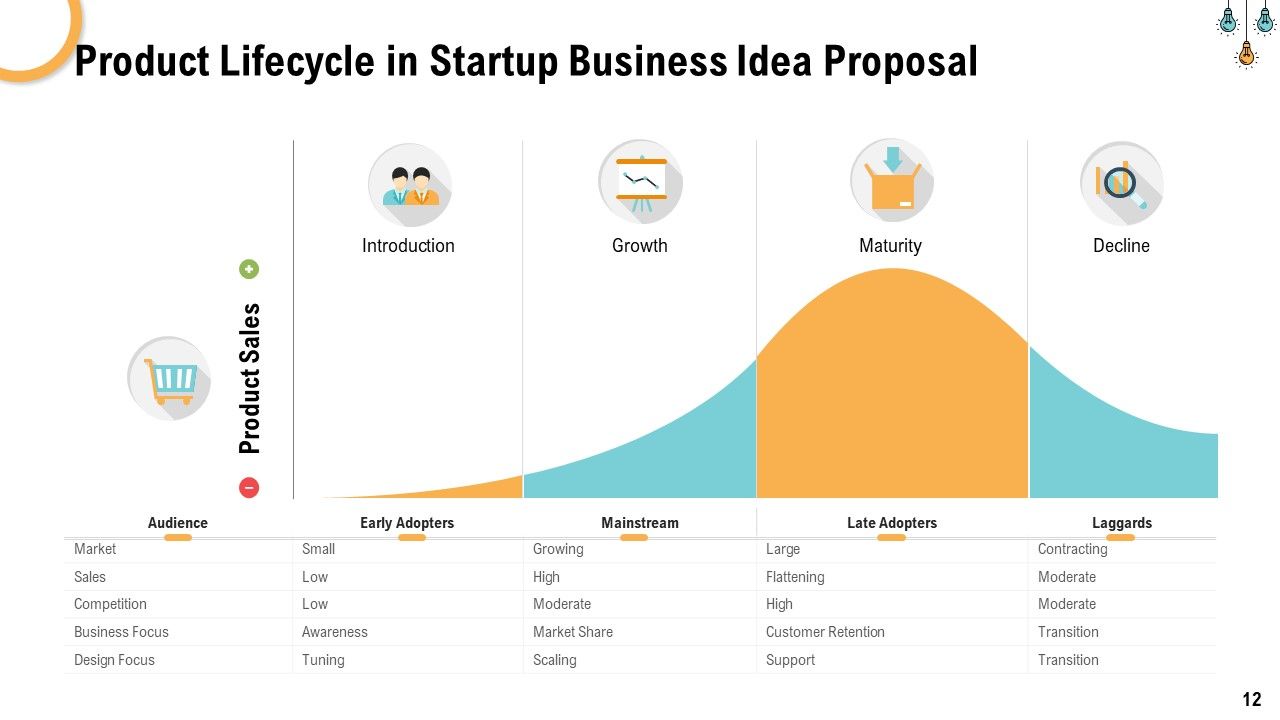
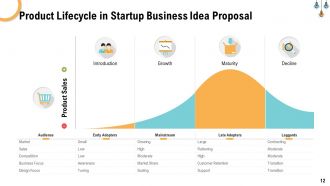
Every product has a lifecycle. Even if the product has not been developed yet, its lifecycle can be ascertained. The life cycle helps in ascertaining the growth and decline of the product’s relevance and requirements. The investors may seek information related to the lifecycle of the product and you can share the same using this slide. You can showcase the product’s early adopters after introduction, then the projected growth in quality and quantity of the product, state or maturity, and more.
Template 8: Budget Allocation in Startup Business Idea Proposal
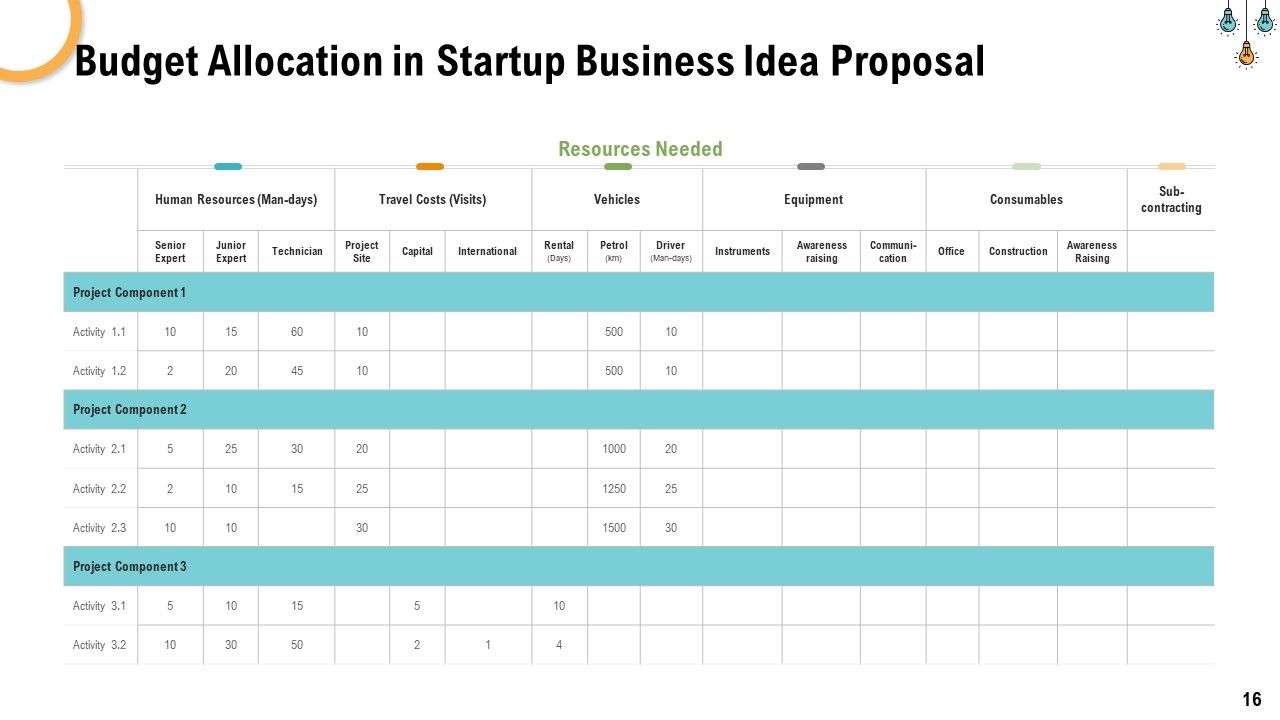
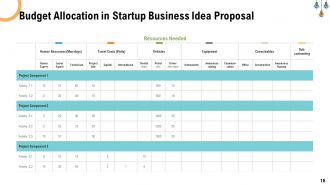
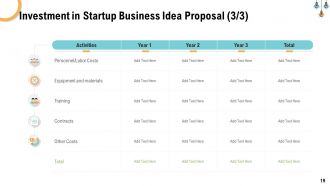
This is a tabular slide in the template that allows you to showcase how the money raised from the investors will be used in the business. This slide will help you explain the usage pattern of the money to the last penny, including the money spent on procuring the workforce, vehicles, leasing or purchasing equipment, funds exhausted on travel, consumables, and others. You can divide fund use, according to project components as well.
Template 9: Funding Summary in Startup Business Idea Proposal
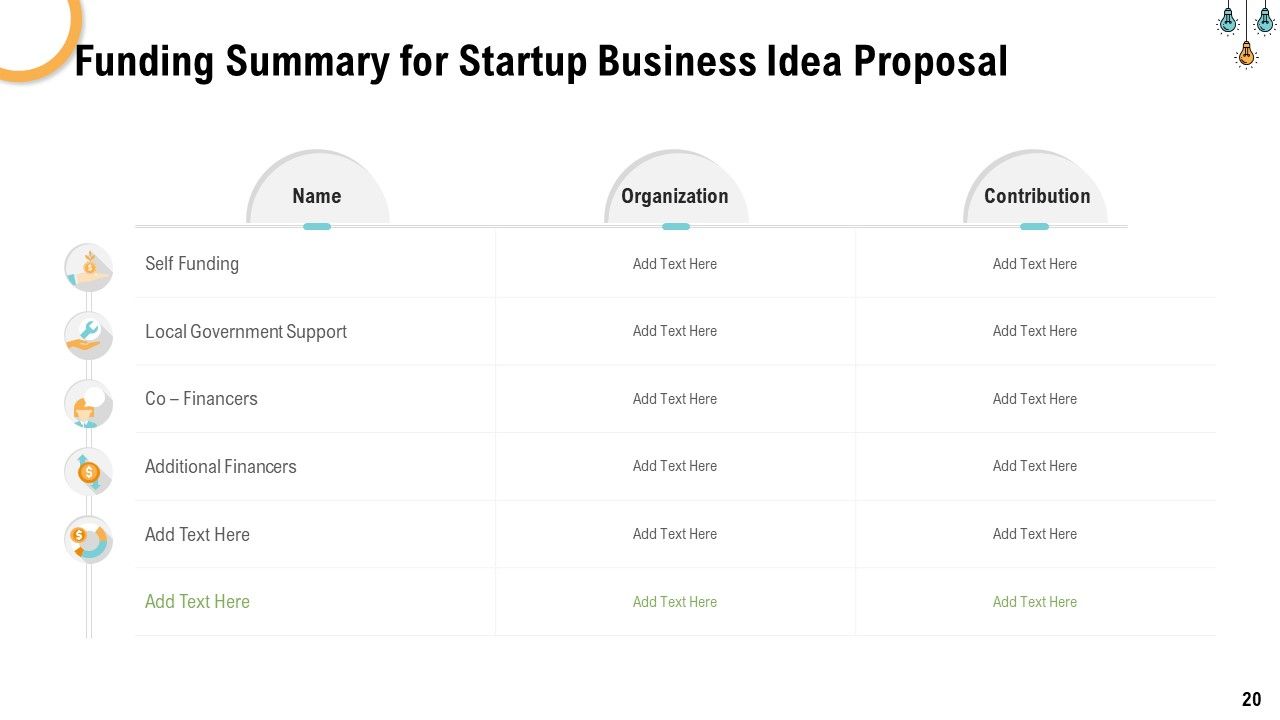
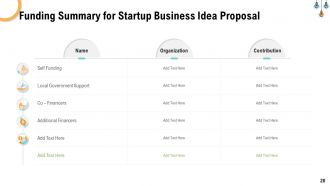
The next slide of the startup template allows you to showcase the division of funding. This means that this slide will help you showcase the facts and figures related to various sources of funding, the total amount raised from individual sources, names of the organizations, and other details. Doing this will help you show your audience that your business already believes in transparency and will keep this virtue within in the coming years.
Template 10: Client Testimonials for Startup Business Idea Proposal
If you already have some clients to back up your startup or business idea, then you can use this slide to refer some client testimonials to your audience. Within the testimonials, you can add the main statement or the crux of the praises given by the client for your business as well as its products and/or services. You can also state the designation of the client in the respective company or organization to make the testimonials more transparent and reliable.
******
From Startup Idea to Reality
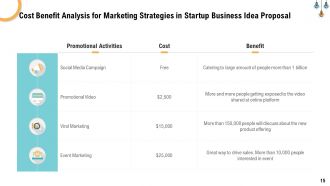
Previously, we had a look at some of the most prominent offerings of the startup business idea template. The above slides offered in the template and their data are sufficient to cater to every query of your potential investors and audience. Using this information, you can not only create a positive image for your business idea but also channel adequate investments required to initiate the business.
PS Understand start-up strategy business goals with this PPT Template from SlideTeam.
Startup business idea proposal powerpoint presentation slides with all 32 slides:
Ambitions come alive with our Startup Business Idea Proposal Powerpoint Presentation Slides. Confidence of achievement will actually grow.


FAQs for Startup business idea proposal
So you'll need the basics: executive summary, market analysis, business model, financials, and team bios. Don't forget to nail down the problem you're solving plus your solution. Honestly, the financial projections are where most people crash and burn - investors will tear those apart if they smell BS. Make them realistic, not some fantasy numbers. Your market research has to prove you actually get your customers and competition. Oh, and definitely have someone outside your field read it first. They'll catch jargon you're blind to. Keep it tight but thorough, and put your best stuff upfront.
Look, market research turns your startup idea from "trust me bro" into something investors actually take seriously. You'll show real demand exists instead of just assuming people want your product. Do some quick surveys with potential customers - honestly, even 10 people giving feedback makes a huge difference. This stuff helps you figure out pricing that won't scare everyone away and shows you what competitors are doing wrong. Plus you'll spot problems early before they wreck your whole plan. I know it sounds boring, but it's what separates real businesses from pipe dreams.
For your startup proposal, you'll need five financial projections. Revenue forecasts for 3 years - don't be that founder who thinks they're special and projects hockey stick growth from day one. Break down your expenses, show cash flow projections, include break-even analysis, and spell out funding requirements. Monthly numbers for year one, then quarterly after that. Cash flow is honestly the most critical since it determines if you survive each month. Oh, and build everything in spreadsheets first. Trust me on this - investors love throwing curveballs with their "what if" scenarios.
Don't just say you're "better" - show what makes you completely different. What's your actual edge? Maybe it's your team's background, some tech nobody else has, or you found a market everyone's ignoring. Honestly, skip the "we'll work harder" stuff since every startup says that. Instead, get specific about partnerships, methods, or data that proves you get this market. The whole point is explaining why YOU can crack this problem when others can't. Those differentiators should basically drive your entire pitch.
Your mission statement is like the soul of your business proposal - it shows investors your "why" beyond just profits. People invest in stories they actually believe in, not just numbers on a spreadsheet (which honestly makes sense). It proves you've really thought about where you're headed long-term and what kind of company culture you want. Plus it helps you stand out from competitors who might offer similar stuff. Just don't make it some vague "changing the world" nonsense. Be specific about what your business actually does and why it matters.
Honestly, visuals are a game-changer for keeping people awake during your pitch. Nobody wants to stare at walls of text - icons and graphics break that up nicely. Charts make boring data actually digestible, and colors create emotional connections (green for growth, blue for trust, you know the drill). The thing is, people remember visual stuff way better when they're deciding later. Here's what works: stick to 2-3 colors max, keep fonts consistent, and don't just add pretty pictures for no reason. Every visual should actually support what you're saying. I learned this the hard way after watching too many eyes glaze over during presentations!
Don't be vague about your target market - that's like pitch death. Your revenue projections? Keep them realistic because investors have seen every inflated number trick. Skip the endless product feature lists and actually explain how you'll make money. Nobody's reading 50 pages, trust me on that one. Lead with the problem you're solving and who's willing to pay for a solution. Your team's ability to execute matters more than you think. Conservative but solid financial projections win every time. Here's the real test: find someone totally outside your industry to read it first. If they're confused, you've got more work to do.
Dude, scalability is what investors actually care about - it's the difference between getting funded and getting ignored. Show them how you'll go from 100 to 10,000+ customers without your costs exploding. Nobody wants to back something that'll forever be a tiny local shop, even if it makes decent money. Map out your growth projections and be specific about the mechanics - like, how will your servers handle 100x more traffic? What happens when you need way more customer support? I always think it's wild how many people skip this part. Bottom line: prove you won't crumble when things get busy.
Okay so first thing - stalk their portfolio. See what companies they've backed, check sizes, read their recent interviews or blog posts about what gets them excited. Then tweak your deck to match their vibe. If they're obsessed with B2B SaaS, don't lead with consumer stuff - hit them with enterprise metrics instead. It's basically dating but with money involved lol. Also adjust your financial projections to fit their timeline and exit expectations. You want them thinking "damn, this is perfect for us." The whole point is making it feel like you built this pitch specifically for their investment style. Takes some work but it's worth it.
Skip the fancy job titles - investors care about what you've actually done. Show them hard numbers like "boosted revenue 200%" or "product hit 50K users." Each bio should connect directly to your startup's specific problems. Like, if you're building fintech, mention that Sarah ran payments at her last company, not just that she's a "seasoned executive" or whatever. Previous exits are gold - don't assume it's obvious. One page with photos and why each person matters for YOUR thing specifically. Keep it tight but make sure the wins jump out immediately.
Honestly, stories beat spreadsheets every time when you're pitching investors. People connect emotionally with narratives - way more than they do with just numbers and data. Start with a real customer's problem, show them struggling, then boom - you've got their attention. Investors suddenly care about more than just potential returns. I mean, we remember stories way better than facts anyway, right? Just don't go overboard with random anecdotes that don't tie back to your actual business. Keep it authentic. Next time you pitch, try opening with a specific customer story that shows exactly what problem you're solving. Trust me, it works.
Dude, you gotta start writing this stuff down instead of just winging it. Make a basic spreadsheet tracking what investors keep saying - pricing issues, market questions, whatever. When three different people ask about your go-to-market plan, that's basically them screaming "fix this section!" Don't fall into that trap where you think they just don't get your vision. They probably do. Address the patterns you're seeing in your next pitch deck. Oh, and definitely call out how you've improved based on their feedback when you present again - investors love seeing founders who actually listen.
First thing - pick your business structure (LLC vs corp, etc) because it impacts literally everything else. Figure out who owns what IP, especially with co-founders involved. Some industries have insane regulatory requirements, so check what applies to you. Founder equity and vesting schedules are huge - definitely nail down what happens if someone bails early. You'll need the usual contracts too: employment stuff, NDAs, customer terms. Honestly, just pay a lawyer to review the big pieces now. Way cheaper than fixing mess-ups later when money's actually flowing in.
So you'll want to build a visual timeline with actual dates and measurable stuff - like "MVP done by March" or "hit 100 users by June." I always pad extra time in there because honestly, everything takes longer than you think it will. Charts work great, or just a simple roadmap format. Each milestone should tie to something concrete investors can actually check on later. Mix in some quick wins for the next few months with your bigger goals too. Oh and make sure it's not just vague BS - they want to see you can think ahead but also get shit done fast.
Start with response rates - are people even opening your stuff? Then track conversions (actual meetings booked), how long decisions take, and what feedback you're getting. I'd make a basic spreadsheet with submission dates and outcomes. The waiting sucks, but at least you'll have data on which proposals actually work. Follow-up timing becomes way clearer when you can see patterns. Oh, and don't just track the wins - failed proposals teach you more anyway. You'll start noticing what resonates vs. what gets ignored.
No Reviews