


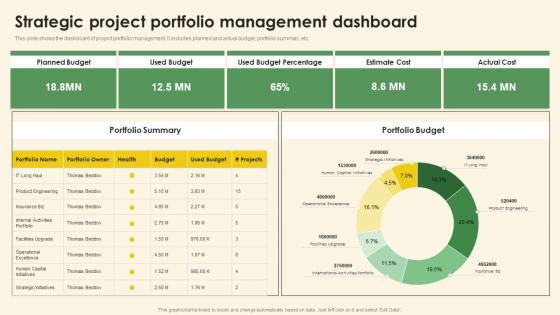
Strategic Project Portfolio Management Dashboard




Try Before you Buy Download Free Sample Product
 Impress Your
 Audience
 100%
100% Editable
 Save Hours
 of Time


This slide shows the dashboard of project portfolio management. It includes planned and actual budget, portfolio summary, etc.
People who downloaded this PowerPoint presentation also viewed the following :
Strategic Project Portfolio Management Dashboard with all 7 slides:
Use our Strategic Project Portfolio Management Dashboard to effectively help you save your valuable time. They are readymade to fit into any presentation structure.





FAQs for Strategic Project
Look, you'll want to nail down four main things. First, make sure your projects actually tie back to what your company's trying to achieve - sounds obvious but you'd be surprised how many random "cool" projects slip through. Balance your resources smart so you're not burning out your team or blowing the budget. Risk management is huge too - figure out how projects might affect each other and what could go sideways. Then track everything with consistent metrics so you know if you're hitting your goals. Honestly, I'd start by just mapping what you've got now against your strategic priorities. You'll probably spot some weird gaps or overlaps right away.
Honestly, just throw them all in a spreadsheet and score each one on ROI, how well they fit your strategy, what resources you'd need, and how risky they are. Weight the scores based on what matters most to you. Sounds boring but it actually works pretty well. Don't fool yourself into thinking you can tackle everything - be real about your bandwidth. I'd start with your top 5 and literally pit them against each other. Which one would you pick if you could only do one? The tricky part is remembering to update your rankings since things change constantly.
Honestly, stakeholder engagement can make or break your whole portfolio. Without buy-in from execs, you're screwed on funding. Project managers will give you the real scoop on resource conflicts, and end users? They'll tell you what actually matters. I learned this the hard way on a project last year - thought I knew what people wanted but totally missed the mark. Map out your top influencers first. Regular check-ins are clutch, even if it's just a quick coffee chat. Start with your 5 biggest decision-makers and don't let those relationships go stale.
So these PPM tools are basically like having a control tower for all your projects at once. You get actual data on what's working and what's bleeding money instead of just guessing. Honestly, the scenario modeling feature is probably the most useful part - you can test out different "what if" situations before committing resources. Quick wins come from spotting those projects that look busy but aren't actually delivering much value. Oh, and you can reallocate people and budget way faster when you see everything laid out. I'd say figure out your biggest 3 headaches first, then find tools that tackle those specific problems.
Honestly, I'd focus on the big three financial ones first - ROI, NPV, and payback period. Those tell you if projects are actually worth doing. Then add operational stuff like on-time delivery and budget variance. Strategic alignment scores are huge too (basically measuring how well projects support your business goals). Oh, and don't skip stakeholder satisfaction - I've seen profitable projects completely tank because users couldn't stand them. Start small though. Pick maybe 3-4 metrics that actually matter to your company, get into a good reporting groove, then build from there. Way easier than trying to track everything at once.
Honestly, I'd build risk scoring right into how you pick projects - rate them on risk exposure plus ROI from the start. Track risks across your whole portfolio too, not just individual projects. Some risks actually get worse when you're running multiple things at once (learned that the hard way). Set up regular reviews where you step back and look at everything together. Then you can make smarter trade-offs between your high-risk/high-reward stuff and safer bets. The trick is thinking about risk at the portfolio level instead of treating it like some project management box to check later.
Look, if your projects don't tie back to company strategy, you're basically throwing darts blindfolded. I learned this the hard way at my last job - we had like 15 random initiatives going nowhere. Map each project to an actual strategic goal first. Seriously ruthless about cutting the ones that don't fit. Your resource allocation becomes way clearer, and you'll stop getting those annoying "remind me why we're doing this?" questions in every meeting. Regular portfolio reviews help too. You'd be shocked how many projects exist just because someone thought they sounded cool.
Ugh, resource conflicts are the worst - everybody's fighting over the same talented people. Leadership keeps changing priorities too, which drives me crazy. Half the projects don't even match what the company says it wants to do (seriously, how does that happen?). You can't see what's going on across different teams, and they barely talk to each other anyway. Plus the decision-making process is usually a mess. Start with solid scoring criteria for ranking projects. Then build dashboards so you can spot disasters before they hit. Trust me on this one.
Honestly, you gotta rank your projects first - figure out which ones actually matter for the business. Make a simple matrix showing who's working on what and how much budget each thing gets. High-priority stuff gets your best people, period. I've watched companies mess this up by spreading everyone too thin across every random project. Don't do that. Have weekly check-ins where you can move people around when priorities shift. The hardest part? You'll need to be brutal about killing lower-priority work when you're stretched. Set up escalation rules so resource fights get solved fast at the right management level.
Honestly, implementing a good PPM framework is a game changer. Better resource allocation and way clearer strategic alignment right off the bat. Your teams finally stop wasting time on random projects that go nowhere - which is like 80% of the problem at most companies anyway. Projects get killed earlier when they're not performing, so ROI improves. Risk management gets better too since you're actually seeing the whole picture instead of just fragments. Oh, and visibility across everything becomes actually manageable instead of a nightmare. First step? Map out what you've got running now. I bet it's more scattered than you think.
Honestly, just ditch those annual portfolio reviews - they're way too slow. Do quarterly check-ins instead and actually prioritize based on what's valuable right now, not what looked good six months ago. I've seen too many companies stick with dead-end projects just because they were in the original plan. Set up teams that can make fast decisions without waiting for approval from five different departments. Kill the duds early - sounds harsh but you'll thank me later. Oh, and do retrospectives regularly to see what's actually working. Start with shorter cycles and you'll be amazed how much quicker you can respond to changes.
Dude, there's a bunch of stuff you gotta watch for. ROI tanking below your targets is obvious, but also look for projects that keep missing deadlines or blowing budgets. Resources being totally maxed out OR sitting around doing nothing - both are bad signs. Strategic alignment scores matter way more than people think, honestly. Customer satisfaction dropping? Time to panic a little. Market shifts can mess everything up too, so don't ignore those. I check this stuff monthly and set actual trigger points instead of just... you know, hoping for the best. When multiple metrics start going sideways at once, that's when you really need to dig in and figure out what's broken.
Oh man, culture is everything when it comes to portfolio management. Risk-averse places? You'll get super conservative project picks and approval processes that drag on forever. Collaborative cultures actually share resources better and talk across projects. Hierarchical ones are slower to decide but at least you know who's responsible for what. I've literally watched amazing PMOs crash because they didn't fit the culture - it's kinda painful to see. You've got to build your processes around how people actually make decisions, not some idealized version. Just watch how things really happen first.
Honestly, tech just handles all the boring stuff that used to kill your whole day. Real-time dashboards show you project health and budgets without you having to dig through like five different systems. AI can actually predict when projects might tank - which is wild if you think about it. Portfolio management tools put everything in one place so you're not scrolling through a million emails for updates. But here's the thing - you'll finally have real data instead of just winging it. I'd say pick whatever process annoys you most right now and find a tool that automates it.
Look back at your finished projects and actually dig into what went sideways - budget blowouts, missed deadlines, that one stakeholder who made everyone's life hell. The same problems pop up way more than you'd expect, honestly. When new projects come up, ask "didn't we deal with something like this before?" Keep a simple lessons learned doc that people will actually use (not buried in some SharePoint folder). Then bake those insights into how you pick and evaluate new projects. Otherwise you'll just keep stepping on the same rake over and over.
-
The quality of PowerPoint templates I found here is unique and unbeatable. Keep up the good work and continue providing us with the best slides!
-
“Thanks to SlideTeam. Now I can make smart presentations in a fraction of time without any hassle.”